
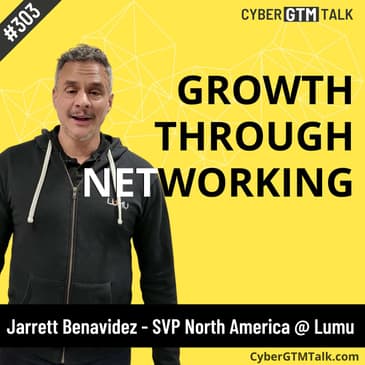
Are you facing the challenge of breaking into a new vertical with no prior experience? Wondering how to accelerate credibility and revenue in unfamiliar markets? Curious about how effective networking can create exponential sales opportunities in cybersecurity? This episode tackles these questions by unpacking hands-on strategies for rapid market entry and leveraging the power of the network effect.
In this conversation we discuss
👉 Navigating and mapping new industry ecosystems for accelerated sales growth
👉 Transforming small initial deals into major multi-account wins through strategic networking
👉 Building authentic, mutually beneficial reference and networking strategies that drive brand advocacy
About our guest
Jarrett Benavidez is the SVP of North America Sales at Lumu Technologies, a veteran in cyber sales since 1999. With leadership experience at Trustwave, BeyondTrust, and CloudKnox, Jarrett specializes in opening new markets and building high-impact sales teams.
Summary
The conversation focused on how a deliberate ecosystem approach, purposeful networking, and delivering real value can help sales teams break into new markets and unlock significant revenue growth. Tune in for actionable insights and proven tactics from a cybersecurity sales leader—listen now to learn how you can successfully accelerate your go-to-market efforts.
The Cyber Go-To-Market Talk is the show for cybersecurity sales leaders, founders, CROs, and go-to-market operators looking to improve cyber sales performance and build more predictable revenue growth. Hosted by Andrew Monaghan, founder of Unstoppable.do, covering cyber sales leadership, revenue leadership, sales onboarding, forecasting, pipeline generation, and cybersecurity go-to-market execution.
Follow me on LinkedIn for regular posts about growing your cybersecurity startup
Want to grow your revenue faster? Check out my cybersecurity sales consulting and training
Need ideas about how to grow your pipeline? Sign up for my newsletter.
Andrew Monaghan [00:00:00]:
When our guest was asked to join his current company to lead North America sales, he told the CEO, don't hire me. I don't know anything about the market you operate in. But he ended up taking the job anyway and had to rapidly learn how to succeed in a space he knew very little about. He drew from his experiences opening new markets in the commercial enterprise segment and started his process of learning, networking, and building credibility. Did it work? Well, in one case, what started as a tiny deal in in a rural school district ended up being a state level project, driving hundreds, if not millions of dollars in revenue. And what's the heart of all this? Something he calls the network effect. And it starts with a question that most sellers never think to ask. Jarrett Benavidez has been in Cyber Sales since 1999 and has led sales teams at companies such as Trustwave, Beyond Trust and CloudKnox.
Andrew Monaghan [00:00:54]:
And he's currently the SVP of North America Sales at Lumu Technologies. And he breaks down his process with us today. I'm Andrew Monahan and this is the Cyber Security Go to Market podcast where we tackle the question, how can cyber security companies grow sales faster? Well, Jared, welcome to the podcast.
Jarrett Benavidez [00:01:22]:
Thank you, Andrew. Very happy to be here. Thanks for the invite.
Andrew Monaghan [00:01:24]:
Yeah, looking forward to this. We've got some couple of interesting topics lined up. A little, you know, some themes to build on here which I think the listeners are going to find interesting. The thing that kind of intrigued me as we were prepping for this conversation is what you told me was you were an advisor to lumu Technologies for a little bit and then you really come on as the head of North America Sales, but you actually told the CEO, don't hire me. I don't have any sled experiences where LOOMU really plays. What, what was going through your mind to say, don't hire me, and then why did you let yourself be hired?
Jarrett Benavidez [00:01:57]:
Yeah, so I'm a career enterprise guy. That's a lot of my career has been enterprise sales, a lot of it in Latin America and then just like the last 10 years, more on the US market. I told him so Lumu had decided that the ICP was going to be sled cities, counties and K through 12. I have no experience doing that anywhere in my career. Now the reason I was here in the first place is because our founder and CEI CEO, we go back 25 years in this business, we grew up in this business together. He happened to need a sales leader and had a gap in his leadership. And so I, I came on as an advisor. And then he.
Jarrett Benavidez [00:02:31]:
And then, as you said, he asked me to stay. And I did advise him, like, you sure you want to do this? Because I really don't know the space. I don't know the nuances. I know Sled has a ton of regulations and there's grant money and there's so many nuances that I just, I really don't know them.
Andrew Monaghan [00:02:46]:
It feels like one of these spaces that you could have to know it though, right? I mean, remember when I first got in, it's like, oh, what do I really know about this? It's a whole different way. They have different funding. It's like so different. Right?
Jarrett Benavidez [00:02:55]:
I mean, it's obviously going into it. Knowing all that stuff is very helpful, but it can be done without. So he convinced me to, to join the company. I joined the company officially so about two years ago. And then the first thing I really had to do was what is this space that I'm working in? Like, how does figure out. So I've kind of approached it from an ecosystem approach. What does the SLED ecosystem look like? What specifically does the K through 12 ecosystem look like? What do cities and counties, how does that look? You know, turns out there's similarities everywhere, but it is different in every state. And even within states there are, there are nuances to each of it.
Jarrett Benavides [00:03:32]:
But just really understanding the lay of the land first and how are these organizations all connected to each other? How do they make decisions? Who influences those decisions? Where does the money come from? So really just understanding the way that they're all linked together and how they operate as an ecosystem.
Andrew Monaghan [00:03:52]:
Were you able to draw on experiences previous in your career where you'd kind of go into a new market or open up a whole new vertical? Let's say. I kind of know the, the playbook. I just need to adapt it. For Sled, I was.
Jarrett Benavides [00:04:06]:
And I was surprised that I was able to because this is what's been so just fascinating about this role is I realized I'd been doing some of this stuff already in the past, but I just wasn't aware of it because when you're doing something real time and things are happening organically, sometimes you really don't realize what it is that you're doing until later. You go back and look and say, okay, oh, wow. You do your, you know, your sort of assessment later, what you learned, what you were doing, how you actually accomplished what you did. So my profile has been usually either startups or startups within larger organizations. So opening new geos or opening New regions within established organization. So a lot of times in my career I've been doing something for the first time and building something new. Sometimes I have more resources to work with, like an established organization or at the younger companies, maybe really doing everything. There's not.
Jarrett Benavides [00:04:59]:
Not an offer yet or there's no customers yet. So that's been my experience. But the one that I really look back at when it is and that I'm comparing to what I'm doing here in this role at lumu is my experience at trustwave, which is a cyber security services company based in Chicago. Back in the day, they were really focused on the payment card industry security standard. So the PCI dss, they hired me to open their Latin American operation. So they sent me to Brazil. I was employee number one. Had to certify as a PCI consultant.
Jarrett Benavides [00:05:29]:
I was the sales guy. I was the office manager. I was the, you know, open the office. Signed Elite. Did everything. But again, I knew nothing about this standard. This was my first time working in. But the people who hired me knew me.
Jarrett Benavides [00:05:41]:
You'll figure it out. So first thing I did again was, was study the ecosystem. What am I selling? Why do these people need to buy this? That was compliance. So there was a direction to go and study that. But really looking at how are the organizations in this ecosystem structured, how, what do they have to do? How are they all related to each other? And then this is the piece of me that's been really. I'd say in my experience, I've overlooked it as a salesperson and a sales leader. And I think a lot of people do. We talk about networking and getting to know the people.
Jarrett Benavides [00:06:14]:
Obviously we do that as salespeople. We need to go sell people stuff. We need to meet them first. And I think we. People look at the ecosystem and they know what sort of organizations are in the verticals they need to sell to. They build a target account list like salespeople do that. But I think we could be more deliberate about it. And then there's one detail that I was definitely overlooking is once you get the lay of the land of this ecosystem, not just who do I want to sell to, but how do those organizations communicate with each other? So why is that important? That's important because if you can figure out how to insert yourself into the conversation that your target list is having or influential people in that industry are having when you're not there, that can really help you build your brand and get awareness out of there.
Jarrett Benavides [00:07:07]:
So it's not just who do I need to sell to, it's who do I need to sell to? But who else is out there who can help me sell? And how can they get my brand into their conversation?
Andrew Monaghan [00:07:17]:
And for Luma, then what's an example of organizations that communicate together in a certain way that couldn't figure that.
Jarrett Benavides [00:07:25]:
So with schools, again, I knew nothing about schools. We had very few school customers at lumu and I start, we just had a couple customers in a couple different states. One of them was, was in Michigan, a really tiny rural school that gave us a shot at testing our product. You know, we think it was a cold call and we, we were able to talk them into trying the product. When we won that and they were so happy with, with the results, we started talking to them like, tell us more about schools. Right. We developed this relationship. Hey, we're really trying to learn this space.
Jarrett Benavides [00:07:57]:
Well, as it turns out, pretty much every school district is not a standalone school district. It's part of something bigger. So the school districts are part of a consortium or we call them an umbrella account. Depends on the state. Arisa, A BOCES and isd. There's different names for them. They're part of a group. So, so what we learned is if you can get your foot in the door with one of these, they're part of something bigger.
Jarrett Benavides [00:08:21]:
And they communicate all the time with their peers. And they're. And that there's somebody up at the top who influences the way that they think about it and it security and the products that they buy and the services that they buy. That this ecosystem, there's communication channels happening all the time. There's usually a meeting once a month. There's email threads where they swap information. So we learned in that account and they helped us do it to, to communicate with all of their peers. There were 25 school districts in this group, not just one.
Jarrett Benavides [00:08:52]:
And we were able to. To start talking to all of those and to. To the. That account up at the top where there's really decision makers who are influencing it. So again, we're that figuring out how do they communicate within that ecosystem and inserting our message there. That really led us to figure out like how to execute our sales strategy.
Andrew Monaghan [00:09:11]:
And when I think about that in the sled world, a lot of it is funding oriented as well. Right. Who holds the purse strings really? And how, where does it all go? I wonder how that that translates into your enterprise experience though. Like if you're sitting there opening up, I don't know, the Southeast, let's say. I mean these companies talk but they're not truly connected. I guess one of the analogous organizations or groups that you think about as you open up a new area.
Jarrett Benavides [00:09:36]:
I actually, I love that question and this is something I'm trying to figure out every day because we've really cracked the nut the, the ICP that we've been focused on. It's going, it's going great. We are, we're in 30 plus states now and we've figured out the process there. Now we're thinking about how does this process apply to, to the private sector also? And you're right, it is, it is. Every sector is different. There's not an official structure in, in a lot of these verticals. But what I'm doing now is searching for, and finding some for, for similarities, likenesses. For example, in healthcare there are hospital networks or community hospitals that have satellite offices.
Jarrett Benavides [00:10:15]:
They're called ambulatory offices. You know, they sit out remotely. That's sort of like the equivalent of a school district in a way. And then. But they report into a community hospital that would be, you know, sort of that umbrella account again that we referred to, that we found with schools. And those folks are influential in terms of what it, those ambulatory services are using. There's also, they have similar business problems. Those remote offices are maybe a single IT director.
Jarrett Benavides [00:10:41]:
They don't really know cyber. They need help, they need advisory. So they're out there. There's one as well that I think everybody who's listening to this would know is your resellers. Your resellers are an umbrella account. Your, your resellers sit up at top, on the top as an advisor to multiple, multiple customers. And that's another way to think about this. So as we're going in now, if we're migrating to the private sector, this is the kind of stuff we're thinking about.
Jarrett Benavides [00:11:08]:
So I think this public sector lessons learned and these strategies that have worked, we're seeing, how do we apply them?
Andrew Monaghan [00:11:16]:
Let's try and make it more practical. Jared, for someone, I'm going to imagine there's a sales rep, he's just joined a startup. I don't know, he's rep number six. Let's say he's in his basement in his house in Ohio somewhere and he's been targeted with opening up this whole new Ohio Valley or North Central territory, let's say. Right. How should he start approaching this? Is he just banging the phones or is there a much more kind of thoughtful way to go about doing it?
Jarrett Benavides [00:11:44]:
Have you been talking to my Ohio guy? Because that's exactly what's happening here, right? I've got an Ohio guy in the basement doing just that.
Andrew Monaghan [00:11:51]:
Did you tell him it's a 10 day hike? I'm going to give you 2 days of food. You can figure the rest out. Right?
Jarrett Benavides [00:11:57]:
So, so actually this strategy that we honed early on, we've been able to document it and, and really put structure in place. To me, it's just really executing the playbook. So it's again, it's studying the ecosystem, finding out who is who, finding out how these organizations buy, who they can buy from, who they do buy from. And then again, the key part, how do they communicate with each other? How do they communicate with each other? And then how do you insert yourself into that communication? How do you get your company's message into what those organizations are talking about for cybersecurity?
Andrew Monaghan [00:12:35]:
And who do you talk to? Learn that it's okay saying that, but do you just try and get in there and just ask them these questions or are there the resellers, are they usually a good source of this?
Jarrett Benavides [00:12:43]:
Hopefully they're your customers. Hopefully your customers are engaged in the conversation, people that you meet through the customer. So referrals, references. In the case of, you know, the Michigan story, we had a very small school, but they eventually introduced us to sort of the top dogs in the district and the bigger districts and maybe those are the people who are more vocal and appear also at the state level and communicate not just with their own ecosystem, mini ecosystem, but in other counties and other parts of the state or even in some cases at the state level. So it's really just meeting, everybody asking around, but, but honestly, like it's not as comp, it's not that complicated. I would ask the question, and we ask this question all the time, how do you communicate with your peers? How do you communicate with other districts or organizations like you? And is there a way for us to join that conversation? Can we sponsor a lunch? Can we, you know, do something? So it's really just asking, how do you communicate with each other and what are the opportunities for us to, to be part of that conversation?
Andrew Monaghan [00:13:45]:
A lot of what you're talking about is, could be brought under the umbrella of networking. Right. You know, I always feel like you ask a hundred sellers, do you network? And 90% will say yes, probably 60% are telling the truth and about, I don't know, 10 to 20% do it. Well, what's the gap between someone who kind of maybe plays it a little bit and someone who really Knows how to network.
Jarrett Benavides [00:14:08]:
This is something that I've been thinking about a lot of. What is networking? Let's start there. Like, what does it mean to you in the first place? Like, how would you describe it? Is it just look, you know, going to events and standing in a booth and talking to everybody that you see and trying to find customers or reseller? I mean, that could be networking. I think it's more about taking a more meaningful and deliberate approach to networking. So when you're out in a new market or you're going after a new sector, build a target networking list. We do that for accounts, right? We build an account list. Who do we want to sell to? And then we start calling in and marketing to them and doing all those things. But what about everybody else? There's other people who can help you get in there.
Jarrett Benavides [00:14:50]:
There's other people who are influential in like, their region or their industry. Like, who do you want to build a list? Like, who do I want to get to know? How do I find those people? Ask around. Ask your customers who's influential? Who do you listen to? What do you read? What events do you attend? And do you know, do you think that's a good event for our company to attend if we want to meet more people like you? Your customers will give you so much valuable information and your prospects, even while you're selling. You have to be your customer yet for them to, to help you with this. And by the way, people love when you ask them those kind of questions. It makes them feel valuable and it's, it's flattering to, to show them that you care what they're saying and it's not disingenuous. This is like a. We're trying to learn your space.
Jarrett Benavides [00:15:34]:
You know more about your space than I know. Can you help me? Because we want to be successful here. And, you know, hopefully we're entering a business partnership and will be. This will be long term and we'll make you successful in return.
Andrew Monaghan [00:15:44]:
Yeah, I find that, you know, I spent three years, I think it was in this slide space, and I moved in from enterprise kind of like you did, and I was pleasantly surprised just how willing people are to help you. Right. You know, as long as you treat them with respect and you're, you're good to them and you're friendly and credible and all the rest of it, they'll do a lot for you. I was really always very shocked about the whole thing. And I always thought maybe in the sled space because a lot of them are career, government, People, right. They're there not for a couple of years and move on. They're in that space because they want to do it for 20, 30 years, get their pension, you know, and get the benefits of that. And they just seem to be much more willing to help you be more successful to help you to help them.
Andrew Monaghan [00:16:22]:
I thought it was fascinating. A very different mindset maybe than sometimes in the enterprise space.
Jarrett Benavides [00:16:26]:
So a couple comments on that one. Asking for something. Are you familiar with Jeffrey Pfeffer, Stanford Graduate school business professor. He's a power Expert. He's written 15 books on power. He has a podcast. He had. He's done multiple webinars.
Jarrett Benavides [00:16:42]:
He actually one of his main points is start asking for help. Start. You will be surprised by how willing people are to help you. And we get nervous about asking for stuff to absolutely ask. People love, you know, people love helping so that you're absolutely right there. Now you also in the sled space, building on your comment about people wanting to stay in the space. That is true, often true. But they do change jobs.
Jarrett Benavides [00:17:08]:
And this is something else that we found is when we are selling to school district A, we say hey, do you know the IT director from school district B? They say of course I do. That used to be my job. And so I know everybody over there. They are also know they move around the they move up the food chain to bigger districts sometimes they move to utilities, they move to the city, they move to the counties. I mean the schools are part of a city, the cities are part of a county. So that that ecosystem and is bigger than we thought it was. It's. So it's not just schools.
Jarrett Benavides [00:17:40]:
We we're able to been able to navigate from those contacts into sort of other parts of the of the sled ecosystem.
Andrew Monaghan [00:17:48]:
I wonder if there's an example that comes to mind of somewhere where you really were able to jump from one to the other to the other and suddenly connect all the dots and put something together for a wider range of organizations than just one school district.
Jarrett Benavides [00:18:01]:
Well, I would say there's a couple of states where we started with just one rural district and then we made our way up to again we call it that umbrella account and just start gathering information like who do we want to know at the state level. We're now in five states. We actually have projects, state sanctioned projects to sell our software. They're introduced, they're hosting the product demos, they're communicating with the every public school in the state. They're bringing in service providers, they're bringing in their Virtual CISO and advisors to learn our products. So I mean it's one little $800 project can turn into something that, you know, we did not see that path when we started. Right. We're, we're really, we're really happy with, about, with, with the way that's worked out.
Andrew Monaghan [00:18:44]:
Yeah. I remember in the. If you read the book the Challenger customer, not a Challenger sale, but the Challenger customer, they talked about the mobilizers inside some of these accounts and there was the climber, right. Who always out for themselves and not everyone else, but is one, you know, wants to advance their career. One of the things I feel like some people sometimes hold them back is they feel like, you know, if I'm too much networking or too much take, take, take, they're going to view me as probably reclaimer. Right. They're going to view me as someone who's all up for themselves and not for them. Any thoughts about how to really balance that so that you just don't go too far and think about the wrong
Jarrett Benavides [00:19:22]:
things, Bring value to everybody that you're talking to. I'm going to go back to the same trustwave experience. This was where I learned how to become a real provider of value to my customers and how important that is for them. To always keep you top of mind is we were, we had to educate an entire region of the world, Latin America. And what this compliance standard was that the card brands were pushing down, nobody understood it. There were fines, there were deadlines and everybody was scared and nervous. We don't know how to do this. There were a couple companies that were there first doing it and they were taking advantage of the lack of knowledge.
Jarrett Benavides [00:19:59]:
They were overselling under delivering, making a ton of money, doing a terrible job with. We went down there and did so much grunt work getting in front of this different, different organizations of the ecosystem. In that ecosystem. There's the card issuers, there's the card, the organizations that process transactions. There's the merchants who take the card in the store. There's different, there's different segments that all touch each other and they all communicate with each other. We went down there and taught them that based on what you do in this ecosystem, the service that you provide, this is what you have to do. These are the requirements that apply to you.
Jarrett Benavides [00:20:41]:
Everything else, forget it. And this is how you get there. Educating them on what they needed to do. Just. We ended up with 95% market share in Latin America. Those other companies, we destroyed them. They were down there first. We own that entire market and we really figured out then our message is just again, these companies all do the same thing and they all report up to these MasterCard, Amex, there's a top of the food chain messaging there.
Jarrett Benavides [00:21:07]:
It just started to circulate. Our message, our brand, our service, our reputation just started to circulate through that ecosystem. And we weren't even the ones talking about it. They were doing it for us. And that was a comment I wanted to make. Used to be talked about. You mentioned like networking. And what does that actually mean? I said, being like, what does it mean to you? Why are you doing it? You're looking for references.
Jarrett Benavides [00:21:30]:
You're looking for someone to talk about your product. And I also think I would advise the listeners to think about what is a reference. What do you want to get out of a reference? In my experience, I think a lot of us think of references as, you know, you have a customer that's happy and they're on a list. And then if you're trying to sell the prospect that they're willing to take a phone call or they're willing to respond to an email about your service, I would push that farther and say that your references could be selling for you when you are not there. If you figure if you are educating them, if you are providing value to them and you have figured out how they communicate with their peers, you can get them selling for you. And they may, it's not disingenuous. And they may not even realize they're doing it. They're just so happy with what they have that they're out there promoting your service.
Jarrett Benavides [00:22:20]:
We get a lot of customers that way.
Andrew Monaghan [00:22:22]:
Yeah, I think that's something where you have to invest in the time. Right. To say, I'm not going to be the person that calls them in nine months and says, I know you haven't heard from me, but would you mind being a reference for me? Right. You want to be the people that you know. It's a contact sport. Right. You want to be. Be in touch with them, you want to be helping them, you want to be supporting them all the way through.
Andrew Monaghan [00:22:40]:
So there's an easy. It's not really a big ask at all. Right. It's just natural step in the relationship. And the, they don't realize that they're, you know, it's not constantly, I'm going to sell for these guys. Right. They're just trying to help you.
Jarrett Benavides [00:22:50]:
So building on that, have you ever seen. Is anyone listening? Have you ever seen your marketing department successfully build a references program? Somehow it Always ends up with marketing. It doesn't work. It's a database of people that nobody knows. And you call and no one's there, or some of the customers are old. They're not even your customers anymore. I, I've never seen it work any way other than sales leaders and salespeople managing those references, because they're the ones who build the relationships. They're the ones who establish the trust and get the deal over the line in the first place.
Jarrett Benavides [00:23:24]:
In my opinion, it absolutely needs to be done by sales. This is something I learned in my first big enterprise role in the US Was as the sales leader. You have a real opportunity to build equity with your customers by reaching out. Well, first of all, you meet the. You're present during the sale, but after reaching out. And by the way, you can ask them to be a reference. Before they're even ready to be a reference. They.
Jarrett Benavides [00:23:49]:
You just get them ready for it. They might say yes. If you reach out after the sale is done and you say, we're super happy that you signed up with us, my goal is to make you want to be a reference for our organization. You're just starting with the service. I know you're not there yet. It's going to take some time. You need to learn the technology, you need to get to know our team. But my goal is to make you want to serve as a positive reference for my company.
Jarrett Benavides [00:24:15]:
I'm going to check in with you in three months and see how that's going. And I'm going to check in with you. You know, I'm going to get on your calendar once a quarter this whole year and talk about it like, they love that stuff. And it's just a great way to build strong relations with your customers. And, and also, you get a ton out of it, too. Is like, you learn. It keeps your customers. If your customer's in trouble, if your account's in trouble, if it's.
Jarrett Benavides [00:24:36]:
The project's going well, it's like you've got your own eyes on it. The executives at your customers really appreciate that.
Andrew Monaghan [00:24:42]:
Yeah, that's a good observation, actually, Jared. I've seen that before where you're almost surprised how early they're willing to be a reference as opposed to thinking, oh, well, you know, they're not quite ready yet. They're not quite ready yet. Right. Sometimes people do it, you know, right after signing the contract, they go, yeah, I know, John, I'll introduce you. I'll just, you know, they wouldn't lie. They said, look, we just started Doing business with these guys, I really like what they're doing. You know, you should talk to them.
Andrew Monaghan [00:25:04]:
And some are very willing to do that.
Jarrett Benavides [00:25:06]:
It's at that point when you reach out early, if you're. Well, if you're again, as the sales leader, say you're involved in the sale and then you reach out soon after the sale. The reason they'll give you the reference early isn't necessarily because they know your technology is great for their environment and you're solving all their business problems.
Andrew Monaghan [00:25:24]:
They.
Jarrett Benavides [00:25:24]:
They think that's going to happen. They hope that's going to happen. The reference is for you. It says, this person has their eyes on what I'm doing. This person is our executive sponsor. They're calling me, they're checking in, they're asking how I'm doing, they're asking me what I need. Do they just. It's more becomes a personal reference at that point.
Jarrett Benavides [00:25:42]:
Like, I trust this person and I trust the values this organization clearly has.
Andrew Monaghan [00:25:47]:
Yeah. You talked about a reference program not really working. Different angle to it. Have you ever seen it work where there's like a gift to get? There's like, oh, if you did this, we'll give you some surprise. Or I don't know what, you know, if you do so many references. You ever seen that work?
Jarrett Benavides [00:26:00]:
I've seen it work. I. It motivates people. I think. I think it works more in the lower ranks of your customers. Like, your engineers don't get a lot of perks, maybe in their. Your customers. Engineers don't get a lot of perks in their job.
Jarrett Benavides [00:26:12]:
They're willing to do that. It might motivate people to sign up for a list. If Mark, like marketing would reach out with that, hey, if you'll be a reference, we'll do this for you and that for you. And they, you know, people may sign up, but in my experience, the references I want are. Would be more meaningful coming from a relationship where you've already given them something, you've given them value in what you sold them, you've given, you've solved their business problems, you've made them successful in their jobs, they've done what their managers expect from them. Those are the best references. But, you know, instead of a night, a dinner or whatever, it is like really just the business relation itself, creating the willingness for them to be a positive reference for you. Those to me are the best references.
Andrew Monaghan [00:26:53]:
Yeah, for sure. I'm interested. As you're hiring people, do you have a way to try and figure out whether that person does have, you know, the ability to network properly and build these relationships and references?
Jarrett Benavides [00:27:04]:
Well, some, I mean depends. Some, some of that stuff you can see what's happening, you can get a high level glance at what they're doing on LinkedIn. But I think it's more about the questions asking, I ask questions about how you build relationships like what are your philosophies on customer support? What are your philosophies on different people in your organization be involved in the sale? Who do you use when you're trying to get a deal closed? Who do you bring in and when? And what I want to hear is people bring in the product manager, people bring in their sales leader, people bring in the CEO people. Are you using those resources that are available to you? So understanding how who they use tells you can tell you a lot about, about how they build relationships.
Andrew Monaghan [00:27:47]:
It's interesting. I had Eric Apple on from island recently and we're talking about how they approach, you know, getting going to Europe and Eric made the comment that you've really got to have a 24 month horizon for your investment to pay off as you're trying to break into a new, I don't know, vertical geo, whatever it might be. Would you agree with that?
Jarrett Benavides [00:28:04]:
I mean, I guess that's a, that's a pretty general state. I, I will, will agree with that. It doesn't happen overnight for sure. I think we were pretty impressed with what we figured out after about five quarters. I guess maybe the, the full numbers weren't there. The numbers. Maybe it took two years for the numbers to really back up. I always say the numbers have to match the narrative.
Jarrett Benavides [00:28:25]:
Right. The narrative isn't good enough by itself. So for really the numbers to match the narrative I, it's probably, yeah, it's, it was close to two years. I mean, I guess I never really thought about a formula but just kind of thinking back in my experience actually come to think of it, yeah even Trustwave down in Latin America was pretty quiet down there for the first, for the first year and a half. And then you know, once, once everything, the messaging got out there and, and the market got the first glimpse or the first they heard for the first time about the work that they were doing. Yeah, it's probably about two years actually.
Andrew Monaghan [00:28:56]:
Yeah, I would imagine that's analogous to island. Right. Eric was saying there's a lot of education for the enterprise browser. Right. Early on. Every chance you get to educate, you educate. Right. And then you get the chance to people start allocating budget or resources to, to look into it.
Andrew Monaghan [00:29:11]:
I guess it was similar for Trust Wave a little bit as well, right?
Jarrett Benavides [00:29:14]:
Yes, absolutely. Yeah, that's. That, that's a really good point on the, on the budgeting because if you're, if it's something new, which has often been my experience and I guess the experience of island is there's no budget. They have, there's no budget there. It's different in some of my roles. I've competed at more mature organizations where there's an RFP on the street from every company for what you're doing already. That's a luxury that I've only had, I think, one time in my career. Completely different experience going in there and convincing them the market in that spirit, to the larger enterprise.
Jarrett Benavides [00:29:45]:
The market's already convinced them, Gartner's already convinced them that they need that. So they're going to go ask for it versus, you know, going out and trying to sell them something that they don't understand yet. And not a lot of folks in the market are doing yet. That's budgeting there is super tricky. You gotta, you gotta. Yeah, you do have to get way out in front of it.
Andrew Monaghan [00:30:04]:
Yeah, yeah. Different tech for you. You join Lumu, you know, you knew the CEO for 20 years. I'm wondering what's different about joining a company where you already have that trust and those relationships with the other members of the exec team versus when you come in pretty cold.
Jarrett Benavides [00:30:20]:
I mean, getting to know your co workers and establishing relationships, it's tricky stuff. It was, you know, my experience, my CEO is pretty tough. We've known each other for 20, 25 years. In fact, the first, you know, seven or eight years of my career. I was actually an operations person. I focused on implementation and worked in security operations centers and built them and policies and procedures. He was running sales for Latin America for, for the company we worked at. And I was his implementer.
Jarrett Benavides [00:30:50]:
I was his tech guy, his almost. And then I became his sales engineer for managed Security Services. So he knew me pretty well and we stayed in touch over the years, but he still, I mean he, he hired me and still kind of revetted me. I think we hadn't worked together for a while, but certainly having that relationship with him, you know, was, was helpful to kind of fast forward through some of this stuff. But he was the only person on the executive team that I knew. So I still had to go through that process of, of getting to know the folks here and getting them behind my ideas and you know, building, building those relationships with them. I'M trying to think if there's another. Actually, the, the Trust wave experience was that group of people also hired me for the second time.
Jarrett Benavides [00:31:35]:
So I was working. They hired me once as a. As a security consultant. Then I ended up in their managed services team in Chicago. That was for Internet Security Systems iss, which was, you know, the first real quintessential cyber security company, the X Force. And so I was. That's where I was doing my operation stuff. They left, started their own company, which became trustwave, and hired me a second time.
Jarrett Benavides [00:31:57]:
So that group of people, I actually knew better. And that was just, Jarrett, go to can, will you please move to Brazil and do this thing for us? So that was, that was an. That was an easier one. Easier to get stuff done at the beginning because they really knew my work and I had already done delivered something, in fact, in Brazil to them before.
Andrew Monaghan [00:32:15]:
One of the things I struggle with is when you've known someone for 20 years, but you maybe had a gap. I always kind of think about, well, that was the person I knew 10 years ago and their strengths or weaknesses and what I thought of them. I have to struggle to get my mind out of that and say, I'm sure they've developed a lot in the last 10 years. I got to be completely open to the fact they're going to be so much more, I don't know, advanced or different, let's say. I wonder if you any. Any experience of kind of how to keep an open mind to that.
Jarrett Benavides [00:32:42]:
I mean, that's been my experience at this role, you know, my CEO. Now we did have to get to relearn each other. I mean, this is. Actually, he wasn't an entrepreneur when I worked with him last time. Now this is his second software company. So he had already been through it once and successfully exited the company. So he's completely different profile than he was when we worked together. So yes, I had to, I had to adapt to that.
Jarrett Benavides [00:33:04]:
But I think there's multiple examples in my career of that. In fact, one of my. The sales folks on my team now is somebody who was my most junior SDR at another company. And as somebody that was always super eager and interested to learn, it's somebody I trained a lot and eventually promoted him off my team. And then he went and coincidentally promoted to a sled team within the company they were at. And then, you know, four years later, I ended up in sled. Who would have known? And guess who I called. In fact, he was my advisor.
Jarrett Benavides [00:33:36]:
He knew more about sled. You know, this 26 year old kid knew more about sled than I did. So I was calling him with questions and then eventually I just, I brought him over. So. So the gap there was, you know, he was just an eager young sort of first job out of college guy to somebody who actually knew what he was doing and could help me in this new role that I had.
Andrew Monaghan [00:33:55]:
Well, Jared, it's April 2026 right now as we're recording this RSA is just finished. I'm wondering what the rest of the year holds for LUMU and what you're focused on with the sales team.
Jarrett Benavides [00:34:07]:
Well, we're super busy now because this is hot time for sled. You know, a lot of fiscal, fiscal years don't line are usually not calendar years in sled. So this is, this is super busy for us. We're really focused these next two quarters on executing all the pipe that we have that we've been developing over the years. So, you know, Q2 and Q3 and sled are usually our busiest times. But then it's rsa. I actually ended up not going this year because I had something pop up. But I've done my, you know, I've talked to my CEO a lot about, it's, it's all about AI and just figuring out how we all fit into that ecosystem.
Jarrett Benavides [00:34:40]:
But you, we've been doing AI forever. We're excited about the opportunities that we, that AI is creating. We think our technology is really mature for that. So it's really just, I guess it's, it's going with the market and, and, and talking about AI in fact actually is going back to something we talked about before. A focus of ours is now that we're really comfortable with what we're doing in our first icp. And we've figured that out and you know, the numbers are matching the narrative, as I said, it's finding that next icp. Which vertical are we going to go into? Where is our sales process repeatable? How can we go just kind of take what we've developed and apply that into another vertical and get the same success. We're really focused on finding the next one or two verticals that we're going to, that we're going to sell into.
Andrew Monaghan [00:35:31]:
It must take discipline, not just jump into another vertical and say we'll figure it out.
Jarrett Benavides [00:35:35]:
It's scary. It's, I mean it's, it's tough stuff. I mean there's so many nuances that you don't think about until you start asking questions. And you know, our advisors, our investors Help us with us with this and they introduce us to people and then the people that they introduce us to who are experts in those verticals tell us a bunch of stuff that's super scary about funding and grants and compliance and regulations and stuff. You think, like, how am I going to navigate this? Like you could, you know, you can build, be working on this stuff forever and then there's never any money there at the end. So I mean it's, it is, it's daunting to figure to make the decision about which is the right vertical to go into because once you're in, like you gotta, you gotta f. In my experience, if you're not all in and focused on it, you're going to get distracted and it's not going to work. I think the reason we are doing so well in what we're doing is because we just said this is what we're doing and we're going to roll with the punches.
Jarrett Benavides [00:36:31]:
Whether it's, you know, I mean, for example, we're waiting for projects here. Homeland Security has been closed. A lot of the cyber money to some of the states comes from there. Like, you don't know the stuff that's gonna, is gonna happen. You can't like think of this stuff in advance. So, so, but now we can like we're, you know, we're a little, we're a little more experienced at sort of anticipating what might happen. So yeah, it's a really tricky decisions.
Andrew Monaghan [00:36:56]:
Well, I wish you making that second ICP decision every success for, for this year and beyond. Thanks for joining me today.
Jarrett Benavides [00:37:03]:
Thank you Andrew. Appreciate sa.