
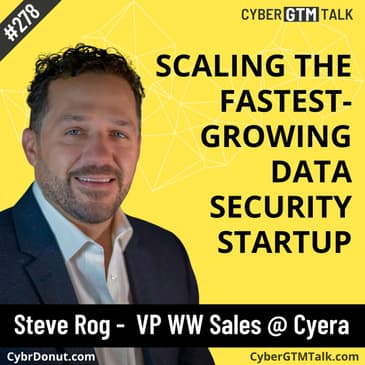
Are you struggling to keep up with the rapid pace of growth in cybersecurity sales? Wondering how to build a high-performing go-to-market team without sacrificing consistency or culture? Curious about what it takes to lead and enable teams through hypergrowth while navigating constant change? If so, you’ll find answers and inspiration in this episode focused on Sierra, one of the fastest-growing cybersecurity firms on the market.
In this conversation we discuss:
👉 The essential building blocks and mindset behind scaling sales organizations in high-growth environments—balancing speed with strategic hiring and enablement
👉 How modern DSPM (Data Security Posture Management) is changing the data protection conversation, including new business drivers, buyer personas, and technical advances
👉 The importance of world-class enablement for sales and first-line managers—and why investing in internal growth and leadership is critical for sustained success
About our guest:
Steve Rog is the VP of Sales at Cyera, a trailblazing and rapidly scaling DSPM company. With a background in both technology and sales across industry leaders like F5, ForeScout, and Foundry, Steve has deep expertise in building elite sales teams and driving hypergrowth. At Cyera, he brings a disciplined yet people-first approach to organization building, sales excellence, and leadership development.
Summary:
Steve Rog shares firsthand lessons from Sierra’s exponential rise, detailing how intentional hiring, robust enablement, and cross-functional collaboration fuel sales success in cybersecurity. If you want to understand how to sustain momentum, empower your frontline managers, and scale responsibly, this is a must-listen episode. Don’t miss out—tune in to accelerate your own sales growth journey!
Connect & Learn More:
- Connect with Steve Rog on LinkedIn
- Learn more about Cyera here!
- Book time with Andrew Monaghan: Book here
The Cyber Go-To-Market Talk is the show for cybersecurity sales leaders, founders, CROs, and go-to-market operators looking to improve cyber sales performance and build more predictable revenue growth. Hosted by Andrew Monaghan, founder of Unstoppable.do, covering cyber sales leadership, revenue leadership, sales onboarding, forecasting, pipeline generation, and cybersecurity go-to-market execution.
Follow me on LinkedIn for regular posts about growing your cybersecurity startup
Want to grow your revenue faster? Check out my cybersecurity sales consulting and training
Need ideas about how to grow your pipeline? Sign up for my newsletter.
[00:00:00] Hey, it's Andrew here. Just quickly before we start the episode, I want to tell you about one of my favorite newsletters. It's called Strategy of Security. If you want to understand the company's ideas and trends shaping cybersecurity and its submarkets, you should take a look. Cole Gromos runs the newsletter and he has spent the last 20 years in cybersecurity, including stints at PwC and Momentum Cyber, the investment bank dedicated to cybersecurity.
[00:00:27] Recent articles I'd like include how could platformization work in cybersecurity, where he talks about there being lots of single vendor platforms, but not a multi-estate platform. And also one called demystifying cybersecurity's public companies, where he explores the pure play ones and also hybrid companies, which are in cyber. He lists all of them and then breaks down the numbers in all sorts of different ways.
[00:00:52] Now, this is not a paid promotion. I just simply enjoy what Cole is publishing. Check it out at strategyofsecurity.com. Now on with this episode.
[00:01:12] All right. Well, welcome everyone. You would have to be under a rock in the past two or three years not to have seen the momentum building up at Syaira. I've seen people I know go there. I've seen funding investments. I've seen industry commentary.
[00:01:27] You just feel looking at from the outside in there's something happening at Syaira, which is why I'm delighted to have Steve Roge, the VP of sales at Syaira join us today. Steve, welcome. How are things going with you today? Thank you. Thank you. Very exciting times. Things are going well. Appreciate it. Appreciate the time.
[00:01:47] Yeah, this will be fun. We've got a couple of different things to cover. First thing, the reason that I kind of even reached out in the first place, I don't know if you saw what I showed on LinkedIn about this, but I did some analysis using Richard Steenen's IT Harvest dashboard about the fastest growing COVID baby cybersecurity companies and using Headcount as the proxy for growth.
[00:02:13] And my other criteria was not name Wiz because that would kind of blow the chart a little bit. And, you know, top of the line was Island. I've had Eric Apple as the head of Sales Island on the podcast about two and a half years ago, actually, just as they were getting going. So they've gone from strength to strength. And then obviously behind Wiz, I had Colin Jones from Wiz on a couple of years ago now.
[00:02:36] Actually, almost the week, my episode with Colin, who was the first CRO over at Wiz, took it from zero to up to that 100 million announcement. So he was on. And now, Sierra, based on the analysis I did, is next one up, right? So you guys are on a heck of a tear. If you can't read this graph, basically what I'm saying is that there's 15 companies growing really, really fast by headcount. Top without Wiz is Island. Second without Wiz is Sierra.
[00:03:06] So this is a good time for everyone. Very exciting times. Yeah. And all friends. So know those guys well. Great people. We spend a lot of time talking to each other. Yeah. Cyberstarts originally companies as well, right? Yes. Yes. Both. Correct. All right. Well, we are recording this live on LinkedIn. If you're watching it on the feed coming through, put questions into the chat area if you have any. And we'll filter through them and see what we can get to.
[00:03:35] But, Steve, first of all, let's get to know a little bit more about you. So I have, believe it or not, a list of 49 personal questions here. The good news is I don't ask you 49. I have this completely random number generator here. And it does an amazing thing. It's actually so advanced I have to protect it. I'm using, you guys don't know this, but I'm using Sierra's DSPN to protect it so no one can steal my algorithm behind the scenes here.
[00:04:04] And it's going to spit out three random questions for you. Let me just hit the button here. Trust me, there's some stuff going on in the background. Let's see what it throws up. All right. The first one is number 19. How did you make money as a kid, Steve? Oh, boy. First generation American. So I can tell you that my parents were very committed to me working early in life.
[00:04:33] And so my wife or my mom actually made a fake ID for me when I was 15 years old so that I could work at the local grocery market. And then soon after that, my dad pushed me into working on roofs. And as a guy that's afraid of heights, I think that was a little bit by design.
[00:04:53] He wanted to show me, you know, what hard work meant and really pushed me to, you know, to continue to educate myself so that I didn't have to do the manual labor that I so desperately didn't want to do while he was forcing it. Your mom got you a fake ID, though? Yeah, she worked at a bank and she laminated basically a fake ID when I was 15 because in order to work at the grocery store, you had to be 16. So she made me an ID that suggested I was 16 years old so I could start working when I was 15 years old.
[00:05:23] At least you didn't get for 421, right? True story. True story. Yep. I was, you know, doing the typical pushing carts and then working in produce, the whole, you know, all the fun of it. Very good. All right. Let me press the random generator here again and see what we get to. All right. Number 29. What's a memorable moment in your sales work life that you want to share with us today? Oh, memorable moment.
[00:05:52] There's quite a few. I've had the great fortune of working for some incredible leaders that have really kind of shaped kind of how I go to market. Memorable, you know, to tell you a funny story. I'll never forget when I was at F5, we did a QBR in the city in downtown Chicago and my SC and I were outside the restaurant and I remember seeing Vince Vaughn and I was so excited. You know, local Chicago celebrity, big Cubs fan.
[00:06:20] And I ran up to him and I was like, Vince, you know, huge fan. Can I take a picture with you? And he goes, why don't you turn around and run right back to where you came from? And I was like, oh, all right. Well, that's a pretty humbling experience. That's that's certainly that that that got a lot of laughs because my SC, you know, felt felt didn't feel short of telling everybody about that moment. Well, they say you don't meet your hero sometimes. Right. There's there's an example why you don't do that. I have a different perspective of Vince Vaughn from that day moving forward.
[00:06:48] Yeah, that's unfortunate. Right. All right. Let me let me hit the number again and get the last completely random question out of here. Number two, what is the story behind you getting your first role in cybersecurity sales? So I I studied computer engineering thanks to my brother in law. So I was I was studying the engineering at DePaul University.
[00:07:17] They they had a course called junior experiential learning, which, you know, the course credits were really to kind of push you into the field to get a job and, you know, the career that you aspired to go into. And my brother in law was working at Checkpoint at the time. And there were a number of value added resellers that he went to to ask if I could do a 10 week kind of a course and work at one of the partners.
[00:07:41] And I had the great fortune of working for a company called Consult Tech, where I started a little bit in engineering and then quickly made the decision that I wanted to be in sales. And I've never looked back since that moment. And was it an easy transition from the engineering side into sales? For me, it was. I think I was early enough in my career. I was, you know, 20 years old.
[00:08:02] So for me, you know, being a people person was always, you know, kind of where I aspired to kind of leverage the technical skill set that was given to me at DePaul. And so I never really worked on the engineering side of the house from the beginning. So that was an incredibly easy transition. Good for you. Good, good career after making that switch over. Well, let's talk about data protection, Steve. So quickly, I want to talk to myself.
[00:08:30] I'm going to make a big faux pas here and talk to myself quickly. I sold my first cybersecurity product in 1998, believe it or not. And it was a email and file encryption product. And since then, I've sold DLP, both network and host-based DLP. I've sold laptop encryption, data access control. I sold encryption again at another company. Basically, my thread through my whole career is around data protection.
[00:08:54] So I've kind of got the scars along the way about what it's been like, you know, over the years to actually try and get attention, try and get people to buy stuff. And, you know, one of the kind of takeaways is that I always felt like people had great intentions to protect data, but they almost backed off a little bit. Say, well, if we screw it up and don't get it quite right, we could really do some bad stuff here. We could hamper the business. We'll get execs complaining and all the rest of it. Let's just not quite do it in the best way.
[00:09:19] In fact, you know, the dirty little secret about DLP back in the day was most of it was DLM. It was monitoring, not actually preventing too much because people don't want to block. So let's fast forward to today, modern data protection, DSPM space. What's the state of the world of DSPM right now? What are security teams actually looking at and viewing the role of DSPM in the world? Yeah, I mean, it's a hot category, no question.
[00:09:48] And I think there's excitement around the fact that there's actually technology and modern architectures that are actually allowing you to solve those problems, right? I think historically it's been a very manual effort and one that was incredibly difficult to achieve given the vast volumes of data that exist within the enterprise space. So I think one of the great fortunes that SIR has is that we were, you know, we were built three and a half years ago.
[00:10:14] So we were able to really take advantage of modern architecture and, you know, the world of large language models and, you know, machine learning. And it gives us the ability to actually scale to the volumes and vast size of our organization's data set. So that's making people very excited. I think they're still very skeptical on the ability to actually go and chew through these amounts of data and have that level of speed and accuracy.
[00:10:39] And when you can demonstrate that, it becomes very powerful and the interest gets very high. And I always think, I always remember thinking about it as people wanted to know what their data is. There was like discovery, there was a finding aspect of it, there was a policy aspect, and then there was maybe some sort of enforcement. Where is DSPM now? Where's SIR, I guess, now in terms of actually being able to enforce as well as to using policies and discoveries? Yeah, it's all those things, but I think it's getting even bigger than that, right?
[00:11:08] When you start looking at AI and the fact that you can now actually enable the business to monetize all that data that they have to really understand, you know, where is our data? What is our data? You know, how can we protect our data and how can we enable the business responsibly to utilize that data? So outside of just, you know, the threat landscape, you're also seeing the business start to want to monetize that data and use AI applications internally, building their own homegrown or using third parties.
[00:11:36] But they have a fundamental responsibility to make sure that they're securing that data while they're enabling it. And that's, I think, where SIR comes in in a big way. Yeah, there used to be a thing where we did DLP engagements was in the readout, we wanted legal in there, we wanted HR in there because, you know, there's implications. We found things in the POC. There was real things that we had to change. A hundred percent. We talk constantly about creating a coalition of the willing. You know, it's also what makes the sell pretty hard, right? You're talking to a lot of different personas.
[00:12:05] There's a ton of different value use cases across all the practitioners in the company. And so, you know, it's what makes enablement so fundamental to what we're doing at SIR. We invest quite a bit in enablement. And that's why, because there's value that's being, you know, realized across the entire organization. And so you have to have many different personas inside of your meetings because there's things that enable the business and there's things that protect the business. And, you know, we're fortunate to play a part across the entire chasm.
[00:12:34] And you acquired a company, I think, called Trail, was it, a year ago, two years ago? Is that fully embedded now? Is that doing real DLP for you? Yeah. Yeah. So you think about the fact that I think we announced that acquisition of Trail about six months ago. So to have that fully integrated, I think we just announced that most recently. It's, I think it demonstrates the power of our engineering and product management teams, which is an explicit differentiator for us as a company.
[00:13:01] Like our company, from an engineering perspective, is best to breed. In the DSPM space, there's the kind of legacy on-prem players moving into cloud. And then you have the newer, like Sayara players in the cloud, kind of maybe turning, move into the on-prem. Is that what Sayara is looking to do, cover everything everywhere? Or are you focusing just on the cloud? No, focusing everywhere. We announced our on-prem capabilities about 13 months ago.
[00:13:29] So definitely have our roots and started within the cloud and SaaS space and now have, you know, embarked on the objective of, you know, really kind of protecting the company and giving them that visibility regardless where the data resides. That's been, you know, a focal point in listening to our customers. Okay. Let me, clearly what you're doing is working, right? You see everything that's going on. I found your March 2025 press release that came out. You used some pretty interesting words, right?
[00:14:00] Fastest world record, fastest growing data security company. I don't know if it was – I don't know. I read some of this, Steve, and you can comment or not comment. You know, outpacing even the most successful security firm. Kind of alluding maybe that you're saying you were kind of going faster than Wiz was back in the day. I don't know. Am I reading too much into this or is this kind of how you're trying to thread the needle a little bit on saying what you're doing?
[00:14:23] You know, I'll leave that commentary to Jason Clark who is a master class of all things strategy and his marketing team that reports up to him. You know, we've had a forced multiplying effort from them. But, you know, what I can tell you is we admire Wiz. I don't think there's any startup that should suggest otherwise. And I think that, you know, we have our objectives and we're really executing on those objectives.
[00:14:50] And, you know, we maintain a very, you know, customer-obsessed kind of culture. And that's really driving positive results for us. Yeah. One question for you since you brought it up, right? I mean, I wonder how much pressure there is sometimes internally to a company such as Sierra, right, that people benchmark themselves. We've got to go as fast as Wiz and it's just this thing and they hit this and they hit that.
[00:15:16] Is that something that you feel a sense around you or do people kind of recognize you can't expect everyone just to be going that fast like they were? Speed is definitely at the center of our culture. And, you know, we don't – it's our own kind of fabric. And certainly bringing Frank Slootman onto the board continues to really kind of push the speed. You know, the outcomes that we're seeing internally are very tangible.
[00:15:42] So, when you see that, the entire company, like the sum of all parts are operating with speed. And speed is a force multiplier for the company, right? It allows us to do a lot of things and that's what's happening. You know, there's speed across the company in engineering. There's speed in – and even legal. Like you start to look at the sum of all parts, you know. I think sales and go-to-market always gets a lot of the spotlight. But internally at Sierra, what's allowing us to have the success is that the entire company is operating with speed.
[00:16:11] And when you have that across the foundation of a company, the outcomes become very realistic. And so, speed is something that we will always center on and focus on in terms of executing as fast as possible. Because at the end of the day, you know, we're trying to help our customers achieve what they're looking to accomplish. And speed is necessary. Yeah, for sure. Sure. Let's go back to November 22, Steve. I think that's the month that you joined Sierra.
[00:16:39] What did you think you were going to be doing in the first few months of joining? And was that what reality was or did everything change in the first few weeks there? You know, when I first joined, I knew the company was going to be successful. Did I think it was going to be successful as fast as it's been? No. I mean, I'd be lying to you if I suggested otherwise. But, you know, I give a lot of credit to the founders.
[00:17:03] You know, Yotam, Tamar and the team because they really allowed and gave latitude to a lot of the people that they hired. And they really they gave us the ability to build the foundation right. So, like if I told you, Andrew, my first two hires were not salespeople. It was a head of operations and it was a head of sales engineering. And they did not come cheap. You know, they were very, very successful throughout their careers. And when we made that decision as a company, it started to kind of permeate across all business units.
[00:17:31] And I think what that allowed us to do was really put ourselves in a position to build a strong foundation for which then we started to really grow on. And, you know, we had early success. You know, we made a lot of very deliberate hires in the first six to 12 months. And it became a snowball effect. Right. Like you start seeing success and you just continue to iterate on it. What's an example of a deliberate hire that you made that we might be surprised about?
[00:17:57] My first hire was head of operations and he has been a godsend to the company. And, you know, a very deliberate hire were my first three salespeople that I'd worked with them in the past. And, you know, they came here and found immediate success. And, you know, in the early days, you know, we were when I joined, I think the company was maybe a year old. So we were buying time. Right. We were buying time. And the only thing that affords you to do that is revenue.
[00:18:25] And so we were able to put some revenue on the board quickly. And that bought us some time. And then, you know, products started to really outpace. And then we started to be able to really lean into the investment and kind of run a little bit hot on expense and start to really kind of invest into the company. And it proved very successful because then the cohorts continued to deliver. And, you know, now we're here today.
[00:18:50] I remember when I was talking to Colin when he was at Wizz, he said, you know, he had to tear up the headcount plan every six weeks because they were just, you know, growing so fast. They don't kind of raise the question. Like, you know, you said you had your first three hires you knew and then you layered on cohorts after that. How did you know or what metrics did you use or what was the kind of internal planning to say, yeah, now is the right time to add the next cohort? Yeah, I've been fortunate in that, you know, I started my career at Foundry and then worked at F5 and then, you know, went to F4Scout.
[00:19:19] And so I've seen different levels of companies, you know, multibillion, hundreds of millions, and then went startup. So I knew what good looked like and I knew what, you know, what timing looked like in terms of really, you know, pressing the gas pedal. And we've also, across the company, have incredible guidance from not only our board, but also, you know, I have the fortunate luxury of, you know, talking to guys like Adam Ahrens and Dave Schneider and, you know, Dan Fugari I'm having dinner with in two weeks.
[00:19:48] Like guys that I really want to emulate and really learn from and understand what they did and when they did it. You know, I spend a lot of time talking to Jordan from Wizz as well. We've probably talked, man, maybe two, three times a month. So I lean on, you know, folks that have done it before me and at this level and this speed because there's not a lot of them out there.
[00:20:11] And I take guidance and then I make, you know, some of the decisions and we work together as an executive team incredibly well. And it's a collective effort. Yeah, so you figure out from their advice about when to start pushing or pulling back a little bit in different areas. Well, you at least get their perspectives. And the more perspectives you have, the more, you know, you have the ability to make an informed decision. Yeah. One of my clients right now is kind of wrestling with this a little bit. They're growing faster than they thought.
[00:20:40] And one of the surefire ways to really piss off a salesperson is to mess around with their territory every few months, right? But you have to do it, right? A fast-growing company, right? This is only so much in the world that you can take. So what have you learned about how to manage that whole setting expectations and then handling transitions and try to keep people who are doing well motivated by, you know, taking away stuff all the time? Yeah, we made the very calculated decision early on to set ourselves up in the pyramid approach.
[00:21:08] So we focused on the G2K from the get-go. So people's territories haven't really changed much because from the beginning, you know, everyone had a list of named accounts. You know, the only way to really measure success and to see what's getting done is to have focus and to see, you know, what kind of gains are we making within the accounts that we really want to consider our ICP.
[00:21:31] So we took a very measured approach to make sure that we did this the right way from the beginning so that you didn't have this situation where, you know, people, you know, the company's growing and people feel like they're losing things. They're not at Sayara. If I'm an enterprise rep at Sayara, how many accounts am I covering then? It depends. So we've now somewhat segmented into three different tiers. And so, you know, you have your traditional kind of majors that are, you know, probably right around 20 accounts.
[00:21:58] Enterprise has anywhere from, you know, 50 to 70. And then, you know, the commercial team, that's more geographic. Yeah, so 50 to 70 is plenty to deal with, right? Still, yeah. I mean, we have a lot of room to grow. Yeah, yeah. I mean, I remember back in the day, always people get upset. Oh, I want to go to 25 accounts. Well, how many have you reached in the last six months? Well, you know, 10. Okay, well, you got some room to get going, you know? And the smart reps, you know, will realize that they'll actually do more with less. I know it's an old adage that people fight.
[00:22:28] But the truth is, you know, you talk to successful sales reps. When they've made the most in their careers is when they focused in on three or four accounts and, you know, really gave, you know, their best effort into those accounts. Yeah. You mentioned enablement before. I noticed in March 24, you brought in your head of sales enablement. Why was that the right time, basically just over a year ago, to bring that person in and start building on a function? So that was when, so we made an investment internally on enablement even before that.
[00:22:57] So we had an individual, I mean, you want to talk about selfless. We moved him from in one executive position into, you know, at that time we were saying enablement was the number one thing. That was the number one thing, my biggest block that I wanted to tackle and had a very selfless individual who went into that role and started, you know, building the content, building the practice. And then we made the huge investment of building that out into a full blown team.
[00:23:23] And the reason for that is, you know, my job is to try to reduce ramp time as much as possible. And the only way to effectively do that is to really enable people as they come in. I think our onboarding and enablement as people come in and they get into boot camps. I think it's world class. I'm incredibly proud of what the work, you know, the team has put together in that category. And so we made a collective decision as a company that that was going to be something that we were going to invest in.
[00:23:52] And I'm really proud that we made that decision. People have all sorts of different metrics about how to measure ramp time and make it faster. What are the ones that you guys have settled on? There's a number. We, from a data perspective, we crunch a lot of internal numbers. But, you know, it's dynamic. I don't think there's any, you know, static attribution that you can really look at for ramp time. But, you know, we have reps that have come in here and closed business within their first 30 days.
[00:24:18] For me, I really consider, you know, a fully ramped rep is when they're producing quarter on quarter on quarter the amount of pipeline that's required to meet the objectives. And, you know, they've hit a run rate. Not necessarily that, you know, they've had a successful quarter. I want to see the consistency. And, you know, proud to tell you that our first quarter, you know, as of the beginning of this year, on average, we are at 136%, you know, achievement across the board. So that's awesome. Yeah.
[00:24:47] I always think when teams are growing fast, business is growing fast, the temptation sometimes is to cut corners a little bit, right? We're salespeople. We're trying to find the easiest and fastest ways to make numbers. And remember, actually, I think you remember this two years ago, I think it was at least, the Cloudflare CEO went on an earnings call and said that he realized that during their huge growth phase, much of their sales team, and he used the phrase, had become order takers. And when the market changed in them, they didn't really know how to sell that well. And he was kind of really, you know, surprised and upset.
[00:25:17] So I guess, you know, how are you thinking about enablement? How are you thinking about your leadership team to say, look, we've got to do this properly? Yeah, again, we invest a lot in enablement, not only internally, but also externally. So we're a very big advocate of the force management methodology. So cutting corners doesn't really exist. As much as we subscribe to the science of professional selling, we also very much appreciate the art that's behind it, too.
[00:25:44] So I don't want us to become a culture where it's just kind of a machine and there's no art and there's no, you know, genuine FaceTime with customers. I think one of the things that we do incredibly well is show up and be curious. You hear that a lot from most sales leaders. Like, you want to continue to have that curiosity. And you want to be professional. So you want to be disciplined about the way you run your campaigns. And I think that's what we've done from an enablement perspective incredibly well.
[00:26:13] And now we're really getting into, you know, spending an adequate amount of time with frontline leadership. I think it's the most important job, most critical job in a company. And so we're really doubling down on what we do to make sure that we enable those people to be incredibly successful as well. Yeah, it's funny. First level, first line management. You know, you ask 100 heads of sales and they'll say, yeah, the most important people, super important, all the rest of it. And say, well, what are you doing to help them, you know, be great managers and leaders?
[00:26:40] And they kind of start looking at their feet and looking the other way and changing things up, right? Guilty, right? I've been there before. You know, you kind of expect so much from those people, but you don't really invest the time that's necessary. So, you know, we do skip levels. Myself, I have 30 minutes on the books with every single frontline leader every month in the company. And, you know, we do use third parties to really train and elevate, you know, make sure that we're making the investment in them so that they know what's expected, what's required.
[00:27:09] And they feel like they're getting enabled and they feel like they're getting the resources from the company to do their job well. On the last episode that we did, last live I did actually, last week before, Rob Ameskwa, the head of sales at Forescat, was on. And I was talking to him about what sort of people he looks for in that first level manager. What about you, Steve? What's important to you for your first level managers? Yeah, I tell a story about it because, you know, I look for people that have the passion.
[00:27:38] And what I mean by that is like, do you remember when you played some structured sports, either high school or college? Remember that grind? Like, you'd wake up in the morning. It would be like weight training, then school, then two hours of practice. You'd run home, try to eat and do homework without falling asleep at the kitchen table. You did all those things because you wanted to win, not just exist. You wanted to be the best. And somewhere along the way, I feel like people lose that passion as they get into their career. And it's kind of mind-blowing to me, right?
[00:28:08] Because if you think about our careers, it should be something that we love doing. You know, it's what brings food to the table for our families. Like, it should be something that we want to continue to educate ourselves and invest as much as possible. So I look for people that have that level of passion, regardless of how long they've been in the industry. I look for that even if they've never done frontline leadership before.
[00:28:29] I think that level of investment into the company is what really starts to differentiate those that'll be good at the job and those that'll be great at the job. So I look for the attributes within people, not necessarily what they've done previously. And the other side to that is, you know, promoting from within, right? It's the classic thing. Well, you're a great salesperson. We'll make you into a leader. And then, you know, people don't realize that there's overlap in terms of the job function. It's only about 20%. You know, we just expect them to figure out the other 80%.
[00:28:58] How are you thinking about, you know, internal promotions in that role? It's incredibly important to me. And I think the reason that you see 20% success rate is because of what we talked about, you know, five minutes ago. I don't think that businesses appropriately enable people to be frontline leaders. Like, think about it. It's not just a skill that people become awesome at. Like, you have to either, A, have a leader on top of you that's training you and giving you a bunch of attention to learn how to do that job effectively.
[00:29:23] Or, B, you know, the company has to make an investment to make sure that you're getting trained properly on how to be a frontline leader. And that's why we take those investments so seriously. I mean, I love the opinion that, you know, promoting from within would be, like, the number one path. So long as the folks that are running for those positions are capable and they have those attributes that I talked about earlier. And then we can make the investments to train them on how to do things from a science perspective the right way. Yeah.
[00:29:53] It's such an important role, but it seems like people, you know, you always feel like there's more bang for the buck to invest other places rather than that first line. But I would do it differently like you are. I feel like if you're going to suggest it's the most important role in the company, then there's a requirement to make the investment to train those people. Absolutely. Absolutely. I mentioned to Eric Apple, the head of Sales Island, that you and I were going to talk. And he said to say to Steve, congrats on the rapid success and the value you guys are driving.
[00:30:22] Great to see the innovation execution. We'd love to get your thoughts on how things change on the journey. And these are his numbers he threw out there, you know, from bigger 100 million plus versus the first zero to whatever you're at right now. So, you know, how are you thinking about the need to change and focus the go-to-market? That's a really good question. And it's one that I think about a lot, right? Because, you know, my responsibility is to continue to have that consistency.
[00:30:51] You know, we're 14 quarters in a row of sequential growth. I was looking at, you know, the spreadsheet that you kind of gave and the company that is, you know, I saw the metrics for the company. I forget the name of it. What was Cyberdonut? So I was looking at that and I saw, you know, last year Q1 was greater than the previous year's Q4. But then this year Q1 was far lower than Q4.
[00:31:18] And so I looked at that and I was like, that wouldn't fly at Sierra. And I think about that question quite a bit because, you know, there's always the suggestion of, you know, the people who got you to 25 aren't necessarily the people who get you to 50 aren't necessarily the people that get you 100 and beyond. I don't subscribe to that.
[00:31:38] I think, you know, so long as we continue to execute at a very high level, so long as we continue to monitor all the attributes that define a, you know, a healthy business, so long as that we continue to make the investments in our people and we hire at a, you know, we maintain the bar of hiring at a very high level. And we'll continue to execute. And so that's the sole focus is to really make the investments in the proper areas of the business and just continue to push forward.
[00:32:07] I feel like that whole, you know, is the person the right person to get you from here that got you there and all this sort of stuff. I think it all depends on, hey, the person, but also how proactive they are, right? You look at someone like Eric at Ireland, right? He was the first go-to-market almost person there, right? They came in and started building the team immediately. He's still there. They're doing really well. You look at someone like Ty Fag at Tanium, you know, he was in the first three salespeople at Tanium and now he's, you know, whatever it is, 10, 11 years later, he's, you know, the CRO. You have to have the right person.
[00:32:37] And if you can proactively make the changes and adapt and do the right things, you know, that's how you set yourself up to really be the right person going forward. I completely agree. I think there has to be a level of humility for the individual to know what they're actually not great at and then make the investments in yourself to get better. No one's perfect at everything right out of the gates.
[00:32:58] And I think if you have the humility to be self-aware and know where maybe your blind spots are and then seek the advice and counsel of how to rectify some of those things and make the appropriate changes, then I think you're putting yourself in a position to be successful long term. And so that's the culture we kind of permeate throughout the entire company. All right. Let's change things up a little bit, Steve. We're going to finish up here with something a bit more lighthearted than go-to-markets planning and execution. It's time for a section I call visionary or high.
[00:33:28] I'm going to throw out some bold predictions about the future of sales and cybersecurity sales. You tell me. I'm in Colorado. Am I a deep-thinking, insightful visionary? Or did I wake and bait this morning with some Colorado gorilla glue before getting to my desk? All right. Okay. I like this. This is fun. So you just have to tell me, am I visionary or high? Here's number one.
[00:33:50] By 2030, so five years, 80% of cybersecurity purchases under 100K will happen without a human seller or a human buyer, just AI agents buying and selling. Is that visionary or am I high? High. Not by 2030. And yeah, I fear the day that that's the case. No, I don't think that's happening by 2030. Where would you draw the line?
[00:34:17] Let's say by 2030, is it 50K ASP? Is it 20K? Is it 5K? It's going to happen somewhere, right? It's going to happen somewhere. I think 100 – what were we initially? What was the original? 100K. 100K too much. I think trivial things that – 100Ks, that's a significant ASP. I'd say somewhere along the lines of what in today's world, corporate's giving people a credit card that they can swipe and buy.
[00:34:44] I think that stuff will happen within the next five years. So somewhere in the longs of 20, maybe 20K. All right. Yeah, that's interesting. It's going to be somewhere. It can't be zero and 100 is too high, right? It won't be zero. All right. In 10 years' time, both the RSA Conference and Black Hat will be dead, completely gone. Visionary or high? High. Tell me more. Too many people enjoy it too much. Just in general. Yeah, in general.
[00:35:14] And it's – you know, it truly fosters an environment where I think practitioners get to get the most out of one week. You know, it's where they find out a lot about technology that they won't necessarily have the time to do. And put – you know, again, talking about continuous education. Like I think that week gives people that don't have, you know, time on their side to go and consume as much knowledge as possible within, you know, five days. All right. Next one.
[00:35:42] The biggest threat to a cybersecurity seller's success right now isn't the competition. It's their own ability to inspire a prospect to change. Is that visionary or is that high? That's true. Yeah, that's – I subscribe to that. Yeah. The inaction is what is hard to overcome sometimes. All right. Here's one. Two more. By 2030, Shadur Saunders will have won a Super Bowl. Visionary or high?
[00:36:12] High. Tell me more. Not so long as he's in Cleveland. So at least he needs to move to a new team, right? I think so. All right. This is coming from a Bears fan though, so I don't know that – Final one here. You've got to think carefully about this one. This is probably my most insightful question. So recently Google announced they were acquiring Wiz and some hacks in the industry called the combination G-Wiz.
[00:36:36] So within 12 months, the OT security company that's called Insane Cyber will buy the other OT security company called Sanctuary and the combined company will be renamed to Insane Asylum. Is that visionary or is that high? I don't know a lot about those companies, but I'd say that's high. It's going to happen. You've got to be a CEO and go, yeah, we should do that.
[00:37:06] We should go and acquire those guys and change the company name. Oh, that's incredible. Well, Steve, listen, this has been a good fun chat today. I appreciate all your insights. I know you guys are hiring if someone wants to get in touch and jump on the train. How do you go about doing that? Reach out. I mean, proactively through the website, through LinkedIn. You know, there's tons of leaders who just reach out directly to us. Yeah, very excited. Thank you for the time today, Andrew. Enjoyed it greatly. Yeah, it's been a blast. Thanks for joining us.
[00:37:36] Yeah, absolutely. It would mean a lot to me and to the continued growth of the show if you'd help get the word at. So how do you do that easily? There are two ways. Firstly, just simply send a link to a friend. Send a link to the show, to this episode.
[00:38:03] You can email it, text it, Slack it, whatever works for you and is easy for you. The second way is to leave a super quick rating. And sometimes that can seem complicated. So I've made it as easy for you as I can. You simply have to go to ratethispodcast.com slash cyber. That's ratethispodcast.com slash cyber. And it explains exactly how to do it. Either of these ways will take you less than 30 seconds to do. And it will mean the world to me. So thank you. Andürüld.