
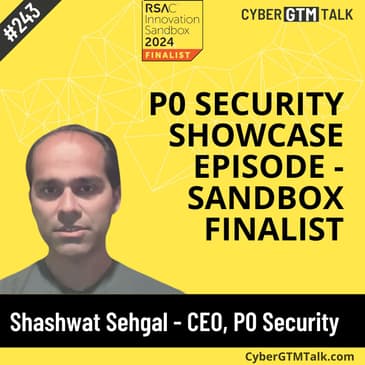
In this conversation we discuss:
🤞 How P0 Security uniquely integrates security without hindering developer workflows.
🤞 The challenges of securing cloud-native technologies and non-human identities.
🤞 P0 Security’s innovative approach to identity governance and administration.
About our guest:
Shashwat Sehgal is the CEO and co-founder of P0 Security, a company that streamlines security practices to enhance operational efficiency without impeding the productivity of development teams. With previous stints at Splunk and leadership roles in multiple tech enterprises, Shashwat brings expertise in cloud security and enterprise software development.
Summary:
Join us as Shashwat Sehgal delves into the complexities of securing cloud-native technologies, highlighting how P0 Security’s innovative solutions help bridge the gap between security demands and developer efficiency. Tune in to gain insights that can transform your go-to-market strategies and fuel your company's growth. Don't miss this episode!
Resources:
Connect with Shashwat Sehgal on LinkedIn
Visit P0 Security's website
Follow me on LinkedIn for regular posts about growing your cybersecurity startup
Want to grow your revenue faster? Check out my consulting and training
Need ideas about how to grow your pipeline? Sign up for my newsletter.
[00:00:00] Hey, it's Andrew. Just quickly before we start this episode, I want to tell you about one of my
[00:00:03] favorite podcasts, the Secure Ventures podcast. The host Kyle McNulty interviews cybersecurity
[00:00:09] founders about what they are building. I enjoy it because Kyle focuses on their technology,
[00:00:14] what it solves, why they build it, where it fits in the market. Also listeners can understand
[00:00:19] the why of these startups. In some ways is a great compliment to my own podcast where I
[00:00:23] focus on the go-to-market side, not the technology side. He set some great guests on
[00:00:27] recently, for example, the CEO of Reality Defender when they talked about the ins and
[00:00:32] outs of deep fate detection. He's had the co-founder and CEO of Go Security and also
[00:00:37] the co-founder radical Chris Peterson, who was incidentally a founder of LogRhythm.
[00:00:42] They talk about the role of AI in the sock. This is not a paid promotion. I just simply
[00:00:46] enjoy what Kyle is doing with his interviews and get a lot out of them. Check it out.
[00:00:50] It's the Secure Ventures podcast. Now on with this episode.
[00:00:57] Welcome to the Cyber Security Go-To-Market podcast for our special showcase episode,
[00:01:09] where we're talking to leaders of the company selected for the 2024 RSA Conference Innovation
[00:01:16] Sandbox. These are just the 10 companies that judges have selected as the most innovative
[00:01:22] startups in cybersecurity today out of hundreds who apply. I am your host, Andrew Monahan,
[00:01:28] and today we're talking with Shashwat Sehgal, CEO and co-founder at P Zero Security.
[00:01:34] Shashwat, welcome to the podcast. Good to be here, Andrew, and great to meet you.
[00:01:39] Yeah, good to meet you. It must be a bit of a thrill to get selected,
[00:01:41] Darren, to one of the 10 finalists. That's quite an honor.
[00:01:44] Yeah, thank you. I'm quite looking forward to meeting everyone, customers, judges,
[00:01:49] and the broader community alike over at RSA. Yeah, the Sandbox Innovation Day Monday has
[00:01:55] turned into quite a big thing. So it's quite exciting to see these companies get the chance
[00:01:59] to showcase what they're doing. But let's get into our discussion today, Shashwat.
[00:02:03] First question for you, where in the world did you have your first Sandbox?
[00:02:08] Great question. So I grew up in New Delhi, India. That's where I spent my childhood. That's
[00:02:15] where I went to university. And then I've been kind of going around the world for my career.
[00:02:21] I spent a few years in London, moved to New York. And for the last 10 or so years,
[00:02:26] I've been out here in the Bay Area. Well, it must be a thrill to be able to
[00:02:29] come from one hotbed, which of course is India, tech-wise these days, into another one,
[00:02:35] which is Silicon Valley, where a lot's going on at the moment.
[00:02:39] What's the story of the founding of P Zero Security, Shashwat?
[00:02:43] So this goes back to what I was doing before I started the company. I was at Splunk
[00:02:50] at Splunk. I was leading product management teams, multiple product management teams within
[00:02:55] observability. And that's where I met my co-founder, Greg, who's also my CTO.
[00:03:02] What we had noticed was that the security team at Splunk was having a very hard time
[00:03:09] at the time trying to make sure that cloud was secure. What do we mean by that?
[00:03:16] We were building all of these big technologies as part of an observability suite. And we were
[00:03:23] looking to make sure that these were something that the Fortune 100s, the Fortune 500s felt
[00:03:30] safe deploying. And as part of that, obviously, the security team wanted to make sure
[00:03:35] that the access to Splunk's critical infrastructure was secure. In other words,
[00:03:41] they could regulate access to both human identities and non-human identities to
[00:03:48] any kind of sensitive resources in the cloud. Now, this sounds very straightforward in theory,
[00:03:53] but as we started implementing these access controls within our environment,
[00:03:58] what we realized was that the cloud was quite different from the technologies that came before
[00:04:05] it. Specifically, cloud-native technologies like Kubernetes, like microservices, etc.,
[00:04:10] were especially challenging to secure access for. Why was this the case? As we dug deeper,
[00:04:15] we found out that this was difficult because the cloud was unique in at least two ways
[00:04:22] from how application development used to happen before the cloud. What were those two ways?
[00:04:27] Firstly, it was an order of magnitude more complex. Why was it more complex? Previously,
[00:04:33] all security teams needed to care about was to make sure humans don't have access to
[00:04:38] production infrastructure. Now, they had to make sure humans as well as non-human identities
[00:04:44] did not have access to production infrastructure. The number of identities exploded 100x from what
[00:04:50] it used to be before and the number of access paths to sensitive infrastructure and sensitive
[00:04:54] data also exploded in number. So, the first reason why this was challenging was just the
[00:04:59] sheer complexity. And the second reason we found it was so challenging was because previously
[00:05:05] the tools that secured access to any sensitive information or sensitive data or sensitive
[00:05:11] infrastructure were not built from the perspective of a developer. Now, increasingly with cloud-native
[00:05:18] development, the gatekeepers of the cloud are developer teams as opposed to IT and security
[00:05:23] teams. So, the incentive of someone in security is to ensure that the changes that
[00:05:31] they are introducing, the access control that they're introducing into the system
[00:05:35] does not impede a developer in any shape or form. And this, what we found was extremely
[00:05:40] hard to do with the existing tools. So, that's how we got started.
[00:05:44] And does that mean that your buyer is on the development side or is it still on the security
[00:05:48] side? A buyer is still on the security side, but we have designed our tools to be, we have
[00:05:55] taken a lot of care to ensure that the eventual users of a product, which is typically the
[00:06:01] developer team, they are not impeded in any shape or form. We meet them where they are
[00:06:06] in their journey rather than introducing new workflows, new ways of doing things.
[00:06:11] For example, we've gone all in on integrations with command line, with integrations with
[00:06:17] Slack, rather than deploying a new software on the laptop of a developer or asking them to
[00:06:25] log into a new portal. We try to meet them as much as possible where they are so that we
[00:06:30] are as less of a hindrance to them in their day-to-day work as possible.
[00:06:33] And where were you and Greg? You said that and thought, you know what,
[00:06:38] why don't we just do a company to solve this?
[00:06:40] Yeah, so that's when we started facing this problem internally. That's when we decided,
[00:06:44] hey, there's probably a company to be built somewhere in this problem, right? Somewhere
[00:06:49] in this space. So that's when I also started talking to my third co-founder, Nathan. He and
[00:06:56] I were peers a couple of jobs ago when we were at Cisco Meraki. So at Cisco Meraki, I led
[00:07:05] the SD-WAN team and he was my engineering counterpart. So collectively we had been
[00:07:11] in the security space for the longest time. And so he had left Meraki to become the VP
[00:07:16] of engineering at Semgrep. And then he was thinking about his next steps after leaving
[00:07:21] Semgrep. So the stars just aligned and Greg, Nathan and I decided to start the company in late
[00:07:27] 2022. That's awesome. And going back to your problem statement, so I get the fact that you
[00:07:32] had a developer first mindset to make sure that they were catered for. But what's the
[00:07:37] biggest innovation that judges would have seen in what you do that got them so excited?
[00:07:41] Yeah, so the broad space that we are operating in historically has been called as IGA, identity
[00:07:48] governance and administration. Historically, this space has been targeted towards developers
[00:07:55] or specifically not even developers, towards human users or employees of an organization
[00:08:00] as they look to gain access to applications. And we believe we are the next iteration of
[00:08:06] this space specifically for the cloud and specifically for a cloud development stack,
[00:08:11] which means we include not just developers but non-human identities as well. So we believe that
[00:08:18] two innovations that we bring to the table is that we are solving this problem holistically
[00:08:23] for the cloud for all kinds of access across all kinds of identities. That's one. And the
[00:08:28] second innovation that we are getting to the table is that we've designed a product, the form
[00:08:33] factor of the product in a way that does not introduce any kind of friction to developer
[00:08:39] workflows. So developers being important people in an organization in terms of the systems they
[00:08:44] support and usually they help the company run and make money, so therefore keeping them happy
[00:08:49] is a big deal. Absolutely. So every company requires some kind of access governance. And
[00:08:56] for better or for worse, access governance has been synonymous with some kind of a tradeoff
[00:09:02] between security and productivity. And we want our goal is to make sure that this tradeoff,
[00:09:09] to the extent that one exists, is minimized in any company.
[00:09:14] Intuitively I get the idea that lots more access is going to have an impact on your
[00:09:20] ability to mitigate risks. But what's the biggest business impact to this that people
[00:09:25] are really worried about? Is there evidence to say that having all these non-human identities
[00:09:29] is a challenge, is causing problems and people getting breached left, right and center from them?
[00:09:35] Yeah, absolutely. So there are usually three sources of business impact to most of our
[00:09:41] customers. The first source is obviously one of security. At the end of the day,
[00:09:46] we are a security company. By some estimates between 65 and 75% of cloud security incidents
[00:09:54] in 2023 had something to do with some kind of identity misconfiguration. If you think about it,
[00:10:00] that's a shocking number, right? And if you're able to move the needle on the statistic, even
[00:10:07] like let's say 10 to 20%, that could be huge in terms of its repercussions on the security
[00:10:13] posture of a company, right? So that's one. Secondly, a business metric for us is to improve
[00:10:20] the operational efficiency of a company, right? So many of our customers, they use us day in,
[00:10:25] day out for things such as automating access requests for individual engineers or for automating
[00:10:34] access reviews of non-human identities, levels of access to the cloud, right? So in
[00:10:42] many instances, we end up saving them hours of their time per week, several hours of their
[00:10:47] time per week, right? So it's not hard to tie that to some kind of a business outcome in terms
[00:10:53] of we all live in a world of now that the zero interest rate environment is gone, everyone
[00:10:59] starts to worry about their margins once again, right? So we help security and DevOps teams do
[00:11:06] more with less. So that ties frequently into yet another business outcome for our customers.
[00:11:12] And the third business imperative for a lot of customers is that many of their own customers,
[00:11:20] especially if they are selling to upmarket enterprise, large enterprise, many of their
[00:11:25] own customers will come with some kind of stringent requirements on securing access to
[00:11:31] their internal data and internal infrastructure, right? And to do that, the easiest way to secure
[00:11:38] access to whoever it is that requires access is to use someone like PZero, right? So those are the
[00:11:46] three big business drivers, security, operational efficiency and revenue growth as you start going
[00:11:52] upmarket that we usually tie into. That's correct. You're talking to the three main
[00:11:57] business drivers, right? That's awesome to be able to do that. Must put you in a good
[00:12:01] position when you're talking where prospects are, as you say, they're scrutinizing this
[00:12:04] a lot more than they were two years ago. So it sounds like you're used to having that
[00:12:08] conversation with people. Yeah. So Ashwag, as you look at the rest of the year,
[00:12:12] what are your big goals for 2024? Well, life in the journey of a startup is that
[00:12:21] your goals are mostly or almost always on a two-week time horizon or a one-month time
[00:12:26] horizon rather than on a one-year time horizon. But yeah, I mean, jokes aside,
[00:12:31] right? So far we've been very happy with the traction and the feedback that we've heard from
[00:12:36] customers. Our goal is to really step on the gas as far as our product development is concerned.
[00:12:44] We've obviously covered a major portion of the stack at many of our customers, but
[00:12:52] we can always keep on building more and more integrations with the rest of the stack. For
[00:12:56] example, if a customer is using some database that we do not currently support access to,
[00:13:02] maybe we want to build access to that. Or if there's some cloud service that they use
[00:13:09] internally and we don't support access to it, that's also something we want to provide.
[00:13:13] So I'd say the vast majority of our time this year is going to go towards improving
[00:13:19] our product and making it ready for customers of all shapes and sizes.
[00:13:24] Simultaneously, we'll also be investing in some go-to-market talent so that we can start
[00:13:31] selling and we can start reaching more customers than the ones that we've been talking to so far.
[00:13:37] Is this an enterprise sales first go-to-market strategy or is there some other way that you
[00:13:43] think you'll have to do this? No, it's very much an enterprise sales first strategy.
[00:13:49] At some point, we'll be exploring other ideas as well around how to reach platform teams directly.
[00:13:56] But again, that's more for the medium to long-term future. I'd say in the near term,
[00:14:03] we are very much a security team focused sales strategy.
[00:14:07] And then if you look to RSA in two weeks' time, except for celebrating the win
[00:14:12] of the innovation sandbox, what else do you have going on that week that you want to tell
[00:14:16] people about? We'll be at Booth 1960, 1960. So any of you all who are attending RSA,
[00:14:25] if you want to see a demo of the product firsthand, if you want to play around with
[00:14:28] the product firsthand, I personally am a strong disbeliever of canned demos.
[00:14:33] I always believe in giving people access to the product, letting them play with it themselves
[00:14:38] and watching their face when they see the aha moment. If you want to do that, please by
[00:14:41] all means come over to Booth 1960. The vast majority of my time at RSA, I'm expected to
[00:14:49] be speaking to customers, prospects, understanding what they like, what they do not like about the
[00:14:55] product and in general just brainstorming on where cloud security is heading.
[00:15:01] And is that in the main floor or are you in the early stage expo?
[00:15:04] No, we'll be in the main floor. Great. All right. And any events with your investors
[00:15:09] at all? Those are more in the evenings. Yes, some during the day as well. But yeah, I mean,
[00:15:15] for me, we'll never be where we are without our customers help. Right. So for me, first and
[00:15:21] foremost, I want to be there on the front lines speaking to people, understanding their
[00:15:27] challenges, what keeps them up at night and really just taking it from there.
[00:15:32] That's great. And I'll put your LinkedIn link into the show notes. Is that the best
[00:15:37] way to get hold of you or do you want to offer a different way?
[00:15:39] No, I think that's the best way.
[00:15:41] Okay. Well, that's what I enjoyed our conversation. Looking forward to seeing you on stage at the
[00:15:46] Innovation Sandbox that Monday and I wish you all the best for that and for the rest of the
[00:15:49] year. Thank you. Really appreciate it. It would mean a lot to me and to the continued
[00:16:06] growth of the show if you'd help get the word out. So how do you do that easily? There are
[00:16:11] two ways. Firstly, just simply send a link to a friend, send a link to the show, to this
[00:16:17] episode. You can email it, text it, Slack it, whatever works for you and is easy for you.
[00:16:23] The second way is to leave a super quick rating. And sometimes that can seem complicated. So I've
[00:16:28] made it as easy for you as I can. You simply have to go to rate this podcast dot com
[00:16:35] slash cyber. That's rate this podcast dot com slash cyber and explains exactly how to do
[00:16:42] it. Either of these ways will take you less than 30 seconds to do and it will mean the
[00:16:46] world to me. So thank you.