
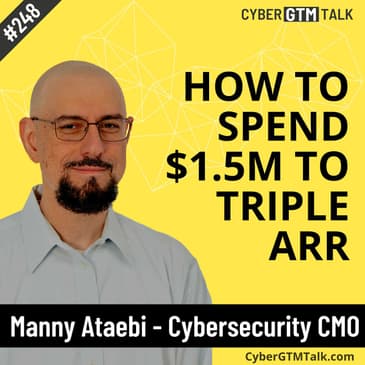
How would you use a $1.5 million marketing budget after securing $20m in Series A funding? Curious about strategies to triple your revenue in the cybersecurity space? Seeking insights on balancing short-term and long-term marketing tactics?
In this episode, Andrew Monaghan tackles these pressing questions with Manny Ataebi a cybersecurity CMO, offering expert advice on optimizing your marketing spend to catalyze substantial growth.
In this conversation we discuss:
👉 How to allocate a $1.5 million marketing budget to drive revenue growth.
👉 The balance between short-term SDR activities and long-term brand-building efforts.
👉 Strategies to creatively differentiate your brand at major events like RSA.
About our guest:
Manny Ataebi's career began at the age of 14, managing the bookings for a car service business, which developed his analytical skills and responsibility. With a strong background in development and technical marketing, Manny has transitioned into a distinguished marketing strategist in the cybersecurity industry, known for his innovative and bold approaches to marketing and event planning.
Summary:
Join Andrew Monaghan and Manny Ataebi as they explore how to strategically spend a $1.5 million marketing budget to triple revenue post-Series A funding. With a focus on scalable strategies and creative differentiation, Manny provides a roadmap for cybersecurity companies to maximize their growth potential. Don't miss out on these vital insights—tune in now to transform your marketing efforts and achieve unprecedented success.
Connect with Manny Ataebi:
- Manny Ataebi on LinkedIn
Follow me on LinkedIn for regular posts about growing your cybersecurity startup
Want to grow your revenue faster? Check out my consulting and training
[00:00:00] Hey, it's Andrew. Just quickly before we start this episode, I want to tell you about one of my
[00:00:04] favorite podcasts, the Breaking Through in Cybersecurity Marketing podcast. Now, I don't
[00:00:10] need to explain what it's all about because the name of it is so good, but here's why I like it.
[00:00:14] Firstly, the hosts not only know what they're talking about because they've been in the
[00:00:18] cybersecurity marketing role for so long, but also Jen and Maria make it fun. They have
[00:00:24] personalities that come out of the podcast and it draws you in. And secondly, they get great
[00:00:29] guests and together they make super useful episodes. My recent favorites were the one with Ross
[00:00:35] Halley Luke, who is a marketer but also just published the book Cyber for Builders all about
[00:00:40] how to start a cybersecurity company or the one with Joe Evangelisto, the CISO at NetSpy
[00:00:46] or even the one all about telling stories in cybersecurity with Mitch Main. I could go on
[00:00:52] with quite a few more. And by the way, I'm not getting paid for this. I just really enjoy
[00:00:56] Jen and Maria's show. Check it out. It's the Breaking Through in Cybersecurity Marketing podcast.
[00:01:02] Now on with this episode. As the funding environment is getting going again,
[00:01:07] I thought it'd be interesting to tackle the question of how to allocate marketing funds
[00:01:12] after a raise. Manya Tebi has been a marketing leader in tech for over a decade. He's been
[00:01:18] through raises and exits. And in this episode, he takes our series A raise with Cyber Donut
[00:01:24] and talks about how to think about allocations and why, types of programs to run,
[00:01:29] and how to unite sales and marketing under common metrics. Don't miss this one.
[00:01:43] Welcome to the Cybersecurity Go To Market podcast where we tackle the question,
[00:01:48] how can cybersecurity companies grow sales faster? I am your host, Andrew Monahan. Our
[00:01:54] guest today is Manya Tebi, a seasoned marketing leader at multiple startups,
[00:01:59] including a couple in cyber. Manny, welcome to the podcast.
[00:02:03] Thanks, Andrew. Happy to be here.
[00:02:04] Manny, I'm looking forward to our conversation today. We used to work together a few,
[00:02:09] couple years ago at one company. I was involved and you were leading marketing there. So we
[00:02:14] got a good rapport and we kind of know how each other thinks a little bit, which is good.
[00:02:19] But we're tackling the question today for our fictitious company, Cyber Donut.
[00:02:24] We're imagining that they've taken $20 million in a large series A round and you and I are going
[00:02:31] to be discussing what the heck are we going to do with that money? Whatever portion of that
[00:02:35] money goes to marketing, what money are you going to spend and how? So I'm really looking
[00:02:39] forward to how we go about doing that. All right. Before we get to the business end,
[00:02:43] got a treat coming up at the end of the episode when Manny tells us about
[00:02:47] his first job as a kid where he's basically doing Uber-like scheduling in his brain.
[00:02:53] And he's also going to tell us about the time when he broke his leg and decided just to tape
[00:02:56] it up as opposed to go to the ER. So watch out for that coming later on.
[00:03:00] All right. Let's talk about the business side though, Manny. So we've got Cyber Donut.
[00:03:04] They're doing really well. They got a sales leader, a marketing leader. They got some
[00:03:07] sellers. They got 20 real live paying customers and they're just about to take the
[00:03:13] series A for about $20 million. So progress is going well for Cyber Donut.
[00:03:19] The big question though is what they're going to do to spend the money, specifically
[00:03:22] in marketing. So let me ask you maybe an unfair question, but I realize that some of these
[00:03:27] questions are going to be, it depends. But if they're going to take 20 million,
[00:03:31] how much would you expect to get as part of your marketing budget?
[00:03:35] I'll specifically not say it depends because you said the answer would be it depends, but
[00:03:40] some of it has to do with what's been working, what we've run so far,
[00:03:45] how much of the business has come from marketing and or sales or is still founder
[00:03:49] led. If they're getting a series A, I'm probably going to assume it's about 50-50.
[00:03:54] Some of their founder led sales are still going there. I think you told me there's three sellers.
[00:03:59] Yeah, they got three sellers plus a leader plus an SE.
[00:04:02] At that point, I'm going to assume probably one, maybe one and a half of them are hitting 100%
[00:04:07] quarter. That's kind of the way it typically looks out there. They brought in their SE.
[00:04:12] This is obviously going to be a technical sale if they have that
[00:04:16] and they have a sales leader. If I had to ballpark it, it could probably fall anywhere between
[00:04:23] 600K to a million and a half somewhere in that ballpark depending on where they need to be.
[00:04:28] For the first year or for the whole?
[00:04:29] For the first year.
[00:04:31] I don't obviously know the answer to this, but I'm going to guess just based on the way
[00:04:35] where the economy is right now, if they're raising a $20 million series A, I'm going
[00:04:39] to assume they got a few million on a seed round before that or a couple million on that.
[00:04:43] If they're hiring at three reps, if they're at three reps, I have to assume they're hovering in the
[00:04:48] three, four million dollar range of revenue because some came from the founder. This is,
[00:04:54] again, assuming all three reps are just crushing it and it might be even a little bit less.
[00:04:59] In my mind, they're probably in the two to five range or trying to get to that either to
[00:05:03] five million or to seven million. They need to find another few million of revenue.
[00:05:07] In that way, in that case, I'm trying to do the math backwards. I think you probably need
[00:05:13] somewhere along those lines of in that spend to be able to market effectively. That would mean
[00:05:20] SDR as well as well as inbound programs. How would I spend it? First, there would be SDR.
[00:05:26] If you have three sellers, probably want to have one, maybe two SDRs, but you definitely
[00:05:31] want to have one working. I think you said it was me and another marketer. I think that
[00:05:36] is okay for now, depending on what that skill set or that marketer is. If they're a content person
[00:05:41] or a campaign manager, I probably want to get one or the other, but I think you're okay with what
[00:05:45] you have. I would really be focused on what are the things that we can run to affect the pipeline
[00:05:51] in the next quarter or two? To me, I'm assuming this is a cyber podcast. I'm going to assume
[00:05:57] it's a cyber company, Cyber Donut, I think it was the name. I'd be looking at doing custom
[00:06:02] events to try to bring the ICP prospects into a room and to try to engage them.
[00:06:07] I would be looking at activation events at a conference. You're not at the point where I
[00:06:13] want to go spend a ton of money at a conference unless there's a strategic reason to do so,
[00:06:17] but doesn't mean that you can't get a couple of tickets and try to set up a dinner or
[00:06:22] something along with other vendors, that sort of stuff. Then we probably already started
[00:06:28] this already, but I would start to be thinking about content and how to tell our story better,
[00:06:34] investing a little bit on our messaging. There's never been a company at 2 million,
[00:06:38] 5 million, 10 million, zero, 15 million that doesn't have an issue with their messaging.
[00:06:42] So it's why we know each other. That's one of the things I would also be investing
[00:06:48] on those things. But they got this far though, right? Some of their messaging must
[00:06:53] be pretty good if they've got 20 real live paying customers. Could be founder selling,
[00:06:57] a founder can get on there and promise anything, an AE cannot do that. So this founder may have been
[00:07:03] successful before and been able to bring that over. This founder may have a VC that throws them
[00:07:08] business. It's just not scalable. You get your series A to start to get on the path to
[00:07:13] scalable. That's what we're looking for. Have you seen founders be a little bit optimistic
[00:07:18] and have roasted into glasses on about their success so far? And then this team,
[00:07:23] I imagine they're going to double or triple the number of reps, right? You take that
[00:07:26] money, you're trying to get some scale by buying some headcount as well.
[00:07:31] That must be a point of conflict though where, hey, it worked for me. Why isn't it working
[00:07:35] for these guys? Well, that comes down to what we call product market fit.
[00:07:40] I have many a conversation with founders where they're like, we have product market
[00:07:43] fit because we have 10 customers. And I asked them straight out, how many of your sellers
[00:07:47] brought in and moved these along? And they're like, none. And I'm like, well,
[00:07:51] you don't have product market fit. Product market fit is when there's a repeatable process
[00:07:54] where more than one person that is not the founder is able to do that. And obviously we
[00:07:59] got to talk about retention and bring them back. But that is the rose tinted glasses
[00:08:05] that you tend to talk about. I do see that conversation quite a bit, or they have one
[00:08:10] seller that is working with the founder to be able to move some deals across. You can get
[00:08:14] to 20 assuming that your product is something that people would want. If it's not, then you
[00:08:19] have a whole different problem to deal with. But what you're trying to do with the AEs to get to
[00:08:24] that repeatable process. So they're coming in through outbound, through inbound, through partner,
[00:08:29] what we would call any all bound or any bound. And now a rep can take that working with an
[00:08:34] SC and can close those deals on its own or on their own. That's what we're trying to
[00:08:38] get to. And my guess is you might have a couple of those 20, but there's no way that
[00:08:43] the bulk is that way. That just math doesn't make sense. So if you have three AEs,
[00:08:48] my guess is you're probably to your point trying to double that because you need to get to four or
[00:08:52] five that are doing what I just said. Would you want to delay though, the hiring of the AEs
[00:08:57] to get some more repeatable pipeline coming in? Or would you say, no, you kind of got to do it
[00:09:01] in tandem? It depends on how good the AEs are that are there and what they're doing right
[00:09:07] today. You might have those facts for me in this thing, but if I would say if you have
[00:09:13] one AE that's at 60% quota and the other two, I've just been hired in the next two
[00:09:17] months, you probably don't want to go hire another three. Let's get those three productive.
[00:09:21] If those three that you told me are all at 80% quota and they've all been there a year,
[00:09:26] different story. I think you have enough of your sales motion from top of the funnel to
[00:09:31] the end working enough that yeah, let's go concentrate on building enough pipeline.
[00:09:35] What you don't want to do is go burn all through this cash to get a bunch of pipeline
[00:09:40] in when that middle isn't working because then you're just throwing money away at that
[00:09:44] point. You're going to get a bunch of opportunities with companies based on all
[00:09:48] of the efforts you're getting to get them to the top and your motion in the middle is not working,
[00:09:52] your velocity drops and everything drops off. That's when you get like,
[00:09:55] damn we have a lot of first meetings but we don't have many POCs going here. Or the POCs
[00:10:00] we have, they're not good ones and none of them are closing. You want to get out of
[00:10:03] that situation. I would say it would depend on where you are with those things. But
[00:10:07] my guess in the fictional company you just said, if they have three and they just raise
[00:10:13] the series A, I got to think that at the point maybe they can hire one or two more. There has
[00:10:17] to be some momentum. I have to believe that they're not, they wouldn't be able to get their A
[00:10:21] if they didn't have any momentum. This is not two years ago. I was going to say like five
[00:10:27] years ago, whatever we'd, the bottom up planning would be let's hire some reps to
[00:10:30] get capacity first and then figure out how we keep them busy. Yes, this is definitely
[00:10:34] not three years ago. That was a very different piece we live in.
[00:10:37] Manny, let's learn a bit more about you. I've got my 35 questions here and I'm going to use my very
[00:10:47] sophisticated next gen AI driven spin the wheel device here. It is fully audited,
[00:10:56] uses polymorphic encryption to protect the IP about how it does it. And it's going to
[00:11:00] generate three completely random questions. So I'm going to spin this wheel and let's see
[00:11:05] what comes of it. All right, number 29, Manny, how did you first make money as a kid?
[00:11:16] Okay. Yeah, we're going to go on the way back here. So this is going to kind of be something
[00:11:21] you probably haven't heard before. So my very first real job, I believe I was, I want to say
[00:11:27] 14 years old. I was working keeping the books for a car service business. So in today's
[00:11:35] world, obviously you have your Uber, you have your Lyft. Back in the old days,
[00:11:40] yet obviously only two choices of how to take a car to work. You get into Yellow Cap,
[00:11:45] which is obviously you stand on the street, wave them down or your company has an engagement
[00:11:50] with an existing car service organization. Now that could be a stretch limo, that could be
[00:11:54] regular black car. Those still do exist today, but Uber and Lyft kind of own that. So
[00:11:59] back in the day, this was even before it was computerized. My job was to price out,
[00:12:06] based off of a price sheet, what the end-all cost was. So that could be, for example,
[00:12:13] you pick someone in Midtown East Manhattan, you make one stop somewhere up North and then you
[00:12:20] drop them off at JFK airport. Sometimes there's multiple stops in between that. Sometimes there's
[00:12:25] wait time. Sometimes there's phone calls. This was pre-cell phone days, so they had a mobile
[00:12:31] phone sitting in the car. My job was to calculate the vouchers for the drivers. Obviously today
[00:12:36] it's all computerized. So the interesting thing about that is I had to memorize basically
[00:12:42] a huge call list of prices. So back in the day, I could tell you that Midtown East of New
[00:12:49] York City to Trenton, New Jersey was $84. And I still remember that to this day.
[00:12:56] And Midtown East to JFK airport was $33. Midtown West to JFK airport was $38. The reason for that
[00:13:05] being you have to cross the east side of Manhattan to get to JFK. So I had to have all of those
[00:13:10] things memorized, getting hundreds, hundreds of these for different drivers. It was an insane,
[00:13:16] fortunately for me, I was good at math, but you had to do it in quick time. You could barely
[00:13:20] make any mistakes. There was no computer to back you up. And ironic part was it taught
[00:13:24] you to be very careful. And what I mean by that is in today's world, you make a mistake,
[00:13:28] maybe you'll get a red X on the computer and say error, all that stuff. In that world,
[00:13:32] I make a mistake. A week later, I have an angry driver coming in screaming his head off.
[00:13:37] But they trusted this to a 14 or 15 year old?
[00:13:40] Yeah. I had a strong math background and I just kind of had to prove it out. So they
[00:13:46] let me do a couple of test runs and I nailed them perfectly. So I knew the guy
[00:13:51] that ran the business. It was like, I want to say a family friend, but like a work family friend.
[00:13:57] And honestly, he didn't want to pay for someone full time to come in. So he was doing it himself.
[00:14:02] So for me to come at first, I was helping and then I kind of took it over, which is funny
[00:14:07] because toward the end of that job, we started to computerize it eventually and getting
[00:14:12] that set up over time, obviously made the job redundant. I didn't need to do that. I more
[00:14:16] had to just click through. And then I kind of shifted into booking and calling and trying
[00:14:21] to find new customers, which kind of was like my early SDR work of doing that. But it taught me
[00:14:27] early on, unlike most people, I wasn't running in a store and trying to do that kind of work.
[00:14:32] I had something that I really, really could not mess up. This is people's lives and goods.
[00:14:36] You had the formation of Uber left in your brain for a little bit. That's fascinating. I
[00:14:44] love the fact that you had a family member who is a family friend who is cheap enough to want
[00:14:48] to employ a 14, 15 year old and then figure out actually this works pretty well.
[00:14:52] Well, I mean, if the alternative is he wasn't trusting anybody else. So he was either going
[00:14:56] to do it himself or he's going to just look over what I'm doing and then just let me do
[00:15:00] it. Over time, you build up that trust. It's kind of like any job, right? But I basically
[00:15:04] took 20 hours off his plate so he could go do other things. And for me, it was just good.
[00:15:10] It was good. It threw me into the fire very quickly. And the stress of that job just taught
[00:15:17] me that like, hey, in pressure time and crunch time, you just got to be on the ball. You can't
[00:15:22] just get overwhelmed because that's the kind of thing you make one mistake. Then you start to
[00:15:26] make 10 mistakes. It's not going to end up pretty. And it's not one of these things like
[00:15:31] in today's world where you're going to have a talkie to at the boss. I can't even explain
[00:15:35] to you what it feels like to hear an angry driver wanting to just like run over and jump
[00:15:39] at you. That's kind of what it was like. I can only imagine. All right, let's spin the wheel
[00:15:43] for question number two. All right. Number six. What is the most embarrassing or memorable moment
[00:15:55] or funny moment in your work life that you're able to share with us on public airwaves today?
[00:16:02] Embarrassing or memorable. So that's going to take like five things off the table right
[00:16:06] away because I can't share them. I got something. This is a little bit ago. This would
[00:16:12] be around 2011 time frame. It's an interesting story because it paints me in a very interesting
[00:16:20] light in that you're going to hear this and think like, wow, you are a trooper. And then
[00:16:25] you're going to also look at it and be like, wow, what's wrong with you? And that's how
[00:16:28] you're going to end up thinking about it. So I worked at this big company in Midtown Manhattan
[00:16:34] back in the days when everybody went into the office. So we would take lunch,
[00:16:38] lunches and all that sort of stuff. Basically not the way that the real world works today
[00:16:42] in terms of hybrid and remote. And I remember going with a coworker to lunch. We were just
[00:16:48] walking down, I believe it was Lexington Avenue. And oddly enough on that day, I guess there was
[00:16:54] construction going on and they were drilling holes into the sidewalk. And for some reason
[00:17:01] I didn't see that we had walked into that area. There were signs. I just did not happen
[00:17:05] to see it. This is probably where they're like, what were you thinking? I was probably
[00:17:08] thinking about what we were talking about. And there was a hole in there and I fell into it
[00:17:12] and rolled my ankle and it popped. I heard the noise and so did my friend. And so did the
[00:17:18] people behind. Like I could tell I've had sprained ankles. This was a fracture or a break.
[00:17:23] I could hear that. So when the initial kind of pain wore off and the shock of this,
[00:17:28] so I picked myself up, I pulled myself over. I'm sitting on the sidewalk and my friend's
[00:17:33] freaking out. He's like, I just heard that. Let's go to the ER. And I remember that I had
[00:17:38] a presentation due that day. So this is, so what I ended up doing is I'm, he kind of helped
[00:17:43] like I lived on him with him sort of carrying me walked over to like a Duane Weed pharmacy.
[00:17:48] I went and I got medicine tape and I taped up my ankle. And this is where it's like,
[00:17:51] wow, warrior. And what's wrong with you is kind of where it comes in. He was looking
[00:17:55] at me like I was nuts. Like I had a second head growing out of my shoulder. This is
[00:17:59] kind of like when you grow up as an athlete, you kind of tape it up, you get through the
[00:18:02] game and then you figure out what's wrong later. I kind of had that mentality. I didn't want
[00:18:05] to miss this presentation. It was important. So I taped up my ankle. I limped my way back
[00:18:10] in. I got a bunch of Tylenol. I made my way through the presentation, excruciating pain.
[00:18:15] I went home. I went immediately to the ER, got x-rayed, was fractured, ended up being in a
[00:18:21] cast for a long time. So I always remember that story not only for that part of it,
[00:18:27] but here's where it gets kind of funny. As a team, we usually did monthly, sometimes quarterly
[00:18:32] like team awards, you know, person that brought in the most business, you know, the person that
[00:18:38] you could go to for help the most often. And they usually either got like a gift card,
[00:18:42] a monetary prize or some kind of trophy. In that case, apparently the person I was with
[00:18:47] went and told everybody this story. And I got surprised at this meeting. The award was
[00:18:52] called the craziest MF'er on the team. And they gave me a pair of boxing gloves,
[00:18:57] these red boxing gloves. And I kept them for like 10 years. It's just a funny reminder.
[00:19:03] And it just became an ongoing joke within the company and with this person that I
[00:19:08] continue to work with. If he's watching, he knows what I'm talking about.
[00:19:12] Anytime I run into a crazy or a tough situation, he brings me back to that story.
[00:19:17] That's what I would say. That was the most memorable and also embarrassing and I would say
[00:19:22] somewhat stupid memory of my workplace. I love it. All right. Let's spin the wheel
[00:19:26] for the last one. All right. Number 14. What is the story behind you getting your first job in
[00:19:39] tech? Not including your 14 year old in the brain.
[00:19:44] It's kind of tech, right? With the computer at the end there. Yeah, it's actually oddly
[00:19:50] enough segueing. It is the same company I just described. As I finished that role,
[00:19:55] I ended up getting my first head of marketing job in technology. The company I was talking
[00:20:00] about the one where I broke the ankle. There was tech, but it wasn't a full on
[00:20:05] heading up marketing. But the job after that, I got into what we call IT tech.
[00:20:10] And the story behind that, and it's kind of funny because that's followed me around.
[00:20:14] I end up taking head of marketing roles in IT tech, dev tech, whatever you want to call it,
[00:20:20] cybersecurity, compliance, tech, privacy tech. A little not well known fact is
[00:20:26] prior to being a marketer, I spent six years as a developer. I started on the front end.
[00:20:32] I taught myself how to code. I started building websites. I taught myself back in.
[00:20:37] I started doing PHP. I started learning a little bit. I started learning JavaScript.
[00:20:42] I started learning Java. I was even going into cold fusion and JSP, which is Java server,
[00:20:47] very not so great technologies. Let me tell you. And I appreciated figuring this stuff out
[00:20:53] on my own. And where that's translated into the tech jobs of marketing is I just,
[00:20:59] I don't want to say it's easier, but I have a pull into those businesses that tend to be over
[00:21:04] a little bit more technical because as a marketer, besides building pipeline and growing brand,
[00:21:10] the number one thing that I'm supposed to do is take something that is very
[00:21:14] hard to understand or very technical, very feature focused and put it into a story
[00:21:18] and a narrative that the buyer is going to understand. And having that background
[00:21:23] and coming from that background of understanding the mindset of a developer, an engineer,
[00:21:28] it has helped me in areas where it typically wouldn't. So the first time that I got into
[00:21:33] cyber, I had not been into cyber before. First time I went into development tech,
[00:21:37] I had not known anything. And 30 days later, I'm basically describing how a public cloud is
[00:21:43] built in terms of like VMs and the hypervisor and all that sort of stuff. I just picked up on
[00:21:47] it, having that background. So that's kind of how it all ties together.
[00:21:53] Now you mentioned the first two things you said you would do were all around events. You said,
[00:21:58] I think customized events and then activation events. Why events? Why is that where you
[00:22:03] would go first? Because it's the quickest return that you can get. So if our ICP is to find
[00:22:11] people on a threat team or are the people who run the cloud team or whatever it is,
[00:22:16] it's a lot easier for me to get them where they are right now than to try to throw out a bunch
[00:22:22] of content that it may take them several months. You want to do both, but I'm not going to see a
[00:22:26] return on that right away. And what you don't want, in this cyber world, this isn't the
[00:22:32] type of space where I can go pay a bunch of Google ads and they will come in tomorrow.
[00:22:35] It just doesn't seem to work that way. The things that are in terms of bringing them to
[00:22:40] you inbound takes several months to start to work. In this scenario, we just raise money.
[00:22:44] We may or may not be wanting to increase capacity of rep count. I want to get some at bats in front
[00:22:49] of these guys so we can see what's working and what's not working. Because in this world,
[00:22:56] I'm probably changing messaging. I'm working on messaging. Without it,
[00:23:00] bats, how do we know if it's even working? Right. You don't have any evidence except for
[00:23:05] just a new gut feel at that point, I guess. Yeah. And you want to exclude all the stuff
[00:23:09] that came from the founder because you know what, if they came from a relationship with
[00:23:12] the founder or the VC, it's not your normal situation. Your messaging can stink and they
[00:23:17] may still close. Right. You get through power of will, relationships, trust, things like that.
[00:23:22] You've got to think about the short term and long term. If you're looking at, again,
[00:23:27] spending your budget you get from this, how would you allocate between, I don't know,
[00:23:31] short term, long term and then any experiments or things you want to go try and see if
[00:23:35] things actually work? I mean, it depends when you get into the company, but rule of thumb is
[00:23:40] 60-20-20. 60% of your budget needs to be about what's going to happen in this quarter and next
[00:23:46] quarter. So a lot of the stuff I just mentioned, that's SDR type stuff, that's going to affect
[00:23:53] the pipeline as of today. 20% should be what I call brand long term thinking. The reason
[00:23:57] for that being at a certain point, you don't want to continue to be grinding to get your
[00:24:02] pipeline number every single month. It's fine for the first six months to the first year.
[00:24:06] Year and a half from now, that's going to be very expensive. Your cap will be through the
[00:24:10] moon. In the beginning, I always say it's not about optimizing. It's about just get them in.
[00:24:15] And then it's about optimizing. So you need to have your brand have some input on how that
[00:24:20] works. That could be things like, I'm not saying go out and get a billboard on the highway.
[00:24:25] That's not what I'm talking about, Brent. I'm talking about content that spreads through
[00:24:29] word of mouth. That's using LinkedIn the right way. That's things like videos, that
[00:24:34] things like Gartner Cool Vendor. Things that is going to help you in the sales process,
[00:24:40] things like that. And then the other 20% is what you call experimentation. That could be
[00:24:44] campaigns and that could be tech. Hey, let's try intent. Let's see if that works for the
[00:24:50] solution that we have for this market. Let's try comedic videos. Let's see if we can get
[00:24:56] one to take off. Let's try, let's create a game on the site. I'll give you a great
[00:25:02] example. I forget the name of the company did this video. It's one of those password
[00:25:07] ones where they created a, it was Dashlane. They created a YouTube video series where
[00:25:13] it was called like Password something. And it was funny. It was basically you're on a boat
[00:25:18] and there's a person like you're going into this thing that they don't say is heaven,
[00:25:22] but it's like an opening in the sky. And this guy's like dressed like the Grim Reaper.
[00:25:25] He's got a hood on. Anyway, you're getting closer to the thing and he's asking you
[00:25:29] questions like, do you want to get in here? And the guy's like, yes. And he's like, all right,
[00:25:34] what was the name of your dog? What was the first street you lived on? And he didn't remember any
[00:25:38] of them and he couldn't get in. And they're like, we make password projections so you
[00:25:42] don't have to go through that. It's such a funny, like that's the kind of thing you're
[00:25:45] going to share with your friends because this is hilarious, right? That's the kind of stuff
[00:25:49] you want to play around with. Now that can't be your overall campaign strategy because
[00:25:52] that's brand play. That's like, oh yeah, those guys had that funny video. Let me check them
[00:25:57] out. That's the kind of stuff you want to play around with if you can. Now I preface that,
[00:26:03] that if you go into a later stage company, you're probably going to be spending more on brand.
[00:26:07] If I'm at 50 million AR, I better be doing a lot more on brand because
[00:26:10] you're not grinding your way to the next 50.
[00:26:12] Sgt. Mike Allen It's funny you mentioned that I interviewed
[00:26:15] David Klein, who's the CMO at Kentik, a network visibility company. And we had this
[00:26:21] conversation about something that he'd done. He said the same idea as experimentation,
[00:26:25] but this is when you have time and a little bit of extra money lying around, not your core thing.
[00:26:31] They created one video which was an advert for Kentik in the style of a perfume advert.
[00:26:38] And it was all about the sweet smell of network visibility.
[00:26:42] And it's funny if you look at their YouTube channel, I think their how-to videos were
[00:26:46] getting a few hundred views and their perfume had about 35,000 views or something like that.
[00:26:52] Sgt. Mike Allen And he said, him and one of his guys did it in an afternoon
[00:26:57] with their iPhone cameras or whatever. And it was very simple how they went about doing it.
[00:27:02] Sgt. Mike Allen And you said that extra time and extra budget. The reason why I think about
[00:27:09] that in cyber is you go to RSA, every single booth has the same messaging no matter what they do.
[00:27:15] And you need to stand out in other ways. I can't tell you my product is better than
[00:27:20] that product because we have this one feature that's 20% better than this one feature within
[00:27:25] the other nine. That's just not going to work. So if there are ways that I can make us stand out,
[00:27:30] now sometimes it's the person that's running the company. You can build around the presence
[00:27:33] of that founder CEO. Sometimes you can. Sometimes you have thought leaders within
[00:27:38] the company. Absolutely, you want to use those. Sometimes you have to get creative like this.
[00:27:43] One of the most creative kind of campaigns I ever seen, not even in cyber was it
[00:27:48] basically was a company called Vidyard that does videos for prospecting. And the campaign was they
[00:27:54] had a bunch of the people sit there and read the most god awful cold emails and be like,
[00:28:00] is this what you're doing? And you're expecting this to work? And the whole concept was it was
[00:28:04] humorous. Now you've got to, it's very tricky to use humor because there's a very fine line
[00:28:11] between funny and unfunny. But this really tied into their message because that is the
[00:28:14] world they were selling against. It's like, do you want to send one of these emails or
[00:28:19] one of 500 emails? Or do you want to send a video which is personalized? And I could be like,
[00:28:23] hey Andrew, here's why I'm reaching out to you in 30 seconds. And that was kind of the,
[00:28:29] that was the hook. And it was good because it got word of mouth. That company grew based
[00:28:34] off of word of mouth of all that stuff. So in cyber, it's even more necessary because
[00:28:38] everybody is either giving you visibility into something or stopping something. And it's like,
[00:28:44] okay, we need to find other things that we can try. And that's why I call it experimentation.
[00:28:48] That can't be your whole strategy. You still got to grind your way to the other 60%
[00:28:52] and build a pipeline. And you also be okay with a bit of polarization, right? If you want to
[00:28:57] be in the middle for everyone, you're going to be boring. If you want to be a little more
[00:29:01] bold, some people won't like what you do and you have to be okay with that. And some people
[00:29:04] are going to love it, which is the payoff that you want to get. Yeah. And the thing with
[00:29:08] cyber, and I think we all know this word of mouth is key. Most CISOs or other people will buy what
[00:29:15] their friends buy. You're not, and this isn't like Martech where I can get into those spaces.
[00:29:20] I'm, you and I are probably not going to join the secret CISO Slack groups, but they will share
[00:29:27] and they're also not going to share your press release. They're not going to share your
[00:29:31] product specific one pager, but they will share something they thought was interesting
[00:29:36] because it's, and if that's enough to get another set of eyeballs to the brand,
[00:29:40] then you did your job. And it's even better if it ties to your message, obviously. Otherwise
[00:29:44] we'd all just do silly videos that have no point. I like that idea though, Manik, because
[00:29:49] these secret Slack channels and secret societies of CISOs that all talk incredibly hard to get
[00:29:57] into. You can't get into, you can't buy your way into them. You can't barge your way in.
[00:30:01] But if you think about your content like that, at least they might say, I saw this today,
[00:30:05] I thought it was kind of funny or stupid or whatever it might be. At least you're getting
[00:30:09] into them somehow, right? Yeah. I mean, it's about that. It's also,
[00:30:13] you know, when they engage with it on social, I want the ideal. The idea of doing this is
[00:30:19] when your reps or STRs engage. I prefer if that's not the first time they heard the
[00:30:25] name of your company. And obviously if you're an established brand, if I'm calling it on
[00:30:29] Palo Alto or I'm CrowdStrike at this point, their brand is probably well-known. It's very
[00:30:34] rare at this point that you're not going to know that, but most companies are not there.
[00:30:38] It's not an easy thing to pull off because you have, you know, it's basically showing a
[00:30:43] personality within your company, but that's experimentation. You're going to do five of
[00:30:47] these things. Four of them are not going to be great. And it's the one that works that
[00:30:50] you're going to want to do another one. That's why I always leave a little room
[00:30:53] that you want to try that. Now, every company doesn't do that. It seems like it's
[00:30:57] an easy thing to do, but it's not. You know, I can name off top of my head,
[00:31:01] five amazing cyber campaigns that I've seen. There's probably 5,000 that I wouldn't even know
[00:31:07] of because I never got to see them. You brought up STRs. Should STRs report into marketing or
[00:31:11] sales? That's behind them. I'll tell you it depends. I believe it should be a marketing
[00:31:17] function if marketing's function is to build pipeline. If the head of marketing is a brand
[00:31:23] focused marketer, then absolutely not because they won't understand. I mean, I think I was
[00:31:27] telling you like it's whatever bound, right? To me, if you own pipeline inbound, outbound,
[00:31:34] partner, all of that sort of stuff, I as a marketing leader want to be on the hook
[00:31:38] for those things. It's kind of hard to only have one of them or only two of them.
[00:31:42] Sales has enough of a job about also marking those relationships, moving stuff through the
[00:31:48] pipeline, managing all that stuff and closing. Obviously, cyber is not a one-stop shop of a
[00:31:55] sale. It's going to take multiple touches with many stakeholders. There's enough to do there.
[00:31:59] But if my skill set was the videos that I talked about and I believe that that's how you build
[00:32:05] pipeline, I wouldn't even know how to do a comp plan much less to be able to handle that.
[00:32:09] When you work with campaigns, when you work with demand gen and work with messaging,
[00:32:15] and when you are a technical marketer and you probably control the stack,
[00:32:18] those are the four tools the STR need anyway. So it's good to have it all under one.
[00:32:22] How do you get your STR trained up? I'll ask the question like this as well. The downside that
[00:32:28] I've seen in that situation is the STR becomes someone who just parrots the marketing message
[00:32:35] as opposed to how sales will interact and engage with someone. So they become a bit more
[00:32:41] of a, I saw this on the brochure, I saw on the website, I'm going to say this thing and
[00:32:45] not realize, well, that's not actually how you might do it if you're actually talking
[00:32:48] to someone live one-to-one, which is what sales does.
[00:32:53] It shouldn't be that way because if you're marketing, you shouldn't just build a message
[00:32:57] on its own and be like, here, have fun with it. They should be working in tandem with
[00:33:01] the sales leader, listening to customer calls, listening to Gong or whatever they have,
[00:33:06] and crafting the messaging that way. I think you know this in our time together,
[00:33:13] when you work on your messaging, you start with the sales messaging before you even look
[00:33:16] at the website. That's the key. So if you work on the sales messaging with the sales team
[00:33:22] and or with or without someone like yourself, then that message should be in tandem. Then
[00:33:28] you give it to your STRs to test out, you give it to the A's to test out on the market.
[00:33:32] That's how, it's not like, hey, say what's on the website. You're doing something terribly
[00:33:37] wrong if that's how you're doing it. What's on the website should reflect what's been
[00:33:41] working in the sales and STR messaging if you're doing it the right way. I usually do
[00:33:46] that and if it's working, then I'll put on the website. A lot of times what's on the website
[00:33:49] and what's in the discovery deck are not going to even be close to each other because I'm testing
[00:33:53] this out before I start putting it all over the place. Because what if we put the messaging
[00:33:58] together, we get on the calls and the prospect is like, I don't have any idea what you're
[00:34:01] talking about or they're just like, yep, uh-huh, uh-huh, and they're just nodding along.
[00:34:05] Well, clearly we're not reaching them. Clearly we sound like everyone else. Oh yeah,
[00:34:10] I've heard this five times already today. You know, when you hear that sort of stuff
[00:34:13] or even worse when you hear nothing and you go into one of these recording softwares and
[00:34:17] you see the talk time is like 80% rep to 15% prospect. Yeah, I wouldn't even go anywhere
[00:34:23] near the websites. That's how you don't do that. Other way around.
[00:34:26] Got it. All right. We've seen a much better world let's say in the last couple of years
[00:34:31] than 10 years ago where there was a lot of conflict between sales and marketing, right?
[00:34:34] There was arguing about credit and all this sort of stuff. It seems like it's got a lot
[00:34:38] better. So in, for Cyber Donut with their 20 million, what sort of metrics should the sales
[00:34:44] and marketing team rally around? See these important things that we should be really
[00:34:48] tracking for. It's interesting because there's a couple
[00:34:50] ways to look at it. One, and not a lot of companies do this, but in terms of let's say
[00:34:55] board when you're at the board, I actually would prefer if marketing and sales had one
[00:35:00] presentation rather than two separate money companies still will do them separate,
[00:35:04] but you have to work with that person to make sure it's telling the same story.
[00:35:08] Metrics like leads doesn't matter. That's an internal marketing metric.
[00:35:12] Start it at discovery meetings and pipeline. If you start there, it's like, okay,
[00:35:17] this is how many disco meetings we set this month. This was the target because we set
[00:35:22] this target together because this is what we thought we needed based on the conversion
[00:35:26] metrics of what we have started discovery, then the different stages across.
[00:35:30] And then it's kind of like where if there are different presentations, then the sales
[00:35:35] leader is usually going to start with here's what we closed. They always do.
[00:35:38] And here's what our pipeline, which is usually very in the middle. Those numbers
[00:35:42] should match and that story needs to match. And if it doesn't, you're going to have
[00:35:47] issues in the old days. You talked about what would happen is the marketing be like,
[00:35:51] Oh, I ran a bunch of webinars and I got thousands of leads. And then sales
[00:35:55] would present and be like, I don't really have any pipeline. You just can't do that.
[00:35:59] Internally, you want to measure the leads number between a marketing team because
[00:36:02] you want to figure out how many of those it takes. And that's only one metric of inbound.
[00:36:08] There's also outbound and all the other stuff. How many of those you need to get to that
[00:36:12] pipeline number? And the pipeline number is kind of the end all be all metric.
[00:36:16] And by pipeline means you've got the right person at the right company.
[00:36:19] And you're doing a deep dive demo. They have multiple people on the call.
[00:36:23] There is a use case there. Not like I just got on a first call.
[00:36:27] Sure. So qualified pipe, right? There's a problem we're solving and they agree and
[00:36:31] we agree to go solve it. So if we all agree on what that
[00:36:34] qualified pipeline should look like, then we both should be working off of that.
[00:36:37] My job as a marketing team is to get enough of those in there. Sales' job is to make sure
[00:36:43] to do what they need to following up and all of that, you know, and closing them, right?
[00:36:48] Obviously, we help the messaging and all that stuff helps throughout. Goal is to get them
[00:36:52] into let's say, in many cases, a POC. Then the product's got to do what it needs to do.
[00:36:55] Right. But by doing that, then you kind of you don't get as much of the leaky bucket.
[00:37:00] If you're getting a lot of people into POC and people are not converting, then it's one of two
[00:37:05] things. Either your product is just not showing any value or your qualification of what you
[00:37:09] allow into a POC is off. First one, very hard to fix.
[00:37:13] You're going to have to go back to the drawing board. Second one is fixable.
[00:37:15] You could put, you know, you could put a medic criteria in there and figure out,
[00:37:20] you know, if they don't check these five boxes, no POC or whatever that number is.
[00:37:25] In the old world, and even as what I described, if you have an agreed criteria,
[00:37:29] it doesn't even need to be an SLA. If the metric of reason is pipeline,
[00:37:34] you don't really need the SLA that you did in the old days. Like, do you get these leads?
[00:37:39] They need to be followed up by this much. Yeah, it's nice to have that, but it's not
[00:37:42] as critical because you're managing that internally now. And the goal is like,
[00:37:47] we've seen we need this many first meetings that are of this quality. Get that number.
[00:37:51] We should be able to do the rest. Miss that number, we won't do the rest.
[00:37:55] Over hit that number, we should be doing better. That helps the conversation along.
[00:38:00] Got it. Well, let's look at Cyber Donut has done very well. Your first investments in
[00:38:05] your 60% and your 20% are starting to pay off. One of the experiments is paying off.
[00:38:10] How would you expand the team? You've got yourself plus a generalist, let's say.
[00:38:15] What sort of heads would you be looking to add as you're getting success?
[00:38:20] Obviously, I want to keep the one to two ratio of SDR. So if the A team grows to 10,
[00:38:25] that one SDR is probably not going to work. You want to grow that to five.
[00:38:28] And you want to do it in a way. And at that point, you probably want to bring a leader
[00:38:31] in there because after about five SDRs, it becomes a little bit too much. So that's on
[00:38:36] that side of the house. Depending on what the generalist does, you would start to specialize
[00:38:41] the function. Because if you're now going, if you're at 10 AEs, you're probably hovering
[00:38:47] the 10 million. You're beyond the traction or you're either at product market fit or you're
[00:38:53] very close to it. That's when you want to start going a little bit away from generalists and
[00:38:59] breaking marketing down into like the four functional areas, which is demand generation,
[00:39:05] which is brand and buzz about the company, which is product marketing.
[00:39:11] Obviously, SDR is its own thing. And you would be doing it around those four.
[00:39:15] As you even get larger than that, then you're going to break out brand into just pure brand
[00:39:21] and stuff and break out ARPR. Because at that point when you're like, that's when you really
[00:39:26] got to start to work the PR. You don't need it early on, but you're going to really have
[00:39:29] to work the gardeners and the foresters and all that sort of stuff. And probably
[00:39:32] that's where you take it another level. You want to build a demand gen team. So it's like
[00:39:36] somebody to do revenue operations, to start to optimize all the processes and the systems
[00:39:42] and the metric reporting. So you're not kind of doing it all on your own. You want to have
[00:39:46] people run campaigns. You obviously want content, depending on how technical it is. You might want
[00:39:50] to have two people doing content. You're going to start to break that up over time.
[00:39:54] So initially I would just start to look, you don't need the heads at that point because
[00:39:58] you're only up to 10, but you're going to start to hire with those buckets in mind.
[00:40:02] Got it. Well, listen, Manny, this has been a fun conversation. I appreciate you
[00:40:06] engaging with us and giving your help to Cyber Donut who are desperate to succeed. They
[00:40:11] feel like they're on a good track and now we've got a plan to go forward with our marketing group.
[00:40:15] Let's rocket ship it.
[00:40:16] Let's do it. Was it rocket ships and rock stars? That's what we're into.
[00:40:20] There you go.
[00:40:22] If someone wants to get in touch with you, what's the best way to do that?
[00:40:25] LinkedIn. LinkedIn is the best way. Just look me up and I'm more than willing to
[00:40:29] connect with anybody.
[00:40:30] And how do you spell your last name so that everyone gets that right?
[00:40:33] It's A-T-A-E-B-I.
[00:40:35] Okay. Well, Manny, listen, it was a lot of fun and I wish you all the best.
[00:40:38] Thank you, man. Have a good one.
[00:40:52] It will mean a lot to me and to the continued growth of the show if you'd help get the word at.
[00:40:58] So how do you do that easily? There are two ways. Firstly, just simply send a link to a friend,
[00:41:04] send a link to the show, to this episode. You can email it, text it, slack it,
[00:41:09] whatever works for you and is easy for you. The second way is to leave a super quick rating.
[00:41:15] And sometimes that can seem complicated. So I've made it as easy for you as I can.
[00:41:19] You simply have to go to rate this podcast.com slash cyber. That's rate this podcast.com
[00:41:27] slash cyber and explains exactly how to do it. Either of these ways will take you less than
[00:41:33] 30 seconds to do, and it will mean the world to me. So thank you.