
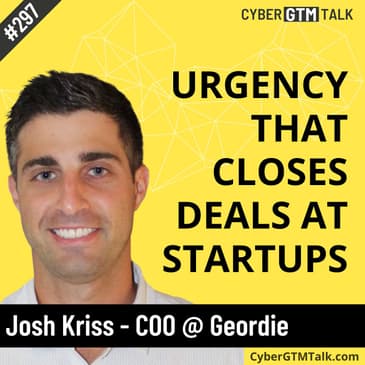
Are you finding it hard to build a united sales culture as your cybersecurity startup scales? Struggling to keep urgency and momentum going in long, complex enterprise deals? Wondering how top teams navigate hiring, collaboration, and multi-threaded sales cycles, especially as new technologies and markets emerge? This episode of the Cybersecurity Go-To-Market Podcast delivers actionable insights to help sales and marketing leaders create stronger, more effective teams while driving revenue growth.
In this conversation we discuss:
👉 Building and maintaining a “one team” culture from early-stage startup to rapid scale
👉 Effective hiring and team formation for high-performance cybersecurity sales organizations
👉 How to create urgency, maintain momentum, and drive next steps, especially during drawn-out enterprise sales cycles
About our guest
Josh Kriss is an experienced cybersecurity sales leader, now helping shape go-to-market strategy and culture at Geordie, a fast-growing AI security startup. With a track record at Darktrace and hands-on experience scaling from founding team to rapid growth, Josh brings practical advice for building high-performing teams that sell complex technology into demanding enterprises.
Summary
If you’re looking for hands-on strategies to elevate your team’s culture, drive collaboration, and overcome sales inertia, this episode is for you. Learn how to hire for “one team” mindset, spot hidden deal blockers, and apply leadership lessons from fast-growing cybersecurity innovators. Listen now for powerful tips you can put into practice right away!
Connect & resources:
The Cyber Go-To-Market Talk is the show for cybersecurity sales leaders, founders, CROs, and go-to-market operators looking to improve cyber sales performance and build more predictable revenue growth. Hosted by Andrew Monaghan, founder of Unstoppable.do, covering cyber sales leadership, revenue leadership, sales onboarding, forecasting, pipeline generation, and cybersecurity go-to-market execution.
Follow me on LinkedIn for regular posts about growing your cybersecurity startup
Want to grow your revenue faster? Check out my cybersecurity sales consulting and training
Need ideas about how to grow your pipeline? Sign up for my newsletter.
Andrew Monaghan:
Josh, welcome to the podcast.
Josh Kriss:
Andrew, thrilled thrilled to, to be here. Thank you for having me today. How's it going?
Andrew Monaghan:
You know, going well. And that's— I'm recording this on February 11th, 2026. I'm here in Colorado. It feels like summer right now. You guys are getting pounded on the East Coast with snow and ice and Armageddons. And we're sitting here going, is this summer or what's going on? It's a weird time of the year over here.
Josh Kriss:
Yeah, it's— I feel like this is the first winter in a while where it's better to go up to Vermont to get a ski day in than it is to go you to, know, Colorado or Utah or Wyoming. So it's been an interesting winter, to say the least.
Andrew Monaghan:
Yeah, no kidding. Well, listen, we're joining you at Geordie at a special moment because I see that you guys are one of the 10 finalists in the RSA Innovation Sandbox competition.
Josh Kriss:
Yes, we announced that yesterday. Super, super excited. It's an exciting time to be at Geordie. We started the company, what, back in April, came out of stealth in September, and working to solve the problem around the GenTech security and governance. And it's a hot market right now. So thrilled to be going to RSA in March and presenting as one of the 10 finalists. Hopefully come end of that day, we'll we'll be, be standing on top of the podium.
Andrew Monaghan:
Well, I think even being in the top 10 finalists is a big deal I because, mean, literally hundreds of people go through the process. So that's a heck of an achievement. And congrats to the whole team on that. You know what I'm interested about, Josh, is what's the process internally to all come together to submit that? Because it's not an easy submission, right?
Josh Kriss:
Yeah, it was was a, it a long process. Henry Comfort, who's our CEO, he posted about it yesterday on LinkedIn and it was actually Dave Palmer, who is one of our main investors on our board, who had said to us right when we started the company, hey, are you guys going to go and apply for RSA Sandbox? And that's really when the process started, so about 10 months ago at this point. And then was just know, a, you a team effort between Henry, our CEO, our head of marketing Juliette, our chief AI officer Hannah, myself, both on the written side, so there's a long written application, and then there's also a 3-minute video. And that 3-minute video is one of the main criteria that the judges go off of. So we spent a lot of time on that, just perfecting the messaging and, you know, really making sure we were putting our best foot forward. And clearly we did. So we're excited to be named one of the finalists.
Andrew Monaghan:
Well, that's great. Congratulations on that. Let me rewind a few months with you on a similar theme though. When you first walked in the door at Geordie, I think it was last summer or before last summer, spring. What did you notice about how the teams were working well together or not working well together? You know, take the submission for the sandbox as one example. What did you see that was happening? Not what you've heard about that was you also, know, sunshine and roses as part of the process before you joined. But what do you actually see when you walked in the door?
Josh Kriss:
Yeah, it's a great question. So we were small. I joined, we were about 10 people at that point, and I had worked with Henry and Hannah, 2 of the 3 co-founders at Darktrace prior to coming over to Geordie. So we're familiar with working with them and knew them quite well. And 2 biggest things when I joined, one was the collaboration on the sales side with the engineering team. And just the customer-first mentality of every conversation that was had. No one was above being on the phone, speaking with CISOs, speaking with AI leads to really understand their day-to-day and what they were struggling with most. So just that customer centricity and collaboration across the org was huge.
Josh Kriss:
And then second, when I was looking for my next role going to a smaller company that really understood the importance of a go-to-market motion. And I think there's so many great companies out there, and some lean a bit more tech, some lean a bit more sales. And I think there's a really nice balance that we found where technology is what's driving— customers is what's driving our technology in terms of the feedback that's being provided and the conversations that are being had there. But we understand the importance of having a good go-to-market motion and being able to scale that quickly and being able to build the correct processes in place. And if we get off a customer call and it's clear to push a deal over the line, we need to execute on X, that gets back to Benji and our technical team. And, you know, if it's it's a, if a long night, so be it, we get it over the line and get it in the customer's hands. So those two things stood out right from the front and For me, Darktrace was such an incredible experience, leaving when we were about 3,000 employees and now joining an organization that is so agile and just every day is a different story and a different challenge has been incredibly rewarding and exciting. So enjoying the grind of building a company right now, that's for sure.
Andrew Monaghan:
Well, I feel that a company that small, you're in control of the culture, right? There's not suddenly 2 or 3 layers of management and people you don't know the names of and things like that, right? You're small enough to have that luxury. But as you grow bigger, it becomes a challenge. I'm wondering what you learned from Darktrace about how to think about culture as you scale that you're going to bring to Geordie as you guys grow this year.
Josh Kriss:
Yeah, it's easy to keep a strong culture right now, to your point, a lot harder as you grow to, you know, 30 and 100 and 300 and keep moving. I think it starts with the hiring process. And, you know, as I think back to my days at Darktrace when, when I was managing our Northeast team, I mean, we had to hire 30 AEs in a month period. There were some pretty crazy targets from a hiring perspective. And obviously there's an individual aspect of every interview, and you want to understand past performance and initiative and motivations. But I think there's also a team element in an interview process. And every interview I hold, whether it's an AE or, you know, helping with SE hiring or channel hiring, I'll ask the question about an account conflict. How have you managed a situation where the CRM or territories were a bit unclear? And is it Josh's account or is it Andrew's account? And I think the answers there really speak to how people work with their colleagues and how people put the team first versus just their agenda of understandably wanting to make as much money as possible and close as many deals as possible.
Josh Kriss:
So I'll you really, know, pull on that thread for a bit and understand and ensure that there is an individual fit, but also a team fit and someone that will come in and do what's best for the group, not just themselves. Uh, and if we can get that right in the hiring process— and look, not saying we've gone 100% on that, you know, mistakes are made— but by spending a few minutes in each interview to really lean into that, we've been able to generally hire, you know, team players who want to work together and buy into a group culture versus an individual culture. And that just makes life more fun for leaders and you know, the, the AEs on the team that are grinding towards the number every day. So yeah, we always think it starts there.
Andrew Monaghan:
What's a, what's a red flag answer to that question where you started digging in a little bit more?
Josh Kriss:
Yeah, that's a good one. I think, um, a lot of people will answer that question talking about how they approached it, how they spoke to their manager, how they spoke with sales ops, but you never hear about the other person? Like, what was the conversation like with Josh going to Andrew? Um, so if it's an III and an escalation versus, hey, you know, the answer I want to see there is, yep, happens. Uh, got on the phone with Andrew, we spoke through it, uh, got it resolved. And, you know, on this one it went to him, and I know I'll get the next one. And that's how I generally handle these situations. No need to get any others involved besides ourselves. That's what I want to see in that answer. We don't need to go to leaders with smaller issues like, is an account mine or his or hers?
Andrew Monaghan:
What else do you look for when you're hiring reps then this early?
Josh Kriss:
Yeah. So I think like right now what I'm considering versus what I considered at Darktrace, which at that point was a bit more established, is quite different. As I think about our hiring profile right now, The entrepreneurial aspect is huge. It's tough to find the balance. We are focused mostly on larger enterprises right now. So we're looking for an enterprise rep who's sold 7-figure deals, but also a person who's willing to pick up the phone and start cold calling again. And that's a tough balance for multiple reasons. So really trying to find someone and speak with people who can speak about their experience from a smaller team into maybe, you know, a bit of a larger organization and a larger team in the early days where they've picked up the phone and they've run prospecting sequences.
Josh Kriss:
I also always ask in interviews right now, like, you know, what do you think should be the expectation of how many self-prospected meetings you book per week? And what should that look like versus we're We're going to hire BDRs. What should the BDRs be bringing you? And just you seeing, know, their critical thinking about how they manage that answer, which I think it's fine to say, hey, I'm going to work with my BDR, but I also realize I need to book my 2, 3 meetings per week as much as I can versus just relying on other inbound sources, BDR sources that more you get, know, handed to me to then execute on. So that's, that's always a fun one to throw out there and see how people take it.
Andrew Monaghan:
Yeah, I always feel like you want to be in control of your own destiny. And any answer that, you know, if I'm running a territory and when I was running territories back in the day, I would assume nothing comes from anywhere except for myself. Right. And anything else is gravy. That's awesome. Right. And it's interesting seeing some people's answers to that. And, you know, maybe different times.
Andrew Monaghan:
Right. But I know it's much more difficult now to get those first meetings booked. Right. So thinking about maybe that's an area, but a team side as well is that, you know, it takes a village sometimes, not just completely cold calls, completely.
Josh Kriss:
And I think too, like, that's where stories just are so meaningful in the interview process. I mean, it's one thing to speak to, yeah, I can book meetings, but hearing a time over the last year you where, know, someone's managed a difficult cold call, hearing about how they've in their career mentored a BDR— I think for us right now, you know, it's important that we have AEs that want to work closely with BDRs and really look at that as a partnership. And when we think about team culture a bit, Andrew, for me, like, that's not just the AE. That's what is the ecosystem, to your point of everyone needing to contribute, that's driving towards the number. So if we're talking about team calls, if we're talking about, you know, uh, QBRs at the end of quarters and the end of years, I've never held those with just the AEs. It's, it's the AEs, it's bringing in the sales engineers, it's bringing in the channel team that has contributed to getting to the number, it's bringing in the BDR team. And I think so much of the time, like, AEs are the ones that are celebrated the most. They're the ones that are most represented at President's Club.
Josh Kriss:
But motivation is just as important for the surrounding ecosystem that's supporting the AEs to get to the number. So a bit easier now for me, right now, you know, when we, when we have one SE and myself leading a lot of the sales. But as I think about what we achieved at Darktrace, it was always just bringing all groups together in those meaningful moments to, you know, be one team versus we have the AE, we have the SE, we have the BDR.
Andrew Monaghan:
Yeah, you know, essentially I was thinking as you're talking there back, uh, I've seen in the past, definitely see some bad behavior, sales leaders or whoever it might be kind of being lone wolves and doing things their way, right? But you'll see a lot of people just trying to do the right thing and not realizing that it's not really helping out, whatever that might be. I'm wondering if you can think of any examples where you've seen people try to do the right thing, but it just wasn't that productive in trying to get that one team working together.
Josh Kriss:
Yeah, it's a good question. My Darktrace career, it was spread across Chicago initially, then was down in Austin, then was, was back in New York. And when I moved down to Austin, took over a team of about 15 people, quite small team at that point for what most sales territories were with, with Darktrace. And there were some great enterprise reps, but they were running incredibly singular in their day-to-day, um, were really not comfortable leaning on SEs, leaning on even, you know, subject matter experts and the executive support that Darktrace offered, um, and were kind of that lone wolf going at it to get the deal done.
Andrew Monaghan:
And why was it like that? Were they nervous? Were they a little bit insecure about it?
Josh Kriss:
No, I I think, think they were from their view, they were hitting their number, they were seeing results. But when we analyzed their deals, most were single product, most were a bit below our average ACV. But from their perspective, to your question, you know, they were doing the job well, they were achieving the number, they were making good money from it. But when we took a step back and really just talked about, okay, so, you know, and I'll always try when I'm coaching, like, let's use a deal. Let's, let's use a specific example. So this was years ago at this point, but like in that situation, it was, okay, we've, we've had this deal. It was single platform. It was below our ACV.
Josh Kriss:
Why? Like, was that really the only opportunity on the table? And it was clear that the answer was no. There could have been a lot more to that. But when you're working with, you know, a larger enterprise, if you're you only, know, yourself and an SE in every call, you're not gonna get multi-platform, you're not gonna touch multiple teams, it's gonna be quite single-threaded in execution. So just trying to reason through deals to then coach someone through, hey, this is why I'm thinking let's take more of a team approach and you're going to make more money because of it. You're, you know, your average ACV is going to triple, uh, so everyone's going to be happy. So, and I get why you weren't seeing that way, because if we looked at are you successful or not right now, we, we would say yes to that question. Um, let's think a bit broader than that. So yeah, definitely Austin the most stuck out with a few situations where that, that was quite relevant.
Andrew Monaghan:
Yeah, and that's a tough conversation, right? You got someone who You know, they're doing the job, right? They're hitting the numbers. Like, you know, the, the ultimate and, you know, the top 10 ways to measure a salesperson all involve revenue and performance against quota, right? And then the numbers, like, dude, leave me alone.
Josh Kriss:
Yeah, I get it. And I mean, you know, you're money motivated, you're liking what's coming in, and, uh, I think it's then easy to forget, okay, well, we never cap plan, which I think is always the way to go with hungry sellers. I mean, I I would never personally work for an organization that did not, that did cap plan. But if you're, you know, achieving 110 and making good money, it's easy to think, hey, this is awesome. But you're missing out on, let's get 160, let's get 170, let's keep pushing it. So yeah, we took two people there specifically and we're really able to just, you know, put the, put our foot on the gas and accelerate their success and their earnings, which was, uh, which is great to see.
Andrew Monaghan:
Yeah, no doubt. One of the top questions I get asked or top problem areas I get asked about with my clients and also just talking with people like yourselves is around momentum, urgency, the classic thing of we felt like we were getting something going with with these companies. We had a good first or second meeting and then things start slowing down. It's like, they miss calls and it's not quite such a big deal. Or, you know, the two-week POV goes into a six-week POV. And is it really ever going to come out of it? Is there a deal at the end of it? It seems like people are struggling a lot right now with that momentum side. I'm wondering what your experience of that is.
Josh Kriss:
Yeah, that's a fun one. It's challenging. There's no way around it. And I think any sales role where you're working with large teams who have their processes and their priorities, it's hard to move quickly. There's no way around it. When I look at a proof of, a POV process, It really starts in those first few meetings. And I think detailed discovery early on in really trying to understand, like, okay, we have Jordy. What is the business outcome you're trying to drive through having this conversation? And, you know, if we get the answer, well, we're trying to roll out agents and drive more efficiency in that.
Josh Kriss:
Okay, great. But like, we need 3 levels deeper of that exact answer. So really trying to push on it and having a one-on-one with the person that seems to have taken most interest in, in you understanding, know, our solution and what challenges we will help them solve through the solution. So if we can do that really well early on,. And we can then get closer to the POC and say, hey, we have heard these 5 things. I always, for every deal cycle we'll run with a POC, we'll run a proof of concept kickoff call. So 30-minute call, uh, we'll make sure that the CISO, whoever that economic buyer within the security team is on that call, and will prepare something to recap. This is what we've heard.
Josh Kriss:
These are the main priorities. Let's confirm that. And once that's been confirmed, I will then walk through what for me has always been like a 3 or 4 workshop process with a goal for each one of those weekly workshops. And we'll say, you know, if we get to the end of these 3 or 4 workshops, we've hit XYZ. Let's start to think about how we move forward from here. And, you know, do I have your commitment that if we can deliver to your biggest points to achieve value in the business outcomes you're driving, we have the opportunity to move forward you within, know, a week or two of this POC process being completed? And I'm not really then getting into the legal specifics or the procurement specifics on that call, but if I can get that verbal confirmation, and then can recap everything in an email after that call, that kind of starts the mutual agreement that, hey, we're working towards a specific date and not, you know, an 8-week process with no ending point, an 8-month process with no ending point that goes on and on and is wasting everyone's time. So I think it's the initial discovery and then really having like a purposeful POC kickoff call to confirm what they said, confirm timeline, and then a detailed follow-up after is like the foundational steps of driving towards an urgency-based, momentum-based sales cycle.
Andrew Monaghan:
Going back to when you said 3 layers deep on the discovery, what's an example of the sort of thing you're trying to get to and understand?
Josh Kriss:
Yeah, so for us right now, it is, to my point, someone says, oh, we want to understand our agents better. Okay, what is current state? What do you currently have? How are you measuring that? How much time is that taking from a security perspective to get those answers? And where do you want that to be? So really like step by step going through current state to future state and what needs to happen to get there is generally how I'll run those conversations. And, you know, on the first meeting, like, that can be tough to really dig that deep. The trust hasn't been built, the relationship hasn't been built. But after that call, you know, I'll try to, as to my point earlier, side channel one or two people to dig in a bit more. And I feel generally in those follow-ups, you know, we'll get a bit more and then we'll circle back with the whole group to recap that in more detail.
Andrew Monaghan:
I feel like in your space, agentic AI, very hot area right right? Yeah. now, You know, the danger is, of course, everyone's feeling their way, wanting to learn. Well, how do we do this? Help, you know, educate us and all the rest of it. But you want to help out, but you're not going to survive by doing lots of education only. How do you kind of, you know, how do you separate the wheat from the chaff on that and really know what's serious and what's really just going to feel the wave for 9 months?
Josh Kriss:
Yeah, that's that's the, uh, the million-dollar question. Um, no, it's, it's been so— it's been fun, honestly, because Darktrace, like, known problem, network, email security, tons of examples of ransomware and phishing, and, and frankly, then easier to sell because the, the, the attacks have been there and there's something to protect against. To your point, agents are so early and, you know, we've seen since I joined, know, you a 60% or so uptick in our conversations of companies actually using agents in production now. So in an 8-month period, that has just skyrocketed. And I think we'll continue to see it skyrocket. I think for us in early conversations, there's two things that we're going to look out for to really qualify in or qualify out. One is, is the company using more than one Agentic platform? So if they're just using Copilot Studio, for example, great, but there's not going to be that much meat on the bone there. And that's quite rudimentary in terms of what's being done when it comes to agents.
Josh Kriss:
So we will try to dig to ensure there's a bit more widespread adoption. And then it's a great fit because these companies are now thinking about security. Or on the other side, we've seen a lot of companies that have said, hey, I simply can't let my team start to roll out agents without having visibility over them. And then there is urgency to get something in fast. So that is, you know, those are exciting accounts for us right now where you have a CIO saying, hey, or a CISO saying, hey, my developers, they're dying to use coding agents. Frankly, I think they probably are using coding agents outside of, you know, what's allowed right now. And we need to know what's going on. And, you know, we then see ourselves as a great fit.
Josh Kriss:
If someone's not falling in either of those buckets and it's more, yeah, we're using a lot of ChatGPT or to my point, Copilot Studio, probably just not, you know, mature enough at this point to really warrant a more sophisticated solution for like true agentic security. So, uh, that, that's coming out pretty quickly in, in conversations, and we then can shift from education to actually how do we add value here and, you know, become a no-brainer as a security partner.
Andrew Monaghan:
Yeah, yeah. Um, going back to the POV Yeah, process. yeah, I like the The way you teed that up with, with the EB or the process was, you know, the end of this, if, if things go well, you're basically asking for a soft commit, right? You're not asking for someone to sign something right there and then. What if they say no? How do you handle that?
Josh Kriss:
Yeah, that's that's a, a good question. I think it's then digging into the why behind the no. From my experience, The why behind the no is generally this is a competitive process where we are going to look at multiple vendors and you're the first or you're the second and we're required to do 3 or 4. I think the reality is in the enterprise space, you're not changing that. I've seen, there's been situations where I've dealt with reps who have tried to say, well, if We're the second, but we blow away the first and we're definitely the best solution. Like we can move forward, right? And the answer is 90% no, we're going to do this full evaluation for due diligence reasons. And then that's okay. And then I think it's outlining, okay, at the end of 6 weeks, we're gonna pull this out, like that will be the process.
Josh Kriss:
And then how do you generally best communicate and stay in touch with vendors as you are looking at other products. Ideally, if it's, you know, if cost allows for it, keeping the technology installed. So at Darktrace, for example, and like, you know, I plan to do the same at Jordi in competitive situations, if we can continue to have visibility into what's going on within an environment, well then weekly try to pull a risk report, try to pull some metrics just to keep us top of mind despite not having the weekly cadence that we had during the POV process. So that's when I generally get the no most. And then sometimes you just have someone and I will say, look, we're not there yet. We haven't thought about buying decisions. You know, we're purely in discovery phase right now. I think in those situations, you know, I think about one close to when I was leaving Darktrace, like that was the type of answer we got.
Josh Kriss:
And then it's how do we really even more than normal, like lean into building a champion and having a coach who can help us navigate that process because we don't want to piss off the economic buyer. We don't want to keep going back to them trying to ask the same you question, know, over and over again. So trying to build up other advocates so we can circle back to that conversation, I'll always try to, try to do. So yeah, ideal world, and I think if it's positioned correctly and there isn't competition involved or we're not at the beginning of a bake-off process, you know, you can control some of that narrative in terms of urgency and timeline. But there are times when that becomes a lot more challenging just based off what else they're looking at or a specific personality who doesn't want to engage in that kind of conversation.
Andrew Monaghan:
Yeah. And those responses are logical, reasonable responses. Good way for humans to engage with each other and ask good questions and learn and understand. One of the things I found, I don't know if you would agree with this or not, is sometimes the seller is really reluctant to have that conversation about if this goes well, right? Can we take the next step, whatever that might be, right? They've got some sort of reason why they just don't feel comfortable. They're maybe scared of the answer sometimes.
Josh Kriss:
I don't.
Andrew Monaghan:
Yeah.
Josh Kriss:
Know.
Andrew Monaghan:
What's your experience of that?
Josh Kriss:
I think back to my early days as an AE in Chicago with the Darktrace team, and I was terrified of these POV kickoff calls. I would not sleep the night before because I was so scared about the last part of the call where we were going to talk about, oh, a deal could happen here. So I think, I mean, it's so natural. Difficult conversations in all aspects of life are challenging. That I, I'm so grateful for some of my early mentors at Darktrace who just really coached me through having productive conversations there. The way I always like to think about it is, you know, I, I try to never have my team think of us as like the vendor and below the customer. Like, they're equals. We've built a solution to be grateful and prideful of.
Josh Kriss:
And we're in this room, we're having this conversation because we've earned the right to have this conversation. This isn't a first meeting anymore where I would never ask a question around, oh, can you buy in a month? But something's worked here. There are synergies. There's a business need we're working to follow or working to solve. And it's— yes, it's tactical and positioning, but I think with more junior reps, it's also just a confidence-building exercise of you can do this. Buyers are expecting this question. Like, they're, they're, yeah, you're gonna, you know, here and there get a stop, go away. That, that happens.
Josh Kriss:
But most of the time, that's not going to be the case. And, um, you know, they're going to have a conversation because they, you know, CISOs, they've gotten to this point in their career because they can work to timelines and they're disciplined in structure and have routines and it's important that as a seller, you understand those, those elements. So, um, I get it though. Like, I, I, the sleepless nights early on of, oh my God, I'm so scared to ask for the business. I'm so scared to set a timeline was, uh, it was very real.
Andrew Monaghan:
I think there's, there's two areas. That's one of them where people get a little bit, uh, um, scared or a bit nervous about. The other one is, is asking, I need the EB and the kickoff call. Having that whole conversation because, you know, it's a big ask for some companies, I guess. I don't know. And they get very nervous about that. You've seen the same thing as well?
Josh Kriss:
Yeah. I mean, it's super challenging. You're dealing with the busiest people who will, you know, they have people on their team they trust and they'll obviously give them work. I sometimes on a a first or second call if we have the EB on. We'll say, hey, you know, I get your team is going to take over this process. It's part of our process. Assuming things continue to go well, you know, we'll look to get this rolled out and we'll look to give you a run in using it. And we generally like to have a 30-minute call before then.
Josh Kriss:
Just to align. And I think it's important you're part of that call because I want to make sure that what I hear from your team over the next few weeks, I can confirm with you so that we're running towards the, the same goal as we work on this POC. So if I can work that into a first call, like it's something I can circle back to to try to get them then on that meeting. I also think it's why like early on in sales processes, especially with larger deals, if you can meet in person and just start to develop that one-on-one relationship, be able to text the person, like those are ways to then be able to get them on a call. But if it's, they showed up to the first call, there wasn't much engagement, you haven't spoken with them since, and then you're trying to get them on the kickoff call, to your point, pretty unlikely they're going to join out of left field. So, I think it's the pre-work that needs to be done to get them there.
Andrew Monaghan:
Yeah, I always use the you phrase, know, discovery is a process, not a one-time event, but I think also building trust is a process, not a one-time event as well, right? Every little interaction is a way to build or erode you trust, know, intentionally we should be building it.
Josh Kriss:
Completely, completely. And I think, You know, that first meeting, like first impressions go such a long way. How polished your deck is, showing up on time, like those things matter. People take note of them. So that's something like they seem like such, you know, non-negotiables, but I think the amount of sales processes they can be forgotten is high. So just keeping those things in mind.
Andrew Monaghan:
Yeah, I think that if I was a more junior seller right now, I think one of the things I would do is listen to the call recordings on Gong or whatever of the really experienced folks just to get a sense of their credibility, their gravitas they bring to these conversations. You know, a good rep doesn't waste questions. They show up and they get straight to the point. There's not a lot of dancing going around for 15 minutes to try and ask the key questions. I think it's maybe something if you're feeling a little bit nervous, you're feeling a bit junior, just trying to emulate that and see the big impact it can have on a conversation.
Josh Kriss:
Completely. No, couldn't agree more. And I think also it's excitement and passion in calls go such a long way. Like Henry, our CEO, he is the most passionate speaker. Like when he talks about Jordy, you just feel, and we've been on so many calls where You know, at the end of the call, it's, we love the product, but like, we also just so appreciate your passion and your excitement around what's been built here. And I think people take notice of that. And yes, passion and excitement alone in presentation isn't going to circumvent, you know, a crappy sales pitch and bad discovery, but it does go a long way in just getting someone else excited. And if you can get the other team excited, then hey, they're much more likely to continue to want to talk to you and have conversations.
Josh Kriss:
So definitely been on many sales calls where people show up and it's like, do they, do they want to be here? And if we're asking that question, well then the client definitely doesn't want to be here.
Andrew Monaghan:
Well, to call devil's advocate, I think it's easy if you're the founder to be passionate. I mean, my right? goodness, This is part of the deal. But a seller, you know, you're coming in, I don't know, maybe you're seller number 15 in the team. You joined because you knew someone, you liked the space a little bit, but you know, you're, you're probably faking a little bit of the excitement, you know, you're just, there's some things you like about it, but you're like, okay, well, I could have worked at 3 different places because I'm an experienced person who knows very well how the game works. So it's a little bit tougher, right? If, unless they're truly, truly into it to have that passion.
Josh Kriss:
Yeah, no, I, I, I see that, but I, I think Every first call, every client interaction, like, is an And, opportunity. you know, most sellers are money motivated. Every call is a way to get closer to that signature PO that then leads to the commission check hitting. And, uh, I you get, know, at the end of the day, you've already given 4 demos. It's really hard on that 5th to, like, bring the energy. But I, I think it's necessary. Like, if the energy isn't brought, if the excitement isn't brought, uh, it's hard for a, a potential customer to get excited. So very, very— a lot easier for a CEO or a founding team to have that excitement, but I think across the it's, board it's, it's important to.
Andrew Monaghan:
Bring— no, I get it. Um, let me ask you a different question. What's something counterintuitive that you've learned and seen about, uh, urgency or momentum in deals know, that, you you kind of— people think it might be the wrong thing to do, but in fact it actually is the right thing to do?
Josh Kriss:
Yeah, I um, you think, know, we talk a lot about like mutual close plans. So to, to my point earlier, after, uh, kickoff call, I'll get it in you writing, know, just a bit about the conversation, success criteria, what we're working towards. And then after each session, I will follow up with a recap of the session and try to align it to a timeline. And you then, know, maybe after the second POC session, we're starting to talk numbers, a bit about procurement. So that will be added into the mutual close plan. So it keeps building on itself. And, you know, if at that point you've gotten verbal commitment, as we get closer to the date we're trying to close by, I think it's really easy to get anxious, overexcited, and start to, you know, it's daily follow-ups, it's daily.
Andrew Monaghan:
Calls.
Josh Kriss:
It'S it's the, the balance of sticking to a close plan and frankly, like annoyance of a CISO and a champion who have confirmed that they're working towards it and don't want to hear from you, you know, 3 times a day, when is this deal going to be done? And I fell into that trap early on. Like, you know, I remember my like first few years as a seller, if I hadn't gotten a response on legal or I hadn't gotten a, you know, a response on something from the vendor onboarding side, like I would freak out and I would start calling and I would become an annoyance and then people pull back. And that's when the close plan that you beautifully work towards starts to get screwed up because people aren't working on the same team as you anymore. They're working on the opposite side because they're annoyed by how much you're reaching out. So I think the instinct is at times, go, go, go, follow up, follow up, follow up. And it requires stepping back and thinking, hey, place some trust in the conversations that have been had and the relationship that's been built. And they're working to get this done, and I'm going to believe in them versus bother them and result in us working on opposite sides. So that resonates with me just because it was so relevant in my career early on and took a lot of coaching to feel comfortable in letting go a bit and placing that trust in the customer.
Andrew Monaghan:
Yeah, I think, you know, for me, it took me quite a few years to learn that dynamic, right? People don't like to be chased. They feel like you put them in control by chasing them a lot, right? Because then they're ignoring you and taking control of it. you But, know, when you step back a little bit, it's always interesting to see what their reaction is when you step back. Do they step in and keep working or do they step back as well? So it's really a tough thing to learn. You know, it's like, you know, these— you've been selling for 2 or 3 years, your boss is on your back. know, You I've been in environments where you haven't called them 3 times a day, you're in trouble, right? You'd be told to get on the phone and chase them down and stuff like that. It's like, well, you know, I don't think that's a good idea. But you get leadership telling you it's the right thing to do.
Andrew Monaghan:
And that's a tough situation to be in.
Josh Kriss:
And I think to the point on leadership real quick, I mean, I think that that falls on the leader as well. Like, I think a fear-based culture where it's if this deal doesn't get done, you know, we're in trouble. If this deal doesn't get done, the team's going to fail. Like, that's never how I like to lead. It's more creating, to the point earlier around the team culture, it's a team number we're driving towards and, you know, we're all working to get there. Obviously, if it's continued lack of performance, there's performance conversations to be had. But if the leader is checking in daily on, is this deal going to get done? Is this deal going to get done? Is this deal going to get done? Well, what do you expect then to see from your reps in terms of how they're speaking with the customer? They'll feel that pressure. They'll feel that fear.
Josh Kriss:
And that's going to be reflected in how they go about it. So I think it's a leadership balance as well.
Andrew Monaghan:
Well, on that note, Josh, I really enjoyed the conversation. I'm looking forward to seeing you guys win the RSA Innovation Sandbox this year. This episode will go out before RSA, so I wish you all the best for that whole process.
Josh Kriss:
Andrew, appreciate it. Thank you. Thank you so much for having me. And, uh, as we like to say, up the Jordies. Have a good one.