
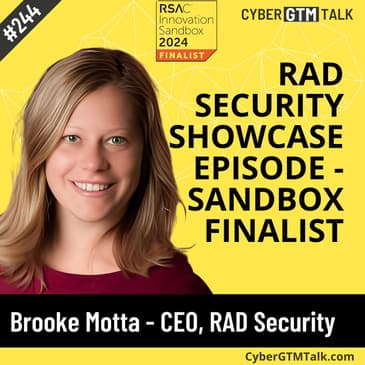
In this conversation, we discuss:
👉 Brooke’s adventurous start from lemonade stands to leading a cutting-edge cybersecurity firm.
👉 The unique approach RAD Security employs to identify security threats before they emerge.
👉 Plans for Rad Security's growth and expansion in the coming year.
About our guest:
Brooke Motta is the co-founder and CEO of RAD Security, a company recently recognized among the top ten at the 2024 RSA Conference Innovation Sandbox. She brings a robust mix of go-to-market strategy and deep cybersecurity expertise to the table.
- Brooke Motta's LinkedIn
- Rad Security Website
Follow me on LinkedIn for regular posts about growing your cybersecurity startup
Want to grow your revenue faster? Check out my consulting and training
Need ideas about how to grow your pipeline? Sign up for my newsletter.
[00:00:00] Hey, it's Andrew. Just quickly before we start this episode, I want to tell you about one of my
[00:00:03] favorite podcasts, the Secure Ventures podcast. The host Kyle McNulty interviews cybersecurity
[00:00:09] founders about what they are building. I enjoy it because Kyle focuses on their technology,
[00:00:14] what it solves, why they build it, where it fits in the market. Also listeners can understand
[00:00:19] the why of these startups. In some ways is a great compliment to my own podcast where I
[00:00:23] focus on the go-to-market side, not the technology side. He set some great guests on
[00:00:27] recently. For example, the CEO of Reality Defender when they talked about the ins and
[00:00:32] outs of deep fate detection. He's had the co-founder and CEO of Go Security and also
[00:00:37] the co-founder radical Chris Peterson who was incidentally a founder of LogRhythm.
[00:00:42] They talk about the role of AI in the sock. This is not a paid promotion. I just simply
[00:00:46] enjoy what Kyle is doing with his interviews and get a lot out of them. Check it out. It's
[00:00:51] Secure Ventures podcast. Now on with this episode.
[00:01:04] Welcome to the Cybersecurity Go-To-Market podcast for a special showcase episode where
[00:01:10] we are talking to leaders of the companies selected for the 2024 RSA Conference Innovation
[00:01:16] Sandbox. These are the very, very few, in fact only 10 companies out of the hundreds,
[00:01:22] not over a thousand that applied that the judges have selected as the most innovative
[00:01:27] startups in cybersecurity today. I am your host, Andrew Monahan and today we're talking with
[00:01:32] Brooke Motta, the co-founder and CEO at RadSecurity. Brooke, welcome to the podcast.
[00:01:38] Thank you so much. Thanks for having me, Andrew.
[00:01:40] I'm looking forward to our discussion here, Brooke. It's the second time for you and the
[00:01:44] company, you and your co-founders, which are actually recording this two weeks before RSA.
[00:01:49] We're getting done to the last few days before we're all going to be there in San Francisco
[00:01:53] and we want to learn more about what Rad is up to. Let's learn a little bit more about you
[00:01:58] first. How did you first make money as a kid, Brooke?
[00:02:04] You threw allowance but also I lived directly across the street from a swimming pond where
[00:02:10] people would come every day in the summer in Massachusetts. I had the traditional lemonade
[00:02:17] stand, so nothing too wild and too crazy. But at the time I thought it was the craziest thing
[00:02:23] because no one else did it and it was a great spot to do it.
[00:02:27] Well, you must be one of the few people that actually made money with a lemonade stand.
[00:02:31] I did just have people coming and going from the swimming pond.
[00:02:36] Location, location, location when it comes to retail, right?
[00:02:39] All right, next question is what's an embarrassing or funny moment in your
[00:02:43] sales or startup career? I just feel like I'm always
[00:02:47] embarrassing, at least to my 13-year-old daughter. I'm the most embarrassing person
[00:02:51] alive. But one time when I worked at Bug Crowd, I was about to go on stage for a presentation
[00:02:58] and two minutes before going on stage, I changed an image in my deck and it was
[00:03:06] picture of King Kong but he was holding paraphernalia and they shouldn't have put
[00:03:12] that picture in a presentation and I didn't even know it until I was on stage presenting it.
[00:03:17] And so that's why embarrassing is so funny. Did you just look at the image and take a double
[00:03:21] take and go, what the heck is that? Oh yeah, a woman named Peyton who I
[00:03:25] worked with was sitting in the front row and she's mortified. So yeah,
[00:03:29] don't change your images two seconds before walking on stage.
[00:03:32] Oh, love it. All right, final question. What is the story behind you getting your first
[00:03:37] job in cybersecurity? So my first job in cybersecurity was at a company called Rapid
[00:03:42] Seven, which is based in Boston where I'm from. I actually applied off of Craigslist
[00:03:50] ad because that was a legitimate way to get a job back in those days.
[00:03:55] So I was one of the first employees at Rapid Seven where I worked for 10 years. But yeah,
[00:04:02] I applied off of Craigslist. So it was a really interesting opportunity and really exciting place
[00:04:10] to be. I was on Newbury Street in Boston so if anybody's ever been there, it's the best
[00:04:15] shopping area in downtown Boston. So every 20 something year old girl dreamed of working
[00:04:22] around there. So it was great. Yeah. Where in the world did you have your
[00:04:26] first sandbox, Brooke? So I'm from Massachusetts originally. And if you mean where did I grow up,
[00:04:35] I can explain that. So I grew up in a really small town called Lakeville, Massachusetts.
[00:04:40] We didn't even have stoplights, I don't think when I grew up. There was a local barber named
[00:04:45] Fred who cut everyone's hair. Same guy. We didn't have a grocery store. The only place
[00:04:50] to buy food was at Savas Plaza, which my friend Katie Savas, her family owned. And that's where
[00:04:56] you'd buy milk or eggs or something you needed urgently. But it was a really lovely way to
[00:05:01] grow up in the woods where we could have adventures without cell phones. We'd ride
[00:05:08] bikes for hours until all hours when we had to come home. But yeah, that's sort of where I
[00:05:14] grew up. And then I moved to Boston as I got older since I really wanted that city life
[00:05:19] experience with accessibility. And I haven't left city life since then. What happened to your accent
[00:05:25] though? The Massachusetts accent. Oh, my accent. Oh, oh, I mean, I can go into it if you want me
[00:05:32] to and talk about getting wicked hammered and going to the packy. But I feel like that's not
[00:05:37] for the her viewers. Maybe we should edit that out. All right. What's the story, the fun story
[00:05:44] about the founding of Rad Security? Take us back to that moment in time when you and your
[00:05:48] co-founder said, you know, I think we might just start a company. So there are two sort of
[00:05:54] moments in time that serve as like the foundational moments of our of us starting
[00:06:00] this company. So the first is was actually created before my time. So Jimmy Mesta,
[00:06:05] my co-founder was working at a telecom in Denmark. And while there, he discovered an
[00:06:14] attack path through Kubernetes that had it been properly exploited would have shut down
[00:06:20] the entire country's 911 operations. So no one in the country would have been able to use
[00:06:26] their equivalent of 911. And so he said, gosh, there's probably a better way to
[00:06:32] solve for this problem than just having consultants like me coming on site and helping them
[00:06:37] to secure their Kubernetes infrastructure. And so he said, let's come up with an idea for a
[00:06:44] product. He then reached out to me soon after that aha moment had happened. And we joined
[00:06:52] forces with my sales and go to market background with his CISO background leadership and security
[00:07:00] background. And then we started the company. Very good. So that was the second moment of him
[00:07:05] making a phone call to me. We actually went on a hike in Flagstaff where he's from and
[00:07:10] talked about how we would run a company if we were to start a business, whether
[00:07:14] market readiness was there, where we would go to start. And so that's how we joined forces.
[00:07:20] So you're out of breath in the mountains outside of Flagstaff at whatever four or
[00:07:25] five thousand feet that is, right? Yeah, that's exactly what it was like. We have a picture of
[00:07:30] the exact moment too where we said, okay, let's do this. Let's start a company and leave
[00:07:35] corporate America in the sense of typical corporate America. Well, what's the problem
[00:07:40] you're looking to solve at RadSecurity and who cares about it inside the organizations
[00:07:45] you're selling to? Yeah, sure. So today in cloud security, the way that most vendors
[00:07:53] are identifying issues, for example, the XZ vulnerability that recently came out is to look
[00:08:00] at signatures and CVEs. That's the way we did it at Rapid7. That's the way it's always worked.
[00:08:05] And since then, we discovered what if we instead of just identifying signatures and looking
[00:08:12] for CVEs, we were fingerprinting an environment for known good behavior and then started to
[00:08:19] identify drift from known good behavior so that we could identify anomalous activity ahead of
[00:08:25] a signature being created or CVE. And so this unique approach has awarded us the
[00:08:33] finalist selection at RSA, but it's also helped us get some really nice customer attraction.
[00:08:39] And to fully answer your question, the people who are interested are detection and
[00:08:44] response teams, infrastructure security teams, cloud security teams, those sorts of people.
[00:08:50] I would imagine with the cloud being ephemeral changing all the time, people using it in
[00:08:56] different ways all the time, getting some sort of fingerprint must be quite difficult to do
[00:09:00] that you rely on, but it seems like you must have cracked a way to do it that is
[00:09:04] trustworthy. Yeah. So just long story short, we maintain a master fingerprint for
[00:09:12] applications in the environments that we scan and can help identify behavior that's in drift from
[00:09:24] those faster fingerprints as they evolve. Okay, very good. So what's the big goals for
[00:09:31] the company for 2024, Brooke? Yeah. So we are in process of raising at the moment. And so
[00:09:38] soon we will be announcing what's happening there and who are partners on that journey.
[00:09:47] We from there are going to be hiring some talented sales and marketing people,
[00:09:53] some product leadership, some researchers to help us identify zero days and those sorts of
[00:10:02] things. And so we're really excited to expand the team as we grow in 2024.
[00:10:08] Well, you got two exciting things happening then you got the innovation sandbox, which is one
[00:10:12] thing and then you get the chance to go and grow and try and create the dream that you
[00:10:17] and your co-founder be working on. Exactly right. And for the week of RSA,
[00:10:21] except for wild exuberant celebrations for winning the sandbox, what else you got planned
[00:10:26] for that week? Any events or parties or briefings, things like that?
[00:10:30] So on Sunday I'm doing a founder round table that is being organized by Leaf Dreisler.
[00:10:38] And we're going to be at B-Sides doing that. And then soon after we are co-sponsoring a dinner
[00:10:46] at Fang restaurant right next to Moscone. It's owned by Caleb Sema's wife. And so
[00:10:54] it's a restaurant that a lot of people in security really like and want to support.
[00:10:59] And so yeah, we're really excited about that dinner. So if you'd like an invite,
[00:11:03] you're welcome to join. And yeah, and then otherwise we'll be around. There's lots of
[00:11:08] different parties that we're headed to. But yeah, that's a party that we're hosting on
[00:11:12] Sunday night. Awesome. That sounds like a lot of fun. Well, listen, I wish you every success
[00:11:17] and luck for the innovation sandbox itself and also for all the plans for the year as
[00:11:22] you get the next round in and go away and build the company. Thank you so much, Andrew. I
[00:11:27] appreciate it. It will mean a lot to me and to the continued growth of the show if you'd help
[00:11:44] get the word out. So how do you do that easily? There are two ways. Firstly, just simply send
[00:11:50] a link to a friend, send a link to the show, to this episode. You can email it, text it,
[00:11:56] Slack it, whatever works for you. And it's easy for you. The second way is to leave a super
[00:12:02] quick rating. And sometimes that can seem complicated. So I've made it as easy for you
[00:12:06] as I can. You simply have to go to rate this podcast.com slash cyber that's rate this podcast
[00:12:14] dot com slash cyber and explains exactly how to do it. Either of these ways will take you less
[00:12:20] than 30 seconds to do, and it will mean the world to me. So thank you.