
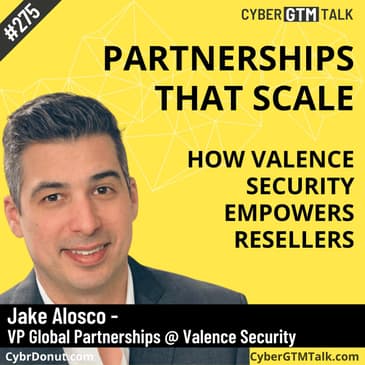
Are you struggling to build a high-velocity partner program that actually drives revenue? Wondering how to structure channel margins and opportunity registrations to attract—and keep—great cybersecurity resellers? Curious about how emerging technologies and evolving needs are shaping the next generation of vendor-reseller partnerships? This episode, recorded live at RSA Conference 2025, dives deep into these questions with actionable insights from a top industry leader.
In this conversation we discuss: 👉 How Valence Security has rapidly iterated its SaaS platform, focusing on remediation beyond just visibility
👉 Strategies for recruiting, enabling, and incentivizing top-tier security VAR partners in a crowded market
👉 Real-world feedback loops between product, partnerships, and sales to reduce friction and accelerate deals
About our guest
Jake Alosco is the VP of Global Partnerships at Valence Security, bringing nearly two decades of experience in channel sales, ecosystem building, and go-to-market strategy for cybersecurity vendors. Jake shares lessons from scaling Valence's partnership program and insights into what it takes to succeed with today’s partners.
Summary
Tune in to discover how Valence Security reimagines the reseller experience, advances its product based on partner feedback, and structures its GTM for win-win partnerships. Whether you’re running a partner program or trying to crack the channel code, this episode is a practical guide to amplifying your cybersecurity sales. Don’t miss these expert strategies—listen now!
Connect & Learn More:
The Cyber Go-To-Market Talk is the show for cybersecurity sales leaders, founders, CROs, and go-to-market operators looking to improve cyber sales performance and build more predictable revenue growth. Hosted by Andrew Monaghan, founder of Unstoppable.do, covering cyber sales leadership, revenue leadership, sales onboarding, forecasting, pipeline generation, and cybersecurity go-to-market execution.
Follow me on LinkedIn for regular posts about growing your cybersecurity startup
Want to grow your revenue faster? Check out my cybersecurity sales consulting and training
Need ideas about how to grow your pipeline? Sign up for my newsletter.
[00:00:00] Hey, it's Andrew here. Just quickly before we start the episode, I want to tell you about one of my favorite newsletters. It's called Strategy of Security. If you want to understand the companies, ideas and trends shaping cybersecurity and its submarkets, you should take a look. Cole Gromos runs the newsletter and he has spent the last 20 years in cybersecurity, including stints at PwC and Momentum Cyber, the investment bank dedicated to cybersecurity. Recent articles I'd like include,
[00:00:30] how could platformization work in cybersecurity where he talks about there being lots of single vendor platforms, but not a multi-estate platform. And also one called demystifying cybersecurity's public companies, where he explores the pure play ones and also hybrid companies which are in cyber. He lists all of them and then breaks down the numbers in all sorts of different ways. Now this is not a paid promotion. I just simply enjoy what Cole is publishing. Check it out at Strategy of Security.
[00:01:00] Strategy of Security.com. Now on with this episode.
[00:01:12] All right, welcome to another special edition of the Cybersecurity Go-To-Market Podcast being recorded at the 2025 RSA Conference in San Francisco. We are in the Marriott Atrium on Benzine, Florida. There's a whole bunch of meetings going on around us. And now what we're doing is we're talking to Jake Olosko, the VP of Global Partnerships at Valence Security. Jake, welcome to the podcast. Andrew, thanks so much for having me on. Really appreciate it.
[00:01:40] And you're the second person we've talked to someone from Valence. Two years ago when Valence was in one of the finalists of the RSA Innovation Sandbox, Yoni, your CEO and co-founder, talked to me for about half an hour about what you were going on in those days. I'm kind of keen. You know, you've been there now just over a year. What's changed in the last year or two since we chatted to Yoni? Just a lot of product advancement. I mean, obviously, the addition to myself and channels and how we're going about in our go-to-market structure.
[00:02:09] But I think the way that we've gone on the product side and just the level of depth that we've gone into on our SaaS platform has really gotten strong. We've added discovery functionality. We've added ITDR. We've added a whole lot of capability. So the platform that was in the sandbox two years ago is definitely not the same platform it is today. And I seem to remember Yoni being pretty adamant two years ago that remediation was the key, not just visibility. How are you progressing in remediation?
[00:02:38] It's so fun. Even the organizations that say, hey, we'll never auto-remediate are third call in saying, hey, can we press the easy button, please? So, yeah, it's definitely a great part of the platform. Yeah. You know, being in security for a while, you know, auto-blocking will send shivers up the spine of many, I would imagine, right? Absolutely. Absolutely.
[00:02:57] I think, you know, it's easy, though, when you have a million shared files that nobody's accessed in a couple of years to say, hey, we should probably revoke access and just trim down the amount of technical debt that we have out there. Well, you're the head of partnerships. Talk to me about the types of organizations that you partner with. Yeah, I think to me, you know, it really, as you're building channels from scratch, especially in an A-round organization, I really do genuinely kind of look towards revenue first, right?
[00:03:27] So partnering with the resale side, getting that built out in a smaller fashion is really crucial to my programs initially. So resale is your primary go-to-market on the partnership side. Is that right? Yeah. I mean, look, there's always going to be important technical relationships and alliances that have to get built out and manage services. But I kind of look at it in a way of we want to move quicker. And resale is that is that speed is that force multiplier that's going to move the needle.
[00:03:56] What makes an ideal resale partner for Valence? I mean, I think first and foremost, somebody that's going to lean into emerging technology. You know, I think there's a lot of great partners that are out there. And depending on the size of your business, they each might have a different impact to kind of how do you go to market? I think for us, it makes sense to keep a smaller program, but ultimately build out some quality in those relationships and make sure we're driving joint business together and trust as we're moving forward.
[00:04:25] Is it traditional cybersecurity partners, though? Oh, for sure. Yeah, we're very focused on security bars at the moment. And are you looking for a big, small regional? What's what's the sweet spot? You know, it's really kind of built down to, you know, a very small grouping, one to two nationals and a couple of regionals per region. Right. We want to make sure we've got the nice blend to cover off on all sizes of customers.
[00:04:51] But at the same time, you know, you again, you want to have that sweet spot of being able to send some opportunities over the fence to build out those relationships. So Justin White is the main salesperson, sales leader at a boutique security bar in Denver called Dersac. If Justin and Dersac wanted to do business surveillance and jump into your program, how is Justin going to make money? How is he going to go to market with you?
[00:05:19] What's he looking for to make this work? Yeah, I mean, you know, I think the nice news is like, Justin, come on down. You know, we want to work with folks, especially if they're reaching out and understand that SaaS is an important coverage area. So we're not limiting it to saying, hey, you know, we don't want to work with you. We certainly do. You know, I think what we're being is a little bit more reactive to those organizations that want to come forward and say, hey, this is important for us. The good news is we've structured it in a way that Justin's going to earn high margins.
[00:05:48] He's going to be able to have access to services. He's going to have access to an NFR platform and he's going to have access to our sellers who are all 100 percent channel. So let's talk about margin. How does he make money? Let's get specific. Yeah, I mean, without giving away the whole program, we are very high on partner registered opportunities. There's no tiered structure. So everybody's coming in at the same level. We do keep our partners whole year over year. And I think that's incredibly important.
[00:06:16] And then we have a very we have a very healthy margin for opportunities that we bring over to our partners. And for for deal reg, then how does that enhance the margin? Is it double it? Does it give me a triple? So, yeah, deal reg is we want it to be very healthy. I think, look, as you're coming in and building out some of these programs and you're early in market, you can't be early in market, have minimal opportunities and have small margins. Right.
[00:06:43] So I think the way that we kind of structured it is say, hey, we're going to help feed you. We're going to give you healthy margins and we're going to go really work hand in hand together. And is it come neutral to your reps so that there's no conflict there? It is. Yeah. So, you know, I think that's another area where we've been lucky enough and I've been lucky enough certainly to have founders that really see the vision of what we're building out and they're truly supportive of the structure. So, you know, they've made it very easy for us to work with the team and work with the reps. That's the thing of beauty, right? Like, you don't get that all the time.
[00:07:13] Well, I was going to ask. So, I mean, that's a that's a usually a massive question mark from finders like, holy, you mean I got to pay people double the part I gets paid? My reps get paid. You know, is everyone getting paid in this deal? How does it work? How did you navigate that conversation to help them see the real value here? You know, I think just some of the relationships we built early and getting them involved was really crucial to like helping drive the internal success. And, you know, quite honestly, they jumped on board pretty quick.
[00:07:42] So, you know, I think they were able to see that, hey, there's a lot of value here. We understand what the partner community is capable of bringing us into. Let's go expand on that and make sure that we're supporting it all the way through. What's one thing that partners have given you feedback on that says, look, this is a friction point. This is something you're lacking that you've either fixed or are looking to fix this year. We had a great partner that, you know, we're starting to build out some really interesting ITDR services and instant response in their instant response practice.
[00:08:11] And, you know, I immediately brought in our Yoni's counterpart and co-founder, Shalomi. And there are two things that they had asked for was, hey, we want to see some additional depth in Microsoft in your ability to cover there. And we want to see multi-tenancy in the platform. And, man, I love my founders. Like, Shalomi called me. That was like on a Friday. Shalomi called me the next Friday and said, hey, remember that multi-tenancy thing we talked about? I said, yeah. And he goes, I built it.
[00:08:41] I said, it's been a week. What do you mean you built it? And it was done. He had just built it. So I think they're taking the critical feedback from the partners and they're then implementing it into some of the product. And even on the Microsoft front, the next week we had an immediate customer request for the exact same thing. And it was already built out. So our partners were able to kind of help us guide some of the product structure. What was the use case that drove the need for multi-tenancy then? I'm trying to think that through from the partner side. Yeah.
[00:09:06] So as we build those services aspects and they go out into their partner environment or into their customer environments, we really, they want to be able to say, okay, we've got separation in those additional environments so that we can go out and test and make sure that those tests and critical findings aren't kind of overlapping or anybody else can see them. And so, you know, multi-tenancy as we start to build out our MSS practice is going to be really crucial to get down into, you know, get down market a little bit more.
[00:09:33] Now, when you think about the sellers, the reps at the partners, that's where the magic happens or doesn't happen, right? What are you doing to, I guess, enable them to come up to speed, but also make sure they're fairly representing what you do and what you don't do? Yeah. Look, I think, you know, it's always hard when it's early and especially in a market that's kind of up and coming, you know? So one of the few things I say, I always tell my reps, hey, first off, be cool, right?
[00:10:01] Like, we want to make sure you're out building relationships and you're not in a position where you're just calling up people asking for deals. Like, we show up with purpose. And I think that's one of the biggest things to me is making sure that we've got learning by opportunity. You can do all the enablement sessions in the world and some of them stick and they certainly bring up opportunity from time to time. But the best way of learning is by doing, right?
[00:10:25] And so I like that hand in, you know, real life examples and real deals to be able to go out and actually kind of execute some of that learning. So talking about real examples, real deals, what is like an average order size and therefore, you know, margin wise, what's a rep going to make on it? Yeah, look, it depends on the opportunity, but we certainly have, you know, opportunities today that are, you know, mid to high six figures. We have some of those smaller kind of mid-market deals that are going to be, you know, sub 50K.
[00:10:54] But the reality is, you know, there's a pretty good opportunity to make, you know, $10,000, $25,000 in GP on a valence opportunity. And the relationship between the valence rep and the partner, how much work are you expecting the partners to take on and how much are you expecting the valence reps to run? I think it kind of depends on the deal, right? So, you know, not every deal is built the same and not every opportunity is built the same. So, and I think there's some partners that want to be more hands-on and, you know, that's always fine.
[00:11:23] I think when it's this early, it's typically very valence-led. And, you know, as we start to get into, you know, more deals together, I don't think this is a challenging enough product that it can't be sold without a valence seller at some point. But we want to make sure that they, you know, know all the nuances as they go into it. So I think, you know, it's up front is pretty valence-heavy today. That'll change as we go forward.
[00:11:48] Does that mean that right now there's no real expectation of the partner reps to be certified or something like that in valence, but maybe in the future it might? Yeah, I don't do a lot of certification programs. If I do, I'd rather have that on an engineering side. And I think that that's really important for them to dig deep into the solution and really understand, you know, how to operate the technology, how to demo it, how to dive a little deeper. You know, for the sellers, I think like my talk track versus what my sales team's talk track is much different, right?
[00:12:17] I want to make it so that it's easy enough to understand and easy enough to replicate the conversation and gain some interest from a customer. So we're usually going a little lighter on those combos. Okay. And then give us an idea about the valence sales team that the partner rep will be working with. How big is it? Where are they located? Yeah. So we have sellers all over the states. We have a smaller team, probably about six folks as we come in into January here.
[00:12:43] But the reality is like they're all insanely partner friendly and we've got folks in each of the major geos. Okay. So look for the local valence rep first or come to you first and then go from there. I'll take it either way, right? We want to have those conversations and we're really excited to just kind of get out there and meet, you know, our partner sellers and start to get some good opportunities brewing together. So ease of doing business is always a big factor in all this.
[00:13:10] Any specific examples where you put things in place to take away friction or avoid friction? I try to do my best job of avoiding friction at all times. I think, you know, one of the things I've learned over the last almost, you know, 15, 20 years of doing this is be easy to work with, let folks trust you, build trust and relationships and have opportunities. So I think one of the things that we've made it really easy to do is come in, register an opportunity, engage the team, start working a deal together. There's no major hurdles you have to jump through.
[00:13:40] Even our partner paperwork is pretty simple. We want to go out and just do easy business and start, you know, start having folks make some money by selling our products. What's the usual turnaround on accepting a partner registration? Oh, it's quick. 24 hours. I mean, you know, for the partners we have, we've got really good depth in relationship. So it's usually a, hey, by the way, I just submitted a reg or you get a text. And the next thing you know, it's like, yeah, it's approved. Like, let's let's go have a conversation. I like that size of interaction. It's fun.
[00:14:07] So you're looking to expand the partner or are you looking to go deeper with the existing partners right now? We actively bringing in some new partners. So based on deals? Yeah. And then going deeper in the relationships we have. So, I mean, I am full on for the U.S. market. I am not in recruit. You know, I think we'll recruit a little bit in Canada. I'll recruit a little bit in other parts of the globe as we start to get to those regions.
[00:14:31] But the reality is, I think, you know, today we're reactive in bringing on some net new folks and then, you know, open to some ideas on how we do things like managed services and alliances to go kind of build out those practices. Do you predominantly North America then? Correct. Any plans for EMEA, APAC coming soon? That's up to the big guys, right? So I look forward to it and certainly a place where I've played a lot in the past. But, you know, we'll probably slow play that for North America.
[00:14:57] So a big topic right now, especially this week, is AI in general and security. But let's talk about AI in the partner world. Anything specific you're doing with AI to help enhance what you're doing inside your partner program with your reps, things like that that you're especially excited about? Not today, but I should be thinking about it more. It comes up so often. And outside of just using ChatGPT to help make my email sound more professional, I think we've probably got to do a little bit more to lean in there.
[00:15:26] Now, the product is using some AI functionality. And, you know, again, maybe it's a good time to bring Yoni back at some point for another revisit on the solution. But, you know, from a selling standpoint, I probably got to dig a little deeper there. Well, Jake, thanks so much for joining us. I hope you have a good week and a good rest of the year. Hey, Andrew, thanks for having me on and really excited to be here. And it's been a great RSA so far. We are back with Visionary or Smoking Crack. Introduce yourself.
[00:15:55] Hi, I'm Hyg Coulter. I'm the Director of Technical Alliances at ThreatQuotient. All right, Hyg. So I'm going to throw out some bold predictions here about the future of sales and cybersecurity sales. You tell me, am I a deep-thinking, insightful visionary? Or did I inhale a little bit too deeply walking through the tenderloin this morning on the way to the conference? Are you ready to go? I'm ready. First one.
[00:16:16] By 2030, 80% of cybersecurity purchases under $100K will happen without a human seller or a human buyer. Just AI agents buying and selling. Is that visionary or is that Smoking Crack? You have been behind somebody leaving a massive vapor trail of crack. That is not going to happen. Tell me why. I can understand a human being making a software purchase without engaging with a sales rep.
[00:16:43] I can't imagine an organization granting access to an AI agent to make purchasing decisions on the company's behalf. All right, I like that. All right, next one. Number two. In five years' time, more CISOs will report to the CFO than report to the CIO or CEO. And sales will shift to be a finance first and security second discussion. Is that visionary or is it Smoking Crack? I think that's pretty visionary. I can see that.
[00:17:11] I think there are real costs to protecting the infrastructure. And I can see how a information security officer would roll up to a CFO for those reasons. Third one. In 10 years' time, both the RSA conference and Black Hat will be dead, completely gone. Is that visionary or is that Smoking Crack? There will be change. I think it's somewhere between the two of them.
[00:17:39] We're already seeing the change where several organizations are opting not to have a presence on the show floor, but have a presence in the immediate vicinity to capitalize on the fact that everyone is collectively in the same place. But something has to change. The sort of expo floor cacophony is not sustainable or of interest, I think. So I think there will be some change over the next 10 years for sure. Good. All right. Last one for you.
[00:18:09] Recently, Google announced they were acquiring Wiz and some people in the industry called the combo G-Wiz. So within 12 months, the OT security company that's called Insane Cyber will buy this other security company in the OT called Sanctuary. And the combined company will be renamed to Insane Asylum. Is that visionary or is that Smoking Crack? I think that is a fantastic joke, but you're Smoking Crack. All right, Hyke. Thanks for joining us. My pleasure.
[00:18:48] It would mean a lot to me and to the continued growth of the show if you'd help get the word at. So how do you do that easily? There are two ways. Firstly, just simply send a link to a friend. Send a link to the show, to this episode. You can email it, text it, Slack it, whatever works for you and is easy for you. The second way is to leave a super quick rating. And sometimes that can seem complicated. So I've made it as easy for you as I can.
[00:19:15] You simply have to go to ratethispodcast.com slash cyber. That's ratethispodcast.com slash cyber. And it explains exactly how to do it. Either of these ways will take you less than 30 seconds to do. And it will mean the world to me. So thank you.