
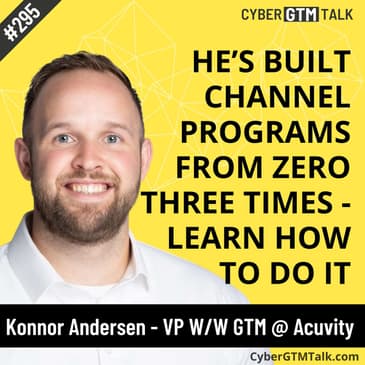
Are you struggling to build a channel sales program that actually produces meaningful revenue? Wondering why bigger isn't always better when choosing channel partners? Frustrated by the constant pressure to sign as many partners as possible, only to see limited results? This episode dives deep into the strategic and tactical mistakes cybersecurity startups make with channel go-to-market, and reveals how to build a scalable, effective partner ecosystem.
In this conversation we discuss:
- 👉 Why focusing on a few right-sized, ICP-aligned partners beats boiling the ocean with major national VARs
- 👉 How to design a lean, high-impact starter partner program, and the must-have elements for early success
- 👉 Common pitfalls: from partner economics to mindshare, and creative ways to drive mutual traction
About our guest:
This episode features Konnor Andersen, Vice President and Head of Global Go-To-Market at Acuvity, who has successfully built cybersecurity channel sales programs from scratch three times across network, email, identity, and AI security segments.
Summary:
Join Andrew Monaghan as he interviews Konnor Andersen to uncover actionable strategies for cybersecurity sales and marketing teams looking to accelerate their channel-driven growth. If you want practical advice, real-world examples, and creative tactics to boost your channel program, this episode is a must-listen!
Connect with our guest and resources:
The Cyber Go-To-Market Talk is the show for cybersecurity sales leaders, founders, CROs, and go-to-market operators looking to improve cyber sales performance and build more predictable revenue growth. Hosted by Andrew Monaghan, founder of Unstoppable.do, covering cyber sales leadership, revenue leadership, sales onboarding, forecasting, pipeline generation, and cybersecurity go-to-market execution.
Follow me on LinkedIn for regular posts about growing your cybersecurity startup
Want to grow your revenue faster? Check out my cybersecurity sales consulting and training
Need ideas about how to grow your pipeline? Sign up for my newsletter.
Andrew Monaghan:
The channel is such a big topic for cybersecurity go to market. There's lots of partners out there, different sizes, different specialities, and I think it's one of these areas that's often misunderstood, especially if you're coming in from outside of cyber and trying to make your way and try to build your company using both direct sales, but also the channel finders seem to get advice from all sorts of people, some of which you've got a ton of experience and up to date experience, and maybe some people whose experience goes back maybe a few years or a decade or two. So I thought, why not talk to someone who has built a cyber channel program from zero? He's done this three times. And in this episode, what we do is we talk about how to start, we talk about where to start, what to start with, really importantly, what not to do, what's going to really annoy whatever partners you want to work with. He gives examples of successes, he gives examples of mistakes. We're going to go through quite a bit in this episode. And my guest today is Konnor AndersEn, who is the vice president and head of Global Go to Market at ACUVITY. I'm Andrew Monaghan and this is the Cybersecurity Go to Market podcast where we tackle the question, how can cybersecurity companies grow sales faster? Well, Konnor, welcome to the podcast.
Konnor Andersen:
Thank you, thank you. Excited to be here.
Andrew Monaghan:
We've talked a couple times before, so I'm actually keen this time to have it recorded and have something for our kids to remember by Connor. How about that? I don't know.
Konnor Andersen:
That's right. Holds you accountable.
Andrew Monaghan:
It's funny, actually, just an aside. My daughter, she's 16, almost 17 now, and she's in the newspaper group at school, and she tells the kids that my dad has a podcast or whatever, right? And one of them goes, is that all he do? He just sits there and talks to people on a podcast? And she's like, no, no, no. He gets our stuff. And then she. Two years ago, irc, I did a cybertruck video where I cyber CROs in a Cybertruck. I drove 20 people around and we, we talked. And he goes. And I go, is that what he does is drive right in a truck talking to people?
Konnor Andersen:
Hey, you're famous now. Having a podcast is the, is the big thing these days.
Andrew Monaghan:
Famous for 10 people in junior school here in Colorado. Anyway, it's kind of funny. Well, here's what we're talking, Connor. Let me, let me kind of set the scene for everyone about a month ago you posted on LinkedIn and let me quickly read this side for people so they have the context and why I thought it was so worthwhile having this conversation. So it says what you posted was I've built a cyber channel sales program from 03 different times and there are only two steps. Step one, go find partners that focus on your ICP that have less than 40 sellers. And step two, ignore everything else. Don't boil the ocean.
Andrew Monaghan:
And you want to say if you're struggling to build a channel program, usually it's because you're trying to do everything and your steps work. If you're building the channel from zero as a founder, they work. If you're building channel in a new region as a leader and it works. If you're dropped into a brand new territory as an AE and you go on to say you want your partners to be big enough that you're investing good time and get meaningful revenue, but not too big that you struggle to get mind share and traction and spend tons of time with your wheels spinning the quote unquote right. Partners are going to be focused on your ideal customer profile and are the right size for you to be able to enable and empower. And then you finally say, I learned this lesson the hard way. I'm now building up a channel program from zero to from there. Zero up from there for the third time.
Andrew Monaghan:
So that was the post king. Let's, let's talk about why you, why you're able to say this. Which companies are you talking about that you're building these programs before?
Konnor Andersen:
Yeah, yeah. So the first one was darktrace, kind of on the, on the network and email security side. Then it jumped over to Zuri on the identity security side. And then now I'm at an AI security startup acuity focused on doing the same thing.
Andrew Monaghan:
All right, so the third time doing it from zero, you must see patterns now that other people might miss. If it is their first rodeo, you know it's not yours. What's the thing that you got completely wrong the first time that you were doing it that you're trying to avoid or you're looking at it for in month one this time, usually it's some.
Konnor Andersen:
Combination of either more is better or bigger is better. Right. Everyone always wants to go to the biggest national partners that have global scale and they have thousands of sellers and if you could just get paperwork with them, they'll take you everywhere. The challenge is, is really getting mind share and time and attention. Every cyber partner wants to go with the biggest vars and so I think that's kind of mistake number one. And then mistake number two is just trying to get paperwork with every single var that you can. And then you realize that you don't have the time to actually invest into those kind of channel partners to make sure that they can be successful. I'd rather have fewer partners that I'm actually deep with, that I'm an important part to their business like they are to mine, as opposed to paper with 50 or 100 different partners that maybe do something, maybe don't.
Konnor Andersen:
But makes you feel good when you report that, hey, we've signed up seven new partners this quarter or something like that.
Andrew Monaghan:
But look, most sales founders, maybe they're guided by their board. They actually want to do the opposite of what you're saying, right? They're thinking, you know, I have to get the big numbers this year. I'm not going to do it. That we think in their mind, with a couple of partners and in Ohio and Colorado, right? So they're thinking that the bigger, the better that gets scale. Scale means revenue. Why is that such a bad idea, though?
Konnor Andersen:
Because I think the difference is, like, the time and attention, right? You might have that partner in Ohio, right? And you can go on site in Ohio, and nobody else is going on site in Ohio. Everybody wants to go meet with the GuidePoint team in New York City or SHI in LA, right? They want to go to big markets, big, big partners and big scale. And so Everybody's going there. CrowdStrike's going there, Palo Alto's going there, Checkpoint's going there, right? Proofpoint is going there. Like, do you want to compete with those folks? Because then you're deciding if you're an email security company, which is where I started. It's like, okay, I can go sell proofpoint or I can sell smaller email security startup. And so it's like, eventually it gets down to the business level. Conversation.
Konnor Andersen:
I remember I learned this the hard way when I was at darktrace because I was coming from proofpoint. Proofpoint had an incredible channel on the email security side. And I was going to build darktrace's email business. And I remember hitting up channel partners that I had done tens of millions, hundreds of millions of dollars worth of business. And I was sitting down with them and I was like, hey, I thought darktrace's email product was better from, like a tech standpoint. And I was like, hey, of course you should sell us. Like, why would you sell proofpoint? And their whole logic was like, okay, cool, let's Say we sell Darktrace, Best case, what do you think we can do this year? And I was like, okay, let's shoot big. I was like, I bet we could do 40 or 50 million dollars this year.
Konnor Andersen:
One incredible. That would be incredible. And they sat down, they're like, okay, well we do a few hundred million dollars worth of proofpoint and have for the last decade. And so it's kind of like you're asking us to risk a few hundred million dollars business that's basically guaranteed to take a flyer on you that best case hits 50 and they're kind of like, tech decision aside, this is just a business decision. I can't risk this business for that. You wouldn't do it either. And so it kind of made me realize that like with the channel partners, yes, there's a tech conversation there. Totally agree.
Konnor Andersen:
But there's also a business conversation. And until you're ready to go fulfill with GuidePoint, CDW, Shi Optiv, those folks like, it's better for you to focus on that regional partner in Ohio that has a hundred really close relationships in Ohio that you can go and win and build market share and be in front of their sellers and have them know you and you know them and kind of really scale that way. And to be honest, it doesn't take very many of those. Right. If you can get four different regional partners, take the U.S. break it up into quadrants, you can have one in each quadrant that can each do 1 to 4 million, 1 to $5 million a year as an early startup. If you can get 4 to 20 million dollars out of a channel early on, that's usually good enough in security to get you the traction you need to kind of keep growing your business.
Andrew Monaghan:
I'm wondering if part of it to talk about the business side. Right. Is what we ourselves as a startup could actually invest properly in a given partner or you know, even reps inside the partner. It feels like if you go to a guide point, they're going to have expectations about what you're going to put into the program that you may or may not be able to match.
Konnor Andersen:
Yeah, there's usually two kind of investment or thresholds that, that you see. There's a lot of those big vars that have a minimum ARR requirement before they can even actively sell you. Everyone's going to differ. But there's a lot of them that's like, hey, if you're below 20 million in AR, we can't even put you on our bingo card. We can't even put you on Our line list to take you to our customers, you have to bring them deals. And usually as a startup, you go to the channel because you want them to bring you deals, not because you have so much pipeline that you just want to take to the channel. And so that is a limiting constraint for a lot of early startups. And then second is kind of the marketing requirement, right? MDF funds, market development funds that they basically expect you to co invest with them.
Konnor Andersen:
Right. This could be sponsoring happy hours, this could be joint events. But that's not like, oh, let's do a happy hour and it's a thousand bucks. Those are usually 10, 20, 30, $40,000 kind of investments. Hey, come sponsor our SCO. It's 50K, you can have a table and you can meet our sellers. And so you don't just want to do that once. Right.
Konnor Andersen:
It's not like field marketing where, hey, we did this event, we met 17 leads at this event, we closed two of them. That's a long game. So it's like, hey, I'm gonna go do an event with this partner twice a quarter for the next eight quarters. And so if each one of those costs 20 grand, you're looking at 40 grand a quarter, you're looking at 150 grand a year across two years. Like, can you invest $300,000 before you really get any revenue out of that partner? Most startups are like, yeah, I don't even have two years of Runway, let alone 300,000 that I can invest behind this.
Andrew Monaghan:
Yeah, I can see that would put people off immediately. Try and justify that to the CFO or the exec team. Now, you mentioned in your post and you picked the number, you said 40 sellers or less. Is there something about that sort of level of company? Is it just about attention that you're talking about or is there about the complexity and the organizational needs that kind of go with it? Why run about there?
Konnor Andersen:
I think there was a data report. I can't remember who put it out. It might have been Canalis or somebody else that does a lot of the channel reporting. And they did something that talked about how the average cam, the average channel account manager can manage about 40 partner sellers. And so to kind of roughly do that. I don't know if that's where that number came from, but to me, 40 was big enough that you can get to the traction that you need. Right. I want these early partners to be able to get me somewhere between 1 and 5 million in new business.
Konnor Andersen:
Right. And so 40 sellers is a good number there. That you're not too small, right? Like, there's a lot of partners out there that are like, hey, I'm a founder and we've got two other sellers and there's three of them. And like they'll take up a lot of time and a lot of attention. And like best case, you can get 2,200k out of that. And so when I look at like time value of money, kind of like what is a good kind of return on your invested time, that to me seems a little bit too small early on. But when you look at 40, it's like, hey, it's worth it. But I could also get time.
Konnor Andersen:
I go meet those 40 sellers, I can know each of them by name, they can know me, they can know my value prop, I can help them on individual deals. That's a lot different than if you go to someone that's got 400 sellers. It's just, it's just a lot harder to, to manage that.
Andrew Monaghan:
One of the things I've heard people say, and I, in the past I've kind of subscribed this to myself is Even at the 40 seller level, what you're really trying to do is get four to six strong advocates who will go to war with you in the territory. You don't try to get 40, you're trying to get 4, 6. Would you agree with that and how would you find those people and, and nurture them?
Konnor Andersen:
Yeah, I would say if you can get to 10 to 20% of a specific VARS sellers to be active partner sellers for you, I think that's incredible. And I kind of define active as like they know your value pitch, they're actively making your value pitch to their clients on a, on a weekly or monthly basis. They're engaging on the trainings or the events that you're doing or any. I need to see effort and activity frequently. Not they deal reg something once and then you haven't heard from them in three quarters, but someone that's actively investing on their side as well. I think if you can get to that 10 to 20% range, I think that's, that's pretty good. So on 40, yeah, you're looking somewhere between four and eight, I think is a good number.
Andrew Monaghan:
And then week two you find the company in Ohio, right. And you've, you started engaging the week two, you're sitting down with them for the first time. What do you actually do with them to get the, get that mind share, getting to even listen and pay attention because you know, frankly the end of day, you know These sellers have their, they kind of sometimes view themselves as their own book of business. Right. And you know, I get, I'm working in a company that wants me to do things, but you know, I kind of like to do things my own way sometimes. Right. And in your example before, if I'm there as the rep in Ohio and I've got, you know, $4 million of proof point renewals coming in, I'm not going to be sitting there going, yeah, Connor, I'm going to, let's go and cannibalize my business. Right? So, so what's that, what's that playbook that says in the second week when you're sitting down with them, how do we get something going?
Konnor Andersen:
I think one, another benefit of that 40 kind of seller partner is you can sit down with executives a lot easier. Right. You'll get timeshare with maybe the owner, maybe the CEO. And so I think that early conversation is really a business conversation less about you and your product and more about them and kind of their business model and how you can fit into their model. Right. As a startup, the perk of being nimble and being able to be quick and move is that you can fit into their models as opposed to try to strong iron them and force them into yours. If you're a crowdstrike or Palo, right. You're big enough that getting a small var in Ohio that's going to do a million bucks doesn't mean that much to CrowdStrike, right? No, no, Shade, I'm sure they would still love an extra million dollars, but it doesn't mean that much.
Konnor Andersen:
So they can't invest that much time. They can't change their partner program for that one var in Ohio. But you as a startup can, you have 13 customers, right. You can be flexible to what that var needs. And so I think it's really sitting down. Usually I would say that your, your VP of sales at an early stage company needs to have channel experience in cyber and so you sit down with them, have a business level conversation, hey, what are you guys trying to do this year and how can we fit into that? How can we be a meaningful part of the revenue growth for your kind of partner business this year?
Andrew Monaghan:
I feel like if I'm going to the founder, let's say this, this mythical company we made up, I feel like I should take something to him and say, look, here's the bare bones of our, the program we're launching or the program we have, you know, rather than just saying, what do you need? We'll just kind of give it to you, right? You gotta have something. What would be in that? What's the backbone that you want to take? And then you can customize from there.
Konnor Andersen:
I think you start with kind of the value that you guys can drive, right? What does your product actually do and who does it do it for? Right? The more specific you could say, hey, here's what we're doing and here is who we're doing it for. And you can't say, oh, we're providing identity security to enterprise. That is way too vague, right? There's so many niches of that. What are you doing? Are you Pam, are you access management? Are you SaaS security? Are you SSO? Like where do you fit in there? Are you non human identity? Like are you, are you focused on AI identity? Like where are you? If you can't clearly and simply articulate that, there's no way they're going to be able to either. And so also I would say go in understanding that they're probably going to be selling a lot of your bigger competitors. And, and so you need to be able to know exactly where you fit in, which is where the benefit of being a point solution versus being a big platform can come in specifically early on. So that is what I would make sure I come with. I need to know who my clear ICP is, I need to know what my clear value prop is.
Konnor Andersen:
And then I would say here's some like door openers, here's ways that, here's kind of buzzwords. When you hear these, I want you to think of us. Here's different questions that you can ask that get their prospects thinking about, oh, here's when I can bring in kind of Conor and his team or whatever the case might be.
Andrew Monaghan:
Going back to the comment about Ball in the Ocean, I think one thing that I've seen is people who don't maybe have the experience with the channel is they go, okay, well we have to go to your point. We have to go and give them some things to be effective. They show up with 45 slides and 8 page documents of questions to ask and things like that. That's too much, right? It's too much for your own sellers, never mind someone who's selling 45 other products. Right? So what, what are those things like you said you mentioned there, you know, listen for a couple of triggers. Here's a couple of questions to ask. What are, what is the minimum viable setup for a rep in that, in that channel? Partner?
Konnor Andersen:
I, I would say, I would say kind of like what does your ICP look like? How big of companies are you looking for? Are there certain verticals that are better than others? I know you want to say, everybody stop. Not early on, early on. Just really keep it as narrow as possible. Makes it easier. You want to almost tell your partners, no, that's not a good customer for us. Because specifically early on, those wins that you have with them, that's how they're going to learn and trust your product. If they bring you into a bunch of deals and you lose, you might as well. That partner is dead, for lack of a better term.
Konnor Andersen:
So I would say I want to have a very, very, very specific ICP and I'm going to list that out for them. I'm going to say here's kind of a 30 second elevator pitch on what we do and how we do it. Cool. I'm going to talk around like the pain points that we solve because that's what they're listening for when they're going and talking to their clients. They're not talking to them about XYZ vendor, they're talking to them generally. Hey, what does your security program look like? What are your priorities for the year? What projects do you have going on? Right. They're trying to be very consultative in nature because they have 30 different products that they can go and sell. Some are services based, some are products based, some are consulting engagements that they can provide internally.
Konnor Andersen:
And so listening to like hey, here are the talking points or here are things that I would listen for. If you hear these, these are things we can help with because they struggle with. The same buzzwordy challenge that we all struggle with in security is everybody is now an AI security company. Okay, that's not super helpful. So when someone's like hey, we're trying to, we're trying to secure AI. Right? Okay, well what aspect about it are you looking at agents, you're looking at non human identities, Are you looking at kind of employees use of these gen AI tools? Right. Like what are you thinking when you mean kind of AI security, are you talking about like having your security team use AI to make themselves more efficient? All of those are very different use cases, all very viable solutions, but all very different. And so you've got to be extremely specific on that value prop.
Konnor Andersen:
So ICP list value prop. And then I try to give door opener questions and if you have like a one pager, a collateral piece that they can kind of leave behind with them, even better, even better if it's co branded. But I would say those are kind of the three or four minimum things that I would, I would try to have going into those conversations.
Andrew Monaghan:
Is it reasonable at that size of company for the partner and also for us to start doing many events together, or is that getting a little bit ahead of the skis right now?
Konnor Andersen:
It depends, because usually it depends on how much money you're able to invest in the channel. My favorite joke to founders when they say, how do I build the channel? And I'm like, well, I was like, in order to do it right, give me $10 million in two years with zero expectation of revenue and you can build a pretty great channel program. Most of them, one, don't have $10 million. Two are not willing to wait two years for any results. So most of them can't do that. And so they're usually like, well, that's unrealistic. But it sets the expectation of one, play the long game. Two, it takes money to make money in the channel.
Konnor Andersen:
And so if you don't have either of those time or money, it's going to be really, really tough to make it work. If you're like, hey, I'm going to sign up this partner and I need to have significant revenue in the next three months so that I can raise my next kind of round of funding. I, I don't know if the channel is your best, best strategy there, but yeah, so I, I, I wouldn't, I wouldn't try to rush it, but I would make sure that you're able to invest and you, that's why I also say narrow it down. Right. If you only have $100,000 to spend across a year. Right. Know that if you had 10 partners, that's 10,000 each. If you have four partners now, now it's 25,000.
Konnor Andersen:
Right. So you increased quite drastically by just narrowing how many partners you're going to focus on. And if you're talking about a large Guidepoint CWSHI, 100,000 is probably just the pay to play. And then you start spawn like that's, that, that's closer to a seven figure investment usually.
Andrew Monaghan:
Let's go back to the Ohio partner then and say, okay, we're going to invest in this partner for 2026. For whatever reason, we believe that the right ones to, to go into the market with and we're going to Invest, let's say 30k, that's the, whatever funds that we have for the year. What would you spend that on?
Konnor Andersen:
Ooh, that's a fun question. So the first thing is, I try to see all of the different free things that they're willing to do with me. Free or free adjacent, but free things. To start, it's like, hey, can we do a joint webinar together, right? We can do fireside chats, we can talk about industry stuff, right? All of that is pretty easy, right? What can we do? Can we just hop on a quick kind of like video and record talking about the industry? We can post it on social, right? All of that type of stuff is basically free and it doesn't cost you anything. And then you can get some of that initial traction. So that's one I love in person lunch and learns and get it to be with one their sales and technical teams, but to have them bring clients with it, right? So then you go and for the cost of some travel and catering lunch, you can get in front of one, their technical team to their sales team and three potential prospects. All of that is like a win, win, win. And so then you can also spend a little bit of money there.
Konnor Andersen:
So if you're like, hey, every month we're going to do a lunch and learn with them and that lunch and learn with travel and everything. Let's say it costs 2,000 bucks. I have no idea. But like let's say it costs two grand, right? I could do that every month for the whole year and still be under that 30,000 mark, right? And maybe it's, hey, I'm going to do that for six months and I'm also going to do one bigger kind of, I'm going to sponsor their SCO or one of the events they have. And because they're a smaller partner, right. Maybe that's only like a five or a $10,000 kind of commitment. And then within six months I've spent my $30,000. And I think if it's the right partner and they have your icp, then I think you'll be able to start to see revenue, traction, deal registrations, that type of stuff within that timeframe.
Andrew Monaghan:
Have you seen any, I don't know what the right word is. Outlandish. Not in terms of, you know, cost, but just really creative ways to, to help a partner and help yourselves get attention or do something rather just a lunch and learn. You know, these guys did something really cool and it got a whole bunch of attention because it was so different and, and you know, valuable for their customers. Anything like that springs to mind.
Konnor Andersen:
Yeah, I hired a, I hired a cam at my last company and it wasn't at our company, but she had experience previously and they did like joint custom sneakers and so they had their partners and their prospects come and they basically created these, like, really cool painted sneakers that had either the customer's company or their name or anything like that. Right. Don't, don't make it kitschy and like very bright that like anybody, you just want to put it on a shelf, you can't actually use it. But like, if you let it be of them, right, they're much more likely to wear it and they'll remember it. And so it's like, okay, how much does each one of those cost? 500 bucks, maybe a little bit more. And so it's like, okay, cool. If we get 25 of our really targeted customers at 500 bucks, that's a decent cost, but it's creative nonetheless. It's a little bit more than like a lunch and learn or a webinar or different things like that, but it's something that people will remember.
Konnor Andersen:
It goes great on marketing. I know the Veeam did it a little while ago in terms of giving it to their sellers for Presidents Club, but I think that that's a fun way. Your channel partners think it's cool. Your potential prospects and customers could think it's cool. And so I think, I think that's kind of a unique approach that I've seen be successful.
Andrew Monaghan:
I think I saw something about that maybe they posted on LinkedIn. But yeah, I think the way that people ruin that is they feel like we've got to put our logo all over the sneakers. And it's such a bad move to, I think, to do that because you're, as you say, I don't want to walk around with exabeam or I don't pick an exit. But yeah. Anyone proof point or dart trace written on my sneakers? Right. I want to just have a cool pair of sneakers that have got something about me on there.
Konnor Andersen:
Yeah. And I also think it's, it's interesting because, like, it goes back to like all of kind of like corporate swag is like, make it look cool and people will wear it. Right. At my last company, I invested and got like, really nice kind of like vuorie jackets and vests for, for the sales team. 1. They travel all the time. And so guess what? You can wear a just like a hoodie to the airport or if you've got these really cool jackets and vest, guess what? They wear them everywhere. And so then it's like, wow, that's a nice jacket.
Konnor Andersen:
Oh, that's also your company jacket.
Andrew Monaghan:
Cool.
Konnor Andersen:
What do you guys do? You can wear them to Trade shows. You can wear them to events, right. Like I joke, in the Bay Area, having like a light jacket is incredible because you wear it 12 months of the year, right? You could put a collared shirt on underneath it and a little jacket over it. And you're good in just about any scenario. If people are in suits, you're good. If people are in T shirts, you don't feel overdressed. And so I think investing in, like, cool swag that people will actually use again, not a extremely fluorescent orange water bottle, not a backpack that's bright green that nobody can wear. Right? Like, make it cool.
Konnor Andersen:
Right? You can do it green, but do it that, like olivey green that's kind of in right now. Find a way to, like, you can have your logo on there, but make it subtle so that people will wear it, including your employees.
Andrew Monaghan:
Yeah, yeah, for sure. Let's go back to the. We're trying to build this relationship with the, the company in Ohio. Who's our. Our partner there. What are some bad things? What, what are the absolute no nos we, we should not be doing as a vendor, sort of trying to rebuild some business with these guys.
Konnor Andersen:
Well, there's obviously, like any type of trying to like, control their margin, cut them out of deals late, all that type of stuff. I hear it all the time from a founder that's like, hey, we're going to miss this quarter. We can juice this deal by 20% if we cut out this partner at the last second. Like, don't do that. It can really kill, really kill the business. I say building from 0 to 1 in the channel is really hard. The only thing that's harder is going from negative one to zero. Like, it's the only thing that's harder.
Konnor Andersen:
And so like one, don't ever cut them out. Don't ever try to control their margin, right? If they want 25 points versus 20, okay. If they need 30 versus 15, like, it's not that big of a deal really. So I'd say, like, don't try to mess with their economics. And I would say second is going in kind of oblivious to the other larger platform players that they're already selling that may be adjacent or competitive with you. If you're selling Identity and you go in there and say, hey, Cyberark sucks. I don't know how they even have a business. It's like, well, they've got to a billion in ARR.
Konnor Andersen:
Like they're doing something right. Right? If you go in there and you're doing something related to Endpoint and You don't know about CrowdStrike or Sentinel 1 and, or what like it's like, oh, you don't need CrowdStrike, use us. You lose a lot of credibility there. So there might be nuanced things that you do significantly better than CrowdStrike. Great. Emphasize those things and talk about where CrowdStrike is better because you gain credibility there. Right. They need you to be consultative and if you come in and say, hey, xyz, massive vendor in our space is terrible, here's you should sell us instead of them.
Konnor Andersen:
You lose, you're not going to get the traction that you need. So I think going in there and saying like, hey, they're really good at this, we're really good at this. If they care about this niche thing, this is where we come in. If they care about this bigger thing, yeah, I would go over here. And so I think those combinations, the economics of your channel partner and then to the consultative technical side of it are the kind of the two things I would make sure that you get right.
Andrew Monaghan:
Let's go back to the economics thing. I'm going to present a scenario to you because I've lived this. So I get the whole thing about trying to tell someone how much margin they deserve or get into the whole price fixing problem area, which obviously you don't want to get into. Right. But then you get the realities of being a startup where you go, you get a price list, but you know what, you don't even know if it's the right pricing because you, you know, it's, it's, it's six months old, the price list is six months old. You've got three people to buy, but you, you don't have 100 buying at that price. You know, it's even realistic. So the priceless is always a, you know, it's a nice thing to refer to, but then the day you try to get some deals done.
Andrew Monaghan:
So how do you navigate that conversation with a partner who you really want to support and you want them to be successful but you know, your list price was 200k and you're trying to get a deal done at 50 and you know, you kind of ran the whole deal, you know, because they, they just haven't been, you know, trained and we're skilled up the SEs. How do you navigate that conversation? Say look, here's the, here's how this should play out.
Konnor Andersen:
I think the easy answer is you can have the deal at 50 or you could have no deal. But I think I, I would look at it from twofold. One, everybody knows that startup pricing is a moving target, right? You're still trying to figure out exactly what the market values of your kind of solution, right? It might be 50, it might be 500, we don't know. And so I think one, rely on your partner to help understand, hey, of all the other products, where do you think we fit? Right? They sell to that specific client. They might know that, hey, this client has a extremely cumbersome procurement process. If you're above 50k, but if you come in at 45 then like we're, we're good, we can skip this other extra process. This procurement person won't be involved. Right? And so it's like, would you rather have the deal at 45 today or 50 but have another three months of procurement after this? Most people say, hey, I'll take 45 today.
Konnor Andersen:
Like let's move. Specifically at a startup when you need time. So I would say like go to your partners and, and ask them for some help. But two, I would also say be really close with your finance team. All right? And maybe you don't have a finance team. Maybe you have one person in finance, maybe it's your founder, maybe it's an outsourced kind of like fractional CFO type of situation. But understand what your cost looks like so you know what your actual floor is. I think like, and maybe you don't have this freedom as a seller, but as that early stage sales leader, you really need to know what the finances and the cogs of the business look like.
Konnor Andersen:
So then you can know where you're playing in terms of kind of pricing the solution. Because you might want to sell it for 200. But if your economics work still at 70 and your partners are saying, hey, this deal probably can land around 100 and you can price it at 70 or 80 and they come in at 100 or 110 or something, I think that works a lot better. But it involves you knowing what the finances are and to having that partnership with your partner. Right. Work through pricing with that. Hey, what do you think customer pricing should be? I'm not trying to tell you what to do, but we're just trying to figure out where our pricing fits within the market. And the right partners like that kind of respect and teamwork when it comes.
Andrew Monaghan:
To things like that and they're small enough that you can have that conversation where you're not going to one of the big guys. And I know trying to completely blow up and get a 25 person committee trying to decide Whether it's the right thing to do. Right. So they're small enough that you can have the conversation. They're used to working with startups as well, right?
Konnor Andersen:
Yeah, yeah. And you can learn while working with that $4 million VAR in Ohio before you try to kind of scale up to GuidePoint, CW, Optif, whoever. And I've done a ton of business with the big bar. Like, they're still great, right? Any of the big vars that watch this, like, you're still great, you're still incredible. But they know that sometimes, like, startups need to, like, mature a little bit before they're ready for some of those other bigger national bars.
Andrew Monaghan:
We're essentially saying this model as well, Connor, that, you know, ignore 90% of the channel ecosystem. Right? We're going to small, very small number. What happens if you're. If your ICP buys from those people? Right. All we ever do is buy from, you know, I don't know, pick your big var. Right? How do you kind of handle that? Then?
Konnor Andersen:
I would say customers come first. Right. And do the deal with the big var. Right? I think that's great. I just think it's different between doing a deal with the big var and investing all of your time, attention and resources behind that big var. So I think one of my favorite, kind of like, easiest questions to ask when people are like, hey, well, how do I even build these channel relationships? Like, okay, you have a first meeting with a prospect and they're probably going to say, okay, cool, like, this seems great. Like, how much does this cost? Right? They'll ask you for some type of ballpark number. And then the easiest thing is like, absolutely, we'd love to get you over a quote.
Konnor Andersen:
Like, do you have a partner that you usually purchase through? And they'll be like, oh, yeah, we use Susan over at guidepoint. It's like, great. Can you get us Susan's name, Email number, phone number? We'll reach out to Susan and get you a quote. Then when you reach out to Susan, she's like, oh, cool, I had no idea this deal was even on the table. She's now like, happy you brought her into a deal and you could start building that relationship with Susan. And that's a very easy way to like, start kind of that zero to one traction. And that's where you learned that, like, hey, maybe all of our partners are buying from the biggest bars out there. Okay, like, if that's your icp, if that's truly your icp, then you might need to go towards some of the bigger vars.
Konnor Andersen:
I think every cyber startup's like, oh, our ICP is the Fortune 500. I, I just like your venture capitalist wants to hear that. Nobody else wants to hear that. And so I think it's kind of like understanding kind of where you're at. But like if, if your ICP is truly just the Fortune 500 and the Fortune 500 truly just buys from GuidePoint or Optiv or whatever big var, then yeah, you're going to need to play that game. But make sure you raise the amount of funding needed to play that game.
Andrew Monaghan:
Let's, let's wrap up with some advice for the start of the year. We're January 2026, we're recording this. Hulk company just hired their first channel leader, channel person, right? And there they've kind of gone to the exec team or the, you know, the board is working with them and said, look, you know, we're going to have a strategy that goes to 6, 6 vars across America to start off with and build from there and they get a whole bunch of pushback. No, no, no, no. Our stuff is, you know, we know the big guys like our stuff. We know that we need to be on Wall street, you know, we need to be dealing with the big guys. You're selling yourself short, things like that. How would you advise that person to handle that conversation?
Konnor Andersen:
I think the biggest thing is, I like the quote, I work closely with Dan Monahan who run at Darktrace and one of the things he always said when he very first started was channel is not a department, it's a strategy. If you treat channel as a department, just like on the side of sales, it's like, hey, they just do their own thing. Like they're just trying to bring in other lead sources. You'll forever struggle. You need to have it be your company wide strategy. Sales has got to be involved, marketing has to be involved. Your exec, staff, CEO, founder, board. If they don't believe in it, you're going to really struggle.
Konnor Andersen:
It's why I think it's really important when founders, when you decided to raise venture capital, that that venture capitalist also understands the nuances that is cyber. Because if they also invest in AI startups and they expect you to go 0 to 100 million in six weeks, not in cyber. Like we're built on trust. Like that's never going to happen. Even the fastest growing, your whizzes or your Sierras or your great company, they don't do that. And so I would say like getting complete executive buy in across the board, making sure that you're whoever runs product understands like, hey, if we're going to tackle an MSP partner channel multi tenancy right, we're going to have to build things into the product that support a channel motion. So it's really important to get buy in across the board.
Andrew Monaghan:
So that's, that's indicative of a much bigger problem or you know, something that needs to be addressed rather than just whether the, the six channels partner strategy is right versus the big one. Right. Is kind of the symptom of something a lot bigger. I have to say though, anything that someone last name Monahan says should be trusted and is highly valuable.
Konnor Andersen:
That's right.
Andrew Monaghan:
I've never met Dan before, but I'm sure he's a great guy. Yeah, absolutely handsome and intelligent at the same time. There you go.
Konnor Andersen:
Exactly. It comes with the last name for sure.
Andrew Monaghan:
Connor, listen, it was just been a blast. I've really enjoyed chatting to you on the, on the podcast, anything. If someone wants to talk to you, what's the best way to get into touch?
Konnor Andersen:
Yeah, I'm one of those that's Fairly active on LinkedIn, so feel free to, to reach out. Connor Anderson on LinkedIn. It's spelled a little funky, but as long as you spell it right, it'll come up there as well. I also started a substack recently, Cyber Building Blocks. So if you want to want to follow me along there, I would love any kind of topic suggestions or ideas on that front.
Andrew Monaghan:
Awesome. We'll make sure we link to that in the show notes. Thanks for joining us.
Konnor Andersen:
Awesome. Thank you. Thank you, Sam.