
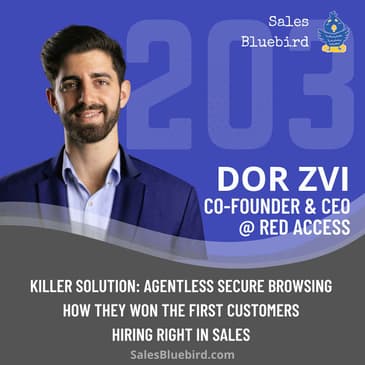
Dor Zvi, cybersecurity entrepreneur and co-founder of Red Access, joins host Andrew Monaghan to share his journey in the secure enterprise browsing market. With a strong background in the cybersecurity industry, Dor and his long-time friend and partner, Tal, identified challenges in the market and developed an innovative agentless platform to protect devices and browsing sessions. Their passion for addressing the needs of a hybrid workforce and their drive to make security more simple, agnostic, and comprehensive have been key to their success.
In this episode, Dor talks about how to:
1. start building a winning sales team in the cybersecurity arena with expert tips on strategy and staffing.
2. strike the perfect balance between productivity, security, and user experience in today's fast-paced cybersecurity industry.
3. Fortify your remote workforce with cutting-edge, agentless cybersecurity methods.
24 Unleash the potential of Red Access's revolutionary cloud platform to boost security and performance.
My special guest is Dor Zvi
Developing the MVP & Validation
One essential step in building a cybersecurity startup is the development of a Minimum Viable Product (MVP) and its validation. This involves creating a product or service that addresses a specific market need, while only offering the core features necessary for initial users to provide feedback for further improvement. For cybersecurity startups, ensuring that the MVP provides adequate security while also maintaining user experience and performance is crucial. The validation process involves testing the product with real users, collecting their feedback, and making necessary adjustments to ensure it meets their needs and expectations. In the case of Dor Zvi, Red Access's MVP focused on providing an agentless approach to secured browsing that doesn't compromise user experience or performance. Through a series of tests and iterations, the company was able to arrive at a product that could be used by their first customers. Dor shared that the validation process helped his team overcome setbacks and build a product that ultimately generates interest from potential investors due to its unique architecture and capabilities.
The Cyber Go-To-Market Talk is the show for cybersecurity sales leaders, founders, CROs, and go-to-market operators looking to improve cyber sales performance and build more predictable revenue growth. Hosted by Andrew Monaghan, founder of Unstoppable.do, covering cyber sales leadership, revenue leadership, sales onboarding, forecasting, pipeline generation, and cybersecurity go-to-market execution.
Follow me on LinkedIn for regular posts about growing your cybersecurity startup
Want to grow your revenue faster? Check out my cybersecurity sales consulting and training
Need ideas about how to grow your pipeline? Sign up for my newsletter.
00:00:00 - Andrew Monaghan The Enterprise browser is one of the hottest spaces right now in cybersecurity. And in this episode, we chat with Dor, the co founder and CEO of Red Access. And Red Access has a different approach to the whole category of the Enterprise browser. Listen out in this episode for their differentiation, the three guiding principles with which they're building the company and also the product. The big deal it was when they won their first customer, how Door supports this first sellers that he brought into the company. And then also why Door won't be doing any shark dives anytime soon. Don't go away. Welcome to the Sales Bluebird podcast, where we help cybersecurity startups grow sales faster. I am go to market guy Andrew Monaghan. Our guest today is Dor V, co founder and CEO at Red Access. Dor. Welcome to Sales Bluebird.
00:01:05 - Dor Zvi Thank you. Happy to be here.
00:01:06 - Andrew Monaghan Well, Dor, I'm looking forward to this conversation for a couple of different reasons. One is looking at your background. You're a first time founder, and I love talking to folks who are decided to change their lives and embark on a journey where they want to not just change their own lives, but also make a big impact on our industry. And the second reason I'm kind of excited about the conversation is that you're in a category which a year and a half ago did not exist. And if you kind of think about the hotter categories in cybersecurity right now, I would put the one that you're in being one of those ones. So I'm keen to understand how you're thinking about that area, how you're different to the other players that have jumped into the space, and how you're ultimately going to be successful and make a mark on the industry. So it's going to be, for me, an interesting conversation. A quick break to say that this episode is sponsored by It Harvest. With over 3200 vendors in cybersecurity, it is hard to keep track of all the latest developments as well as research and analyze categories and subcategories within cybersecurity, which is where the It Harvest cybersecurity platform comes in. Want to know which subcategories in cloud security are growing the fastest? You'll get it in a few clicks. Want to know and track everything about your main competitors and keep up with their hiring and news? Simple search to be done. Want to know the top 20 fastest growing companies based out of Israel?
00:02:40 - Dor Zvi Easy.
00:02:41 - Andrew Monaghan Just a couple of clicks to get that. It. Harvest is the first and only research platform dedicated to cybersecurity and it's run by Richard Steenan, who has done it all in cybersecurity from the VP of Research at Gartner, a CMO at a cybersecurity vendor, a Lecturer on Cybersecurity, advisor to startups, advisory board member at Startups and a main board member as well. The whole lot. Find out more by going to Salesbluebird.com Research. That's salesbluebird.com research. Now back to the episode, but let's go back to your history a little bit. Door as I looked through your LinkedIn resume, like many, you spent a few years in the IDF, came out of there. Looks like you went to startup Solbit for a couple of years. You were security researcher, developer, and then Solbit got acquired by Mimecast. You then spent two and a half years at Mimecast. And then after a while there, you said, you know, what I really want to do is give up the security and the comfortableness of being in a corporate environment and get a regular paycheck, and I'm going to go and start my own company. So it's a big change to make, and obviously our conversation this morning is going to be a lot about that. I'm going to do something a little bit differently this morning. Door usually what I would do at this point is say, tell me about Red Access. I'm going to go a limb and give you my summary of what I think Red Access does based on looking at the website and digging into a few things here and there. And you can correct me, in all likelihood, I've got some or all of this wrong, and I'd love to get you to correct me or get me back on track at the end of it. All right, let me tee it up this way. So if you look at over the last 1012, I don't know, 15 years, more and more of the work that we do as employees at companies has been going on inside the browser. And it's got to the point right now where for many roles and departments, all of our work is inside the browser. So it kind of makes sense, if that shift has happened, to think about, well, why don't we secure what happens inside the browser as opposed to just working at the operating system level on macOS or Windows or whatever? Because anytime you get closer to data, closer to processes, then your ability to secure them and mitigate the risk associated with that work becomes more relevant and more impactful, I guess, more efficient, right. And that's why I believe in the last 18 months or so, the enterprise browser category has kind of popped up. It makes a ton of sense, and there's some companies that have got some good traction going in that area. If I look at what Red Access does in that area, it seems to me that you believe that companies should never have to compromise on security, user experience, and ease of management. So that was always the three things, right? Pick two, but you won't get three of the mantra for many years. And that's why what Red Access is doing is giving an agentless approach to secure all web traffic. And this is different to everyone else because what everyone else has done is saying, you need to replace your browser with our browser. Now, it might be in a Chromium based brace browser, but it involves a lift and shift of browsers or what they're doing is doing plugins into browsers which has pros and cons to go with it. And I think what Red Access is doing is saying, look, you'll get all the benefits of having your browser activity, processes or assets protected, but without the pain of having to change out your browser. And it seems to me that not only is there the kind of risk mitigation side of doing it in the browser, you're doing it in a way that doesn't impact user ability, user acceptance, and also there's probably a tools replacement ROI in there as well. If you are doing more in the browser like that, you probably don't have to have as many of the tools that go around it on the machine that you're protecting. And that's kind of what I read into what Red Access does. So where did I get that wrong?
00:07:09 - Dor Zvi You get it perfectly the way it is. I think that situation of people working from anywhere with different types of devices and now requiring the same level of productivity and security as before, it's the challenge. Now, every change that happens that quick, it has an impact on a wide range of aspects. And I'll say like number one obviously is security. You need to protect more endpoint devices of employees and also you need to protect corporate resources that are now remotely accessible. Now number two, which combined together is productivity because when you change your environment, you change your security. It immediately impacts the performance, the user experience because usually one comes at the cost of the other, but it should not be the case. And from the company side, I would say like management, as you mentioned. So how does the security team manage security solutions in a distributed organization? I would say like even the simple maintenance upgrade or downgrade, how do they support 10,000 of distributed devices by email, by video call, or I don't know, should they send an engineer to each house? So it may sounds funny, but that's an important question. Also like how does the security team gain visibility on what happens? So that's, I think, a great change of hybrid work, but also come new challenges that need to be addressed right now. So, as you mentioned, we started from the need to secure in the hybrid work and yeah, we developed the first agentless platform, provided a nondisruptive way to protect devices and browsing sessions from growing cyber threats when people are in and outside of the office.
00:09:16 - Andrew Monaghan Let me go into that a second. So I'm not a technical person, so don't bamboozle me with all the details. But doing an agent less, that's highly attractive anytime you can say that in the security world, right, one less agent to worry about. What does that actually mean though, right? Does it mean that they don't have to use your browser or there are other things going on that we need to be aware of.
00:09:40 - Dor Zvi All right, so I would say first it started with the guideline that we kept in mind that was always zero compromise on security performance and user experience. So users do not need to install anything. They continue to work with their preferred browsers, their preferred web applications. For them, it's work as usual, but without the risk. Now as well for the security team, there is no more hassle of managing security agents or solutions such as VPN or VDIS just route the traffic back to the office. We created a cloud based, which is a solution, which is a unified, I would say, agentless platform that fits all users, the ones that are inside the office or remote users and third party contractors. All devices that some are managed, some are unmanaged and even bring your own device. And we protect all the browsing activities. So it's browser agnostic on any browser and also any web application. I mean, the browser is at the core of the hybrid work. However, it's far from being the only risky application in the browsing space. There are many more applications that we use on a daily basis, such as file sharing applications or chat applications and video conferencing that contain more browsing risks that are not browser based. So we took that mission of securing a hybrid workforce to try to make security more simple, but also agnostic and with a full coverage.
00:11:18 - Andrew Monaghan When you described that to me, one thing that popped in my mind was it sounds like it might be more analogous to like a ZTNA type solution as opposed to just a web enterprise browser. Am I totally off on that?
00:11:33 - Dor Zvi There is a lot of overlap, obviously, in cybersecurity and we also offer ZTNA functionality as a part of the product. I'll say it works in kind of a proxy way, which it is, but it's more securing the content that is inside a browser. Protect users from attacks that are happening inside a browser that are invisible for any other layer, let's say skew web gateway or EDR solution on the endpoint, that's missing layer here of what happening inside a browser and inside the browsing applications that's a space became to protect on. So with that strategic position as a cloud based solution, yes, it is very compelling that we will provide also a ZTNA capability or CASP and other functionality that we are able to provide.
00:12:28 - Andrew Monaghan Let's go back to the genesis of red access to take us back to that moment in time. Where were you? Who you was when you sat there and said I think we might just start a company here? Where were you? When was that?
00:12:46 - Dor Zvi All right, I would say that it all started with my partner actually, Tal, who is a friend since the age of ten. We've been at school together and we served then in the army together and had our first jobs together. So I think in the beginning it was just him and me identifying challenges in the market that we wanted to address. And while we started to develop like a prototype and started to collaborate with design partners, then we got funding, obviously. I think it's always starting with bread. Let's address the needs on market, then let's test how we can help, which is the main brainstorming. And you start testing, then you start validating that with customers, partners, even investors, they're always updated on the market. And after you found something and you got your first, I don't know, partners and design partners, identifying their challenge, starting developing a prototype, going out on market, building your team, that's journey. So I think that based on our experience, first at the army, then at Solve It, then at Miamcas, all the way we did together, that's created first. Like there's a partnership that based on a friendship, but also with a sense of we know that at some point we're going to create something together. So I would say from that point.
00:14:26 - Andrew Monaghan And was it easy to lose that corporate paycheck? What was your mindset going into it? Was it, this is what I do, I've got no problem with it, or was a big decision for you to say, yes, we're going to take this step?
00:14:41 - Dor Zvi I think that we felt it's time we started our journey as a part of a small startup. And we chose that specifically because we knew that at some point we would like to create our own company. So we came to learn. We knew that that's a journey going to be a complex one. So we came with a state of mind that we're going to learn process, but also learn to be constantly adapting, evolving and learning. And I think that sharing with other true practitioners, whether they be experienced founders, CEOs or investors, brought us unique insights and perspective. So part of it, we learn to seek for the people inside and outside the organization that will give us real and straight feedback. I believe it's super important to create an environment that facilitates getting feedback.
00:15:43 - Andrew Monaghan And based on those experiences early on with Red Access, are there any misconceptions that people have about what it takes to start a cybersecurity company?
00:15:54 - Dor Zvi Yeah, always. I think that the cybersecurity space is very crowded. As always, a lot of overlap between companies and that's a stage in life. I think like any company, not just in the cybersecurity industry, that's a decision you make. For some people, it's going to be a big decision. You have some other responsibilities in life or you never had any kind of experience as entrepreneur. For others, they feel like they're born to do it and for them it's super neutral. So it really depends on situation. But as always, especially as a first timer, you got some concerns, but you also got the passion. So you're here to stand on the guard and fight for your company?
00:16:44 - Andrew Monaghan Was there a moment where you were kind of starting to develop the MVP and starting to get the validation? Was there a moment where you kind of had a setback and thought, I'm not sure this is going to work out?
00:16:58 - Dor Zvi I think I was ready to meet some challenges, so I wasn't surprised. And I knew that, I guess, the best CDO in town. So, no, I never got nervous. I think, as you said, that's a new space, but I really believed in it, and I think that we validated very well. The problem before we started, that there is a need and the use case is repeatable. So I felt okay with it.
00:17:26 - Andrew Monaghan Okay.
00:17:27 - Dor Zvi It was the right decision.
00:17:30 - Andrew Monaghan And when you're talking to a prospect and you either use your sales deck or you use the product to demo, is there a moment that is like a wild moment where they go, oh, I get it, I've not seen that before. Something new that just makes them kind of sit up and go, this is cool?
00:17:48 - Dor Zvi Yeah, for sure. I think that the concept of the product as you're getting control on everything, but keeping it agentless was unique. I think like most people, I mean, they're familiar with the products that they knew, or they're currently working with secure web gateways. And then there are some alternatives in the shape of an agent on the desktop, but never heard about an agentless, one with those capabilities of protecting my activity inside the browser. And the moment I explain the architecture more in a technical way, they get it. And then I'm getting a smile. I'm getting a smile. Oh, I understand now I see that. Wow. All right, so you created something with the capabilities that I need, but you got rid of the baggage from other solutions that I knew. So that's the wow point, and they understand. All right. I will get the perfect user experience. I will get the security level I want, but also the management part is going to be pretty easy for me. Yeah, that's very compelling. And that's the wow moment.
00:18:56 - Andrew Monaghan It's almost like the magic words. And with no agent.
00:19:00 - Dor Zvi Exactly.
00:19:02 - Andrew Monaghan No one ever said, I wish there was another agent out there for me to manage. I could see how that would be pretty compelling for people. They get all the functionality that they want without the dreaded. Yeah, you have to install my stuff on all your endpoints. Right?
00:19:16 - Dor Zvi Exactly.
00:19:18 - Andrew Monaghan That makes perfect sense for me. Let's get to know a bit more about you. I have 35 questions here on my list. The good news, I won't be asking you 35 questions. What I will do is ask you to pick three numbers randomly between one and 35, and I will read out the question they correspond to.
00:19:39 - Dor Zvi All right, it's getting interesting. I would pick number 312 and 34.
00:19:46 - Andrew Monaghan 312 and 34. Okay. Three is what is the scariest animal out there.
00:19:53 - Dor Zvi Scariest animal. I would say sharks. Shark is when you're like, in the deep ocean, can come from nowhere. In east territory. You're like, out of clue, nothing to do, can fight with it. Probably the most scary one.
00:20:11 - Andrew Monaghan I like that. So, quick story, I've got two teenage girls and I thought, I'm going to let them watch Jaws. This is like two or three years ago, and I thought that when I was a kid, was watching Jaws. And I'd get scared of my mind about the music and the people getting randomly getting attacked by sharks. And they started watching and they just started laughing. They said, these effects are these special effects are just not special. You can tell that's a rubber shark. Yeah, but it scared me when I was a kid.
00:20:45 - Dor Zvi That's a great reaction.
00:20:46 - Andrew Monaghan So I was kind of pleased about their reaction. Well, not pleased. I was not surprised by the reaction. But the good thing that came of it was now when we go to the ocean, they're not quite so worried about sharks. Rubber sharks seem to know what they care about more than real sharks.
00:21:02 - Dor Zvi Next stage is diving with them. So keep in mind oh, have you done that? No, I never don't have any plan to.
00:21:11 - Andrew Monaghan All right, that was 312 is window or aisle?
00:21:15 - Dor Zvi I would say window.
00:21:17 - Andrew Monaghan Any reason?
00:21:19 - Dor Zvi Nothing specific. I would say just first answer that pop in mind.
00:21:24 - Andrew Monaghan Yeah, I kind of go back and forth, depending on the length of flight, whether I prefer window or aisle. Sometimes on these flights, you don't have much choice these days in the US. Anyway. The flights are so packed that you take what you can get. And the last one you said was 34. So this is an interesting one. You can't pick your own company. Which cybersecurity startup do you really admire right now?
00:21:47 - Dor Zvi I would say probably we at the moment got into a space with big competitor. They started from ground up pretty fast. I mean, they won a few awards. And how fast they grew up, I don't know. It gives me a better perspective on even that. You got better, I don't know, technology or even less better technology. It always so affected by so many verticals. I mean, company, it depends on your marketing force and sales force and how fast can you move, how fast can you build your entire company with each department work separately, but all together, end to end. And I don't know. That's inspiring to see how fast company can grow and think that Asaf is an amazing entrepreneur to learn from. So, yeah, I would pick that one.
00:22:43 - Andrew Monaghan Yeah, I like that choice. I mean, you have to be living under a rock in the last year and a half not to be impressed with their success and quite what they've achieved in the last 18 months or so. We were recording this on the 1 March 2023 just two days ago, they announced that they took another round, $300 million at a $10 billion valuation. And I think that's significant because it's great they've been so successful. But in a world that we're in right now, where valuations have been hit for the last year or so, obviously, I don't know what their arr is, but somewhere probably just north of $100 million, you're looking at a 25 to 30 X valuation, which I think helps the industry when we're looking at raising right now. And probably something you're thinking about more than me right now, but valuations and raising and things like that, it's kind of important, right? Everyone's going to be pointing to that valuation and saying, yeah, but if they can get it, we should be able to get something close to that as well, which is I think it's important.
00:23:43 - Dor Zvi I completely agree. I think last year was I call it a big party, but I think personally, personally, I believe that companies should grow more organically and not with blown up evaluations or big funding rounds that are oversized. But still, that company, against all that, they took a big chance, big hit, started with amazing funding. Round survived that, but more than survived. Seems like they're following KPIs. They're doing great on sales. They grew up that fast. That's why they got the next round, I guess, while the whole market is struggling, people talking about that as a hard time right now on investments, on sales. See, companies are reducing their security budget or it budget, and still they're there hitting hard. That's really nice to see.
00:24:47 - Andrew Monaghan Yeah, it's great to see. Great to see the success. And some of the other companies in the category have taken a lot more money with a lot less revenue. And I think even though it's big numbers, it seems looking in from the outside, that it's justified. So it's nice to see that coming through. And I'm going to tease this right now. In about a month's time, I'm scheduled to do an interview with Colin Jones, their chief revenue officer.
00:25:16 - Dor Zvi Right.
00:25:17 - Andrew Monaghan He was there pretty much right from the start, one of the first hires into the sales team. So hopefully he'll be able to take us on a journey about those early days and how they started getting some success and the learnings from that whole process. So, subject to calendars and all the rest of it, I'm looking forward to having the chat with Colin in about a month's time.
00:25:35 - Dor Zvi All right.
00:25:39 - Andrew Monaghan Tell me about the day that you won your first real, live paying customer at Red Axis. Not design partner, but, you know, first real, live paying customer.
00:25:50 - Dor Zvi Yeah, the first customer of that. All right. It was last July 2022. It was at a financial institution with 16,000 employees. This company, they used to work from the office before COVID and when the first lockdown started, part of the workforce had to work remotely, so they had to quickly decide on a solution to secure their remote browsing activities. So they used a VPN service to access corporate resources and it lasted for two years. And over time, the hybrid workforce started to grow, finally became permanent, and VPN solution started to show its limitations. It was not suitable anymore. And they look for a unified solution both for their in office and hybrid workforce to protect browsing and manage access in a frictionless way. And they selected the Red access platform. So after we started, they told us like, all right, now our users are protected from those browsing cyber threats without the need to connect to the VPN service anymore, which is great news for them, or download any agent to their personal devices. So, on the one hand, I think the company benefits from the agent list architecture. They make the process very easy for them. On the other hand, they have a centralized control panel where they can manage security policy for all users and their distributed devices. That was the first one. We had at least five more customers at that specific use case.
00:27:33 - Andrew Monaghan I imagine inside the company you had a bit of a celebration that day.
00:27:37 - Dor Zvi Yeah, our company definitely for sure. That's a stage, a big stage in a startup where all the code, that all the team was very focused here on working and developing that it started showing its value in a real customer environment. And once the admin told us, like, I'm happy with it, you solve my problem, that's a stage. That's why we created the company for eventually.
00:28:07 - Andrew Monaghan Yeah, the validation to say we kind of knew it was good and we kind of suspected it was going to be impactful. But until someone pulls out the checkbook and says, here's quite a bit of money to transform how we do security at my company, you don't really know. Right? And it's just such a validation to say, yes, you can't get the second or third one without the first one. So the first one is important.
00:28:32 - Dor Zvi Yes, there is a very big gap between customers saying, all right, it may work, it sounds okay, sounds like it can solve their problem to a second that he says like, all right, I'm going to try it out, I'm going to install it in my environment. And the third stage of I'm happy with it. There is a huge gap here in between that requires any company to get a cycle of, I don't know, testing, fixing. Obviously as a new company and a product which is unique, you're developing it for the first time, facing those new challenges, new issues that you never came across. That's the cycle. So when you got the first one saying, I'm happy with it, it works perfectly smooth, I'm going to pay for it. That's a big moment. That's a moment of relief and happiness. And the team is happy. And it changed. Also, the company state from a development stage to I'm a service provider now.
00:29:33 - Andrew Monaghan I love that. I interviewed Adam Gavlak last year. I think it was Adam is the CEO at Duke Control and I asked him a similar question. He goes, everyone's a friendly until you ask them to pay money.
00:29:48 - Dor Zvi Exactly.
00:29:49 - Andrew Monaghan Everyone wants to give you advice and help and experiences, but until you actually ask them to pay money, they do it. That's when the real action starts happening.
00:30:00 - Dor Zvi Exactly.
00:30:01 - Andrew Monaghan So that would lead then door to you thinking about building a sales team, right. You've got your first couple of customers. You think you said you get a number of people on this use case. How did you think about a the timing to say, yes, let's get some salespeople and then what sort of salespeople you wanted to hire?
00:30:21 - Dor Zvi All right, so building a sales team. Building a sales team, that's a definition of something that as a first timer, you think of it as, all right, I'm going to develop my product and then I'm going to sell it, obviously. And for that I will need sales team to help me grow faster and think like speaking about the right timing. So first, as an entrepreneur, you always wear different hats along the way. You start as a first timer entrepreneur with just a vision, with a vision to solve a problem. And you start working on a prototype. Then you're working on or recruiting your own team or building your company's state of mind. And then getting into marketing a little bit, getting to validation with customers, touching with investors. There were many hats along the way that always like once you learn the process, you define that, the guidelines, the guiding points you want that process to be and continue working the same way. Then you get someone in that position to be together with you. So building a sales team, I think it should be the same concept as the CEO of the company. You should start with the first sales. You sell direct to your customers and you're making the first sales. You want to get the most accurate feedback as you can and improve your product. You want to get the customer feeling not from a summary on whatever system you're using, but you want to get it in a real call. You want to feel that only once you succeed in making those first sales, you understand the use cases, you understand the repeatable use cases out. That's the right timing of recruiting your sales team because it's going to be a repeatable process as well. You build your playbook, you know your use cases, you know where you win, you know where you lose. And it's going to be a repeatable process for you and for your company. So only when you feel comfortable with it and you think you got the answer for all of those questions, that would be the right timing to start recruiting your team.
00:32:29 - Andrew Monaghan And. Then how did you think about what type of person to hire? There's lots of people with opinions on this whether you hire an SDR to book more meetings for you as the founder, do you hire a full cycle salesperson who could find opportunities as well as close them? Or do you bring in a leader who then carries a bag for the first while but really is going to be your leader? How did you think about that?
00:32:56 - Dor Zvi I think that that's always a dilemma. If you can get someone who is a leader, is an expert in your space, that's an advantage for sure. But if this guy used to work in big companies with a very defined process and a clear process, it's going to be very different. Working in a startup which is basically a greenfield, most of them don't have a stable playbook or a sales process, they got their first initial sales, but it's not going to be the same way. Also SDR, SDR in a big company with that reputation is going to be very different from an SDR in a small startup with no reputation that no one ever heard of this name at all. So I think that's always a dilemma and if we try to get a statistic, I would say that for each company and each entrepreneur you will find that the thing that worked there is going to be different from the other company. For me, what I was trying to do, I'm always in a mode of testing and fixing and test, create a process very quick, learn something from it and then if you have to fix it, do it quick instead of spending more time until I'm getting a decision. So I started by looking for someone who is in the middle, right? So he's not a junior but is not a director. I need someone to be my first boots on the ground here. There will come with a state of mind that that's also an opportunity for him for getting his next job. So he will not be super expert, but not a junior. And then together we're going to customize that process and attitude of sales. And as long that process moves forward, I'm getting more answers to the questions and then I can fix them more quickly.
00:34:44 - Andrew Monaghan And I imagine that person is joined at the hip with you. Right? They're letting lockstep in those early days, always doing things with you, right, exactly.
00:34:53 - Dor Zvi At the beginning we work really like hand by hand fixing together. I mean, that's not a state of a company. I'm going to get that position. It's going to make the sales for me and I can forget it and move on to my next s. I'm always with them together in creating the process. Only when both of us can feel good with that process that he worked, that he answered together on all of our questions, that's the moment that he will ask for more opportunities to get things on his own.
00:35:27 - Andrew Monaghan And what did you learn about that learning process for them, for him to get things out of your brain and into their brain and make sure that they could get going quickly?
00:35:40 - Dor Zvi I think establish first a friendship and the relationship that is open and not like, I'm your manager and you're going to work for me. I will tell you what to do. I will tell you what I think. You write everything down, and now you start acting like that. I like to make them feel first. I'm with you in that process. I'm going to be with you for the whole process. Whatever you need for me, I'm going to be there for you. And as well, I expect from your side. So we'll feel open with each other, we'll feel comfortable with each other. And then we're going to explore that process together. We're going to see how things are going. We're going to be much smarter in a few months that we are now. Let's start working on that with what we do and what we know today and let's see how it goes.
00:36:26 - Andrew Monaghan I like that because even though you do have a use case that you can go to market on, you're still learning, right? I mean, everyone you talk to is going to be slightly different. You need someone with a mindset who can feel like you've got their back. And if they come to you and say, I don't get something or I screwed up something up, they don't feel like they're going to get fired. Right? So having that safe environment to work closely with you, I bet, was a huge advantage for them as they were thinking about what they were doing there, right?
00:36:56 - Dor Zvi Maybe as a CEO, you must know everything, right? You must know how to lead your team. You must know how to get the process of sales. And you have to do that with a confidence. That's your job as a CEO, you need to lead that company eventually. But at one point, I will always remind myself that I'm also here to learn. There are things that I don't know, and it's very cool to admit it. I mean, I'm a first timer. That's a unique space, a new space. That's a unique approach. And there are things I'm going to learn that I don't know today and admit it. So keeping that in mind will move you from resisting to learning and adapting and evolving. And that's the process. That's how I believe you should build a company.
00:37:41 - Andrew Monaghan I like that. When you think about your sales team, let's say your sales motions, your whole go to market right now, if you could fix one thing just overnight, even though it probably can't be fixed overnight, if you fix one thing for your team right now, what would it be?
00:38:00 - Dor Zvi If I have to fix one thing? That's a good question. Things I would fix because I feel we fix a lot of them already, but maybe I can share one of those. I think that when we started, we took on ourselves very big missions that we shouldn't have. I mean, like start working with enterprises, large enterprises, as first customers, it worked. But for the company, for the sales team, where the sales cycle obviously is more complex, takes much longer. Maybe I would start from smaller companies. I would say at the beginning, I would get more feedback. Instead of putting a lot of effort in one or two very big companies, I would start by getting many more smaller companies so I could get more feedback on the first place. And I think it would accelerate our growth significantly.
00:39:06 - Andrew Monaghan So by going to mid market companies and more of them, you get quicker feedback just because then the speed they work at or the easier access you get. Is that what I'm hearing?
00:39:17 - Dor Zvi I think getting more touch points, more touch points with customers. So you get different feedback from different customers, different environments, different needs, and then you can decide better when you got more data to work with instead of working in a big shiny logo of a big company you want to have. Obviously I want to show that logo, which is my customer and he's happy with my product. But I think, like time perspective, time management here, I would fix that. Okay, if I can go back into it.
00:39:51 - Andrew Monaghan Last question. Let's flip things around a little bit. Is there a question for me about go to market selling cybersecurity startups that I can attempt to answer for you or address?
00:40:03 - Dor Zvi Yeah, for sure. I think that for any cybersecurity company that works in any space inside the cybersecurity, there's always a very small gap between productivity and security for their customers. Eventually customers, they need to work. That's a company that need to work, but they also want to be secure. How much do you think that companies specifically startups, considering that when establishing a new idea, if you get it or.
00:40:35 - Andrew Monaghan You want me to no, I think very few well, let me put it this way. I don't think that many companies don't consider it. I think very few companies make it a center of how they think about building the company and the product. Right. I think that one of the things that has been true in security for a long time is when you bring something to market, you start with visibility. We'll give visibility. And in the rush to visibility, you anchor around that and you get people excited about the visibility you're going to give them. And I kind of look at visibility as the easy button. By definition, you're not doing anything else, you're not blocking anything, you're not necessarily mediating anything. You're basically saying, I'm just going to shine a light on these things that you didn't know about before. And frankly, we talked about wiz. I mean, that's one of the things that Wiz did very well at the start, right? They had a very short time to market, time to value for their customers to see all the things they didn't know were going on inside. Their cloud interface was beautiful and it was workflows were good and it was just there. Right. But I think in many ways that's the easy button, right? It's easier to do before you then start getting the hard task of saying, well, now what? Right? And I think that's where sometimes those decisions are maybe, in my opinion, pushed out a little bit. We'll start with visibility and when it comes to the hard things, we'll get there and we'll figure that out and that's why it becomes a little bit of a lagging thing. And obviously it's really important that we have good user experience, but it's not the core tenant of what they do. Right. I think we've seen that again and again and again. And I could say in the Casby space a few years back, a couple of companies got a lot of traction at the gate with visibility and then they kind of disappeared a little bit when it came to the next wave of, well, now you got to start blocking stuff. It's like, wow, that's hard. It's hard to do because if you block the wrong stuff, then people are very mad at you. People get fired for doing that sort of stuff and you impact revenue streams inside companies. So that's where I think, as you're saying, if you've got the three points of the triangle from the outset and it governs how you do things, you probably do have an advantage compared to those that are kind of going to get there, but they haven't quite got there yet. I don't know if that's how you were thinking about, but that's what's front to mind when you ask that question.
00:43:11 - Dor Zvi That's a good answer.
00:43:12 - Andrew Monaghan Well, listen, I've enjoyed our conversation this morning. Door a lot of good things going on. If someone wants to get in touch with you and keep going with the conversation or talk about future employment at Red Access, what's the best way to do that?
00:43:27 - Dor Zvi We got many different channels. Can use our website, can use our emails, LinkedIn, any acceptable way. We have our sales team in the United States. Just pick one.
00:43:41 - Andrew Monaghan Very good. Well, listen, I'm looking forward to seeing you at RSA this year. Is that right? You'll be there?
00:43:47 - Dor Zvi Yeah.
00:43:48 - Andrew Monaghan Very good. I'll see you at RSA and I wish you and the team of your success for the rest of the year and into next year as well.
00:43:54 - Dor Zvi Thank you so much and thank you for inviting us today.
00:43:57 - Andrew Monaghan Well, there was someone who brought a very thoughtful approach to how they're tackling a hot part of the market, how they're building the company, building the product, and some of the philosophies that they're bringing to how they do all that. I really liked how Door described a lot of the things they have going on at Red Access. For me, there was probably three things that I took away from this. The first one was centering around those guiding principles and to remind you, they were user experience, the ease of management, and also the security with their approach. And his idea is that they should not be compromising on those three things, which is hard to do, frankly, in security. As we know over the years, it's always been pick one or two of those three things, but in the day, the other one is going to be hard to do, right? And if they're bringing something to market which tackles all three, that's going to be very compelling for a lot of different people. I thought it was interesting as well. Second takeaway was how he described that moment when they got the first customer right. It was obviously the celebration and the validation and things like that. But he said, we moved from being essentially a development company, a software development company, into a real company with customers and commercial things about it, right? So you have to take orders and process and support these customers. So that whole transition as he described it was really interesting and very thoughtful. And the final thing I thought was interesting was how he described how they approached solving the problem. It was to start with solving the problem as opposed to thinking, well, let's get into a category, or we've got some expertise in this technology, let's figure out where we might go and solve problems with this technology. I heard from him was we did the customer discovery, we found the problem, we got centered in and around that, and then we figured out, well, what's a different way to solve the problem given our guiding principles. I think that for me that was quite compelling. And I bet you there's a lot of companies out there who probably think that that's how they do it. But I wonder if they get a little bit wrapped up in their technology and think about how cool their technology is and how cool the product is and then think about where it might go and be used and have some impact, which of course is probably not the right way around. So I thought it was really good how because it's centering around the problem. Clearly, obviously got some expertise, but centering around the problem and then using the guiding principles to solve that. So for me, great episode, really thoughtful person, company that's starting to grow, getting some traction and be really interested to see where Red Access goes. They'll be at the Early Stage Expo at RSA this year and I'll catch up with them there and I hope you do too.