
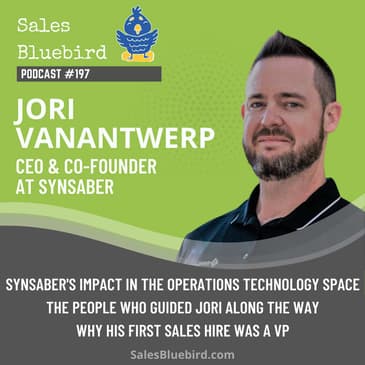
Moving from being an employee to founding your first company is a big step for anyone to take. In this episode, Jori VanAntwerp, CEO & Co-Founder at SynSaber, talks about how he did that and more.
In this episode, you will learn the following:
1. The big impact SynSaber is making in the operations technology space
2. The people who guided Jori along the way
3. Why his first sales hire was a VP
Resources:
Jori VanAntwerp
Sponsor:
This episode was brought to you by IT-Harvest.
With over 3,200 vendors in cybersecurity, it is hard to keep track of all the latest developments as well as researching and analyzing categories and subcategories…that’s where the IT-Harvest cybersecurity platform comes in.
IT-Harvest is the first and only research platform dedicated to cybersecurity. And it’s run by Richard Stiennon who has done it all in cybersecurity. Find out more by going to salesbluebird.com/research
Other episodes you'll enjoy:
Bob Kruse, CEO and co-founder of Revelstoke Security, on how a sales leader becomes CEO of a cybersecurity company
Mike Baker, CRO at Noname, talks about leading a sales team through hyper-growth
Action:
If you enjoyed this episode please could you give a review by going to Salesbluebird.com/R. It would mean a lot to me personally and it helps grow the podcast.
Connect with me:
YouTube: https://www.youtube.com/@salesbluebird
Twitter: https://www.twitter.com/unstoppable_do
LinkedIn: https://www.linkedin.com/in/andrewmonaghan
The Cyber Go-To-Market Talk is the show for cybersecurity sales leaders, founders, CROs, and go-to-market operators looking to improve cyber sales performance and build more predictable revenue growth. Hosted by Andrew Monaghan, founder of Unstoppable.do, covering cyber sales leadership, revenue leadership, sales onboarding, forecasting, pipeline generation, and cybersecurity go-to-market execution.
Follow me on LinkedIn for regular posts about growing your cybersecurity startup
Want to grow your revenue faster? Check out my cybersecurity sales consulting and training
Need ideas about how to grow your pipeline? Sign up for my newsletter.
Moving from being an employee to founding your first company is a big step for anyone to take. In this episode, Jori VanAntwerp, Antwerp, CEO of Synsaber, talks about how he did that, the people that were invaluable guiding him along the way, and the big impact Sincere is making in the operations technology space. Oh, and also the one song he would listen to for the rest of his life if he had to. Welcome to the Sales Bluebird podcast, where we help cybersecurity startups grow sales faster. I am your host, Andrew Monaghan. Our guest today is Jori Ben, Antwerp CEO and co-founder at Synsaber. Jori. Welcome to Sales Bluebird.
Thank you.
So this is an interesting conversation, for me at least, and hopefully for you. We realized in our prep work that we were actually at McAfee at the same time, many, many moons ago. But our past did not cross very much, or at all, frankly. It seemed back in those days, maybe we're in the same calls or in the same kickoffs and the same things like that, but I don't think we worked with anything together. And you get a rich career, rich history at some really good brand name companies and cybersecurity. And in the last few years, you decided to start your own vendor. So I'm looking forward to hearing about how you did that in the process of doing it.
A quick break to say that this episode is sponsored by It Harvest. With over 3200 vendors in cybersecurity, it is hard to keep track of all the latest developments, as well as research and analyze categories and subcategories within cybersecurity, which is where the It Harvest cybersecurity platform comes in. Want to know which subcategories in cloud security are growing the fastest? You'll get it in a few clicks. Want to know and track everything about your main competitors and keep up with their hiring and use simple search to be done? Want to know the top 20 fastest growing companies based out of Israel? Easy. Just a couple of clicks to get that. It. Harvest is the first and only research platform dedicated to cybersecurity and it's run by Richard Stiennon, who has done it all in cybersecurity from the VP of Research at Gartner, a CMO at a cybersecurity vendor, a Lecturer on Cybersecurity, advisor to startups, advisory board member at Startups and a main board member as well. The whole lot. Find out more by going to salesbluebird.com/RESEARCH. That's salesbluebird.com/RESEARCH.
Now back to the episode. So let's get to the business side. I looked at your LinkedIn profile. Let me give you my 32nd summary here quickly. You started off in the vendor world, at least when you worked for Secure Computing back in the day as a solutions architect. And then, of course, Secure got bought by McAfee, which is where our path should have crossed but didn't. At least we can remember. You went from McAfee to FireEye, where you built and ran the Global solutions architect team there. You were employee number 898 at FireEye after FireEye. You thought, let's move to another big brand name to Be, which was CrowdStrike. And you built and ran the Global Si and consulting partner program there. And after doing that for a little bit, you thought, I'm going to make a switch from the enterprise It world into the OT world, and you joined Dragos and ran the Solutions architect team there. Have I got that about it right?
Yes, sir.
But then the big movement for you, I would imagine, is you're there, you're an employee, you've been in some good companies that did very well, and you said, you know, something's going to cause me right now to go and start my own vendor rather than work for someone else's dream. Take me back to that moment in time. Where were you? What was going on, where you said, you know, I just have to go and do this.
So it's not as exciting as it might sound. One of my favorite foods is hamburgers. Hamburgers are I'm simple. Hamburgers are fantastic. So it's a local place here in Arizona called Arizona Wilderness. Eating a hamburger, chatting with my wife. I had been around the block per se on startups. I had been through some earlier stage races and helped a lot. And the more and more that I looked at the problem that I saw in OT, I just had this overwhelming feeling that I could address a lot of concerns that were being left out. And in that particular instance, it's a light bulb moment. I had this light bulb go off and said, you know what, I think I can do this and I can really impact the community and the industry and empower our operators and analysts. And that's how it started.
It must have been an interesting thought process though, right? Because you're saying, okay, that's a good idea, I want to go do that. But how did you get the confidence or the belief that you could actually go and do that? Because many people have the idea they should, but not many people actually do.
I am still a little bit of an analyst at heart. Starting before my vendor time was a systems engineer and a Sockey enlisted. I immediately went and started looking at the market. I started looking at the market, I started looking at competitors, I started looking at how things were being approaching, how things were being approached, and then I started getting into more of the community groups at the time and looking at what people were asking for. What is the customer asking for? What do they need? What are their problems? And it just really kept solidifying that my hypothesis was correct. And with that, that's what gave me the confidence of I've been in network security for years, both on the technical side and then on the vendor side. And I've seen a lot of things done and I think we can take what we've learned in It cybersecurity and apply that to OT and it built my confidence up step by step.
That's interesting though. So your first kind of customer discovery was not actually talking to customers, it was just listening and reading what they themselves were talking about on various boards or forums.
Yes, I was speaking with some of them over some of the discord and slack communities that are out there, but for the most part it was just a gut check. The next step was where we got into market research and product research, where I engaged everybody I could possibly get a hold of to actually have a conversation around.
That very cool. I want to get into detail though. Where were you exactly when you were thinking, this is the thing that I'm actually going to start researching?
I think honestly, I was playing video games after I had gotten home and I really thought about what are the problems and how could they be solved? Because that's really the trick, right? There's always 100 different ways to solve a problem. But I was sitting down on an end and I was playing a video game. I think it was destiny too at the time and I played way too much of that game, if I'm honest. And so it was kind of going through the motions and all the time I was thinking about how could I simplify the challenges, first of all, in my own head, understanding what breaking them down into small bite-sized chunks and then how could I approach that with a solution? And what did I know of the space and the you know, I refer to them as predecessors, you know, those who came historically, before, Synsaber, and how they were approaching things and why there wasn't a lot of stickiness there and.
Then you're the cofounder of Synsaber. So what stage are you thinking? I need to enlist some folks to go on this journey with me. And how did you do that?
So I actually started building up kind of how I wanted to approach things and working on a little bit of a prototype. And I thought to myself, I do have quite a bit of OT experience, but the majority of my experience has been in it. And a lot of what really is a showstopper in the OT side of the house is really understanding the environment and the regulatory, maintenance and support cycles that operators fall under. And with that I had experience, but not to the depth. So I reached out to a gentleman I had been working with at the time at Dragos, Ron Fabella, and started talking with him about this. And it's a semi embarrassing story. I call it proposal. I proposed to Ron it's three times and I was turned down twice. The third time he fell for it.
I love your persistence.
I should say. I really think we have something.
Yes, I get it. So then you and Ron are working together. At that point, you're going past prototype into MVP, into something that you feel like you start really showing people properly you might be able to deliver on.
No, actually, the prototype itself that I had built was very it was just off of open source. I was proving the concept it was more of a POC than a prototype. Ron then actually, once he was bought in, started looking at changing that prototype a little bit or that POC and turning it into a prototype. So once we had that prototype, we knew we had something. That's when we actually went out. So we went out with an idea. When we went to go take our seed round, it was to build the product. We didn't have a product or an MVP at the time.
And who did you reach out to for your seed round?
So I initially reached out to some very good friends of mine over at Revelstoke, josh McCarthy and Bob Cruz, and just kind of talk through some of the process I was going through. And they made an introduction to the Cyber Mentor Fund, which I'll call Cmf. But Cmf was amazing. So speaking with Joey Andy and Tim Eads over there, we very quickly knew that we had something and they were very excited about it. And Cmf helped us in understanding how to approach funding. And I think they really short circuited our funding process because they give you a framework in which to work and they help coach you through it. They really are a mentor in that sense. And through timids and Bob and Josh, I was introduced to J. Leek over at Sin Ventures and Charles Bealer over at Rally Ventures. Not to make too much light of it, but they fell for it and now we're off to the races.
I love that. It's great when you hear about people who in that world who really, truly are mentoring someone like you, who's known a lot about this space, but hasn't actually raised before and done this before and could do with some mentorship. I love hearing those stories, and I imagine at that point you're going, okay, now we're off to the races. We're starting to build all the rest of it. Take you back to a moment in that process or after that process when you thought, oh my goodness, this is harder than I thought. I don't know if this is really going to work out.
I luckily have not gotten that far yet. I don't know if that's good or bad. I've never had that moment where we're not going to make it or this isn't going to work out. What I can say is that there was a lot of effort and time put into the race, and there's negotiation that goes back and forth, and there's a lot of you have two different legal firms involved usually, sometimes three. So negotiations were going back and forth, and it was a bit of a grind in that sense as soon as we actually took funding, because I honestly wasn't going to believe it until it was in the bank. As soon as it hit the bank, there was this crushing weight of I have to go execute. I have to go do this now. And I think that it was a little shocking just how quickly that takes place, because it was unbelievable until that point. Once it came down, it's like, wow, I am a founder, I am an entrepreneur, and now I have to deliver on what I promised and the execution begins. So I think the only time that really stumbled after that is when we first started the company. We really needed engineers at the time, and starting during the Pandemic, that was not an easy thing to do. People didn't want to move. So it took us a good two months, almost three, to start hiring engineers and really moving on what we needed to do.
How hard was it to get engineers on board when you're so early stage and ask them to give up maybe, I don't know, a more certain paycheck maybe, than they were used to.
Getting it definitely was not easy, especially again during the Pandemic, I think made that harder. And then also because we had all of the people who were at large companies moving out away from the coasts and inboard, it made just negotiations difficult in certain areas. But it all came down to mission. If you can get somewhat excited about the mission that you have, what you're trying to do and make it genuine, it's a lot easier to get people over. So it shifted from talking about it in a technical sense to talking about how are we going to empower the customer, how are we going to change things? And it's not just an OT cybersecurity, but how are we going to change things for cybersecurity all the way around? How are we going to change how vendors approach this? And when you get people excited about that, then it's much easier to start bringing them on board, even in uncertain times.
What's interesting is that I had this belief a long time ago, and I still hear people talk about it. Tons of technical people, we need to talk about technical things. And I've come to realize over the years, that's complete bullshit.
I completely agree.
Everyone's human, right? We have our analytical and logical side. We have our emotional side. And if you want someone to make a big transformation in their life or whatever they're doing, it's the emotional side that you have to tap into, not the technical side.
Absolutely. And it is different. I will say that having been more on the sales side, even though it was technical presales for the most part, speaking with salespeople is a little different. We know the two step, right? We can dance back and forth and have a conversation and get in and warm up pretty quickly. With engineers, you have to work a little bit harder at finding the cracks. And then when you find those cracks and you can relate immediately, as you said, it's not about technical. It really is about that individual, what their beliefs are, right. And what excites them. That's what it's about.
Yeah, I've had probably, honestly, the more interesting conversations with technical people at customers or people I work with, and the salespeople more in depth and thoughtful conversations than otherwise. Let's get into Synsaber itself and jewelry. So if I was a twelve year old CISO, if there's such a thing in the OT side, how would you answer my question? What does Synsaber do?
Since labor is an observability and detection platform, pure software to help you see, know and defend inside your industrial environments.
So let's define OT then. So you'll get an idea of the world that you're talking about.
Absolutely. So operations technology, or OT, is the space that since average is focused on. And when we say that, it's kind of important. There's so many terms thrown around. You have ICS, you have industrial, you have SCADA, so on and so forth. Kind of what the industry has landed on as a whole is OT is encompassing of all of those things. So when we say operations technology, we're normally speaking of things that are physical and they do have a digital side, but they're more physical. So we're talking about fulfillment centers, we're talking about oil derricks, water utilities, liquid natural gas, energy, and it can go all the way out to transportation, it could be a train, et cetera. The systems that control all of these major physical wonders, in my opinion, are relatively similar. We have different manufacturers, but the type of machines that are used in those spaces, the only thing that changes is how they're being implemented and how they're configured. So if it's the baggage claim system at your local airport, or it's the AWS fulfillment center and all the things running in between, they usually have a very similar back end.
So is that the idea that you had the AHA moment where you said, what if we brought some things you've learned from the enterprise it side to the OT site?
Not so much. I think it's important to understand in industrial you hear a lot of things insecure by design. Everything is meant to be robust. So when you build that system for your local airport, when you build that system for your local energy provider, they're meant to run 25 to 40 years. So there's support and maintenance that happens in there. And each one of those solutions is a standalone solution. You don't have a cookie cutter. This is what a substation looks like, this is what a baggage claim looks like, all different sizes and shapes. And so, because of that. It makes it a unique environment where you have these. Yes, it's the same devices, but how they talk with each other and what they do are so different that it makes it difficult to do more traditional It work in there as well. There isn't really security in a lot of these environments. Not all. Some do have secure protocols, but encryption isn't really very common. Authentication isn't very common on these devices. So what really kind of did it for me and the way I would pose it to you is it's like taking a trip in the way, way back machine in the 90s when we had conversations with people like, hey, you really need a firewall, and they would ask you, what's a firewall? It's not that they don't know that, but it's a good way to look at it is that they're not simple, they make very complex things happen, but they are robust through taking out any extra stuff. It's just what's needed to do the job.
So I was just going to say potentially to me is that you might build something in ninety s, and then 20 years later it's still working and functioning today. But what we would think of in the normal day to day lives, technology has moved on through like five generations, never mind five iterations, like five generations in that time.
Absolutely.
And yet probably the technology the thing runs on is still the same as it was the 90s, right?
It is. And this is where you hear your horror stories of I walked into such and such industrial plant and there was a Windows XP machine or Windows Nt. These things do happen. And that's not for lack of an It or an OT person not wanting to patch again. This goes back to support and maintenance. Whoever the vendor is says, this is the solution. We haven't tested that, you can't change that system or you break your contract.
I interrupted you as you were going to say. What I thought was.
Yeah, my apologies. What I thought was that we've been doing in the It world, we've been doing IDs so intrusion detection systems for years, and we've been doing them very well. I mean, we do great deep packet inspection. We understand that very well in the It world. And honestly, it's become such a commodity. I mean, next generation firewalls do it. We do it at the end point it's across the board that we almost took it for granted. It was like guilty knowledge. Why don't we have an IDs that performs like an It IDs in OT? And that was the first question that kind of popped into my head. And they're very different. Trust me, It and OT are very different. There's a paradigm shift there that has to happen for technology, but it doesn't mean we can't learn from all of the amazing things we've done in It and apply those in OT. And that's really what kind of sparked excitement for me was I know that we can do this. I've done it, I've seen it. Let's make this specifically for OT.
Now, I imagine salesperson's layman thinking here is that you probably want to put IDs on the traffic as opposed to on the boxes. If the boxes are so old and they have to be so certain to work, you can't muck around with them. It's probably one of the comments that you have to think about ideas. Is that right?
Yes. And so that's one of the things that we try to approach. So we are a traditional network sensor in the sense that we take data off a tap or a span or we can do broadcast as well. So we have to have a way to ingest that data. But the thing that makes us different is that we're pure software and to try and make this easier for the client is we can install on dang near anything. So if they do have a switch with a compute module, we can install there. If they do have hardware where we can side load, we can side load. If they have a virtual, we can be virtual. If they need to put in a device, they need to put in hardware. We can do that too, and we can install directly on the hardware. But the idea was to make it easy for them to use what's already there because trying to get a new device in can be difficult as well.
Okay, I haven't thought about that. So they're thinking, in this environment, we know this works and we want to do the minimum possible thing to disrupt that. But I'm guessing they're thinking, but we do care about security because we should do. And there's probably regulations you have to stick to, right?
Yes. And it's interesting. A little bit of a side tangent, there's some fud around operators or asset owners not caring about security. Totally untrue security is on their mind. But how that plays in is different. It's safety, it's efficiency and it's reliability. All of those things can be affected by security. But they're immediately thinking, is this safe? Is this up for the operation that needs to happen? And is it efficiently operating? The thing is, we can collect data around, just raw data around security and process that. We can take that same data and we can provide those operators with some more business analytics. Right? Am I efficiently running? Do I have devices that are having issues and get proactive about it? And that was something that I hadn't seen in the marketplace at all. I had seen everyone focused on cybersecurity. We're already collecting the data. Let's help the operator as well.
And when you're talking to companies about this, obviously on the enterprise side, you get a CISO. You've got stock leaders and enterprise architects and infrastructure operations type people. Who do you go to sell to on the OT side.
So normally there is a leader in that that is similar. Should be VP of Operations or Plant Manager, depending on what vertical you're in. That can change. But the CISO is always involved. It's an interesting selling motion, if I'm honest, because you're doing things in parallel a lot. You're selling both to the OT side as well as the It side. The OT in many cases has the budget, it has the need, so you have to provide to both of those audiences.
So the CISO does have oversight. Is that you're saying over OT as well?
Usually depends on the company, but we're seeing it more and more, I would say majority at this point that we engage with. Yes. The CISO has been tasked with what's in. We don't have any visibility or security on this side of the house. We'd like to start wrapping that into our cybersecurity program.
And in your opinion, is that a good thing or do you wish it was different?
I don't see it as good or bad. It's one way to approach. The only concern that I have is these OT systems are very, very different. So you could harm the relationship between It and OT by making rash decisions and not talking to those operators. Those operators know these environments inside and out. They know every asset that's in there and they know how they function. And it is literally, in some cases, as scary. As you walk into one of these 25 year old facilities and you open a cabinet and you look at a Plc programmable logic controller wrong, and I swear they will go down. So you have to be careful. You can't actively scan in these environments without talking to the operator first. So you just need to make sure that communication is good and provide a way for It and OT to communicate.
Yes. I think in my brain, thinking back, it's almost like having SE's reporting into sales. Every sales leader is an expert on SEs and how to run them, but they've actually never actually done it before. And you want to help them, but you don't want to get in the way and make decisions that affect them too badly, right?
Correct.
Let me ask you, so when you show a prospect what you're doing, when you show them the product, you give them a demo. What's the thing that makes them stop and go, wow, that is cool, and I haven't seen that before.
There's actually two things that combine together. One is the size of our software and the ability to install in all these different platforms. So these environments go down to very, very low rates of throughput to what we're considering. I mean, 0.5 megabits per second would be pretty fast for a substation. So we can do analysis on two cores and two gigs of Ram, very tiny. And we can deploy in these hard to reach environments and we do the analysis so all the normalization detection, the curation, the asset identification is all done at the Edge. I don't send that back to a centralized server, so it stays on premises. So if you have something that has to be like nurkcip compliant, for example, or has other regulatory boards, it is your data. You're the one that controls the destiny of that data and it stays on site. The second piece is the big one, having come from a sock. Used to have people sell stuff to me on a regular basis and they'd say, I'm going to pick on symantec. So I apologize, symantec, but it's a good one. We have our Symantec Enterprise console and this is how you're going to do all of your systems. And I'm like, I have eight other consoles, I don't need a nine. Can we just integrate this with my SIM? That would be fantastic. And it was always difficult. So what we did here at Sensaber to really be different is I don't have an analytical front end like that. You can come in and you can see your assets, you can configure your sensors, you can deploy new sensors and you can understand how those sensors are functioning. But the idea is to set it and forget it. It should be going to your infrastructure, it should be going to your SIM or on the OT side, maybe you need that to go to your historian or your alarm management system, but it should go anywhere that you need it. I will do the processing and curate it for you on the outbound, but it should go wherever it's most useful to you as a client. And that seems to really resonate with quite a few people.
I imagine that affects time to value. Right. They don't have to learn new stuff and then install even more things and do that, right?
Yes. And a lot of the learning models that we have in it that have moved over to OT, it's difficult to do that at a higher level in the network. Not to get too geeky, but if it's at a centralized point where you and I might think of a firewall, going north south is the best way to look at data coming in and out of my environment. With an OT environment, 98% of the traffic plus is happening all the way down at the Edge. So if you're up top just looking at north and south and you're not seeing east and west, your visibility is very small. So having to get out there is difficult, which is why we've made this so small. So when you have you're building a model and you're only doing it when a device communicates outbound, it's difficult and it can take time. So you will have some of the predecessors in the space tell you it's two weeks, three weeks, it's four weeks to learn your environment. What's beautiful about deploying at the Edge is that it's. Instantaneous. I don't need to learn it because I'm already seeing it. So the time to value is much shorter and then we'll send it wherever you need it.
Time to value is such an important thing these days. I think people are fed up with the you got to wait a month and two months and six months and things like that. They want to get the results pretty soon, but not to get too geeky again, you use a couple of terms, Nurk, FERC, and Sip. What's the layman's explanation of those?
So Nurk is an organization and you will forgive me, I don't remember the exact meaning of it, but Nurk is an organization that actually falls into power and Sip is a regulatory or compliance. Think of it like HIPAA. Or PCI. Or PCI. Same type of thing. In the energy world, that is something you have to comply with 100%.
Okay, so that's the overall regular body framework everyone has to conform to. Correct? And tell me on the enterprise side, it's so noisy, right? There's just so many vendors trying to get their attention. On the OT side, is it the same or is it not quite as bad?
It's not quite as bad, I would say, honestly, this market, cybersecurity and OT didn't really start to take off until about 2008. Industrial Defender was one of the first ones that came out. And as that, as we learn more and more through iteration, we haven't even really defined the market. We're just barely starting to get the edges and we haven't filled in the middle. So there's a lot more growth available here in the space as a whole for different types of solutions for OT when we go into places. It's interesting because in many cases, some of what we would think of as small organizations like a co op or municipality that's providing power, these are still multimillion-dollar organizations from an enterprise perspective. They have nothing, they have nothing available to them. And this is really why the critical infrastructure bill was put in place by the Biden administration, is to say, hey, we really need to at least have visibility into these environments. And that's made a lot of change in how people are approaching. So we're seeing individuals coming into the marketplace to try and buy the solution that's best for them.
Yeah, that makes a lot of sense. Coming up next is how you think about sales. But before we do that, Joey, let's get to know a bit more about you. I have 35 questions here. I'm going to ask you, though, not all 35 questions. Just pick three numbers between one and 35 and I'll read you out the corresponding question.
Let's do 13, 20, and 30.
13 is window or aisle?
Aisle, definitely.
Why is that?
I can't sleep on airplanes, so I hate waking people up to get out of the seat. And that way I can just stand up whenever I like.
Yeah, I hate that feeling of, like, being hemmed in. Right?
Yes.
And I can do a two or three hour flight and just be fine, but longer. I do need to get up as well and move around with you on that one. Next one you said was 20, is that right?
Yes.
One song you could listen to for the rest of your life.
Oh, boy. Probably the Immigrant Song from Led Zeppelin.
Oh, I don't know that.
Oh, you've heard it.
Trust me, I have.
If you go listen to it, you'll know exactly what it is.
So why that one, then?
It's just my dad was a lead Zeppelin fan, so I heard it a lot at home, and then it is prolific throughout movies and everything in between. And it's just an amazing just the vocals, everything about it is very memorable, and there's no easy way to put it not annoying. So I can listen to that all day long.
That's awesome. All right, last week you said was 35?
Yes, sir.
A good book or a good movie?
I read a lot, so this is a tough one. If I was to pick a really good book, I'd actually start you off with the Wheel of Time Series, so it'd be Eye of the World, and it's a great book. Okay.
So you must prefer books to movies, and then that's the book that you would choose. Right?
I would take a book over a movie any day, but if I haven't read a book, I'd rather see the movie first. It always seems to go better in that direction.
Yeah. Why is that? Because the books are more detailed and they're never quite as you imagine them, is probably how I would think about it. Right?
Exactly. So you've already built a picture in your mind of the characters and how they interact, and you go watch the movie, and no matter what, even if you set aside your own bias, it's hard to watch the movie and not judge it against the picture you have in your head. Whereas if I watch the movie, the book for me is almost an expansion. It goes deeper.
Yeah. I like that way you think about that. Let's talk about the business side. Tell me about the day that you won your first customer at Sydneysaver.
There is a conference coming up next week called S Four. It's one of the most amazing conferences for OT security as a whole. S four last year. So S Four 2022 is where we landed our first customer. And it was one of the most exciting sales processes I've ever been involved in because it started as a conversation, literally, at the tent where we were checking in for our badges and ended up three days later with a commit to go into a POC. And then at the end of the conference, it was assigned PO before we even got there. That was a magical moment for me and my co founder Ron, just because I've never seen anybody move like that, ever. It's never happened to me before. I'm sure everyone has one of those stories, but that's the first for me.
That's incredible though, because I have in his mind that this is a slower moving world, maybe at times, but there's a situation where that's faster than 99.9% of enterprise deals I ever hear about and still get involved in a little bit.
I'll be happy with the one, I just have the one and I'm okay with that. But that's actually a good point to bring up is that the sales cycles traditionally have been longer. And I honestly don't think that's due to I don't think it's due to any process. I think that's because a lot of the products that we're trying to push from an It cybersecurity side don't address anything for the OT operator. So the second that you say, hey, yeah, we'll provide all this cybersecurity stuff to the CISOand that will help him and you, at the same time we're going to provide you with reliability, safety, and efficiency. And light bulbs start going off because it means that they can actually apply this to other budget areas outside of security and it moves a lot faster.
Yeah, I know. You get something that's just got that fit and you're addressing their highest needs, then yeah, things can move faster, especially on that site, as you said. Right. They tend to have the budget. There's budget on that site to do things and I imagine it's a small part of a big budget that you're looking for. Tell us about your sales team right now. What is the nature of the team? Is it you? Is it you plus others and how's that growing?
It is myself, my co founder, and we have a really good solutions architect. His name is William Machete. That's an esse, basically on our side of the house. That is the majority. I've just hired a VP of sales, which we'll be announcing actually that's for next week that I'm really, really excited about. But it's been primarily us out there doing everything we can from a founder-led sales approach.
And how did you know is the right time to hire that VP of sales?
You know, that when you can't keep up. It's literally where it comes at because first things always start as, you know, when you're prospecting, you're creating demand gen, and when things are coming inbound, it starts at a slow roll and your iteration on your process gets you better at the actual prospecting and qualification of those deals. And then you get to a point where I don't have time to even qualify them. That is when you immediately need to go, okay, I'm going to work some extra hours here and hire, I need to hire a salesperson.
Yeah, you put the extra hours in the short term to save the hours in the medium and long term, right?
Yes.
And this is going to be released after S four. So I'd love to know the profile of the person that you've hired as a VP of Sales. I see it go different ways. Either someone very junior who's got the title, but you're going to do a lot of the work, or you hire someone more senior. What did you go for in terms of a profile?
I went senior and I'm happy to share his name. His name is Jason Moore and Jason has a very interesting background. But the one that I'm going to talk about first is a company called Brikata. And Bricada was another intrusion detection system. It was aimed more at the It side of the house, but a similar software approach. So immediately understood what we were doing in the power on the OT side of the house. And I went senior and decided to hire a leader first. Just because I've seen that work more often personally than hiring sales reps and then bringing a leader in afterwards. That just always seems to have more friction, in my opinion. And I wanted someone honestly, I wasn't even worried about too much of the experience as far as longevity, but I wanted someone who had been first in the door. That's hard to replicate is having that start up first in the door experience and knowing that certain things just aren't going to be in place and you're going to have to step outside of your comfort zone or your swim lane, if you want to call it that, and make things happen.
And how are you thinking about that transition from founder Led selling to VP sales led selling and making sure that things don't get lost in the switch.
So I am treating this as if I was still running business development or even a sales team. I'm going to be lockstep. So we will be four legging every customer engagement for probably the first three to four months, maybe six. And that's to ensure involvement in handover so that there's nothing accidentally missed. So it'll be lockstep with the VP sales.
I like that a lot. I imagine what he will be doing is documenting and building the framework so that he feels like it's in his language and then he can start hiring people. When you guys are ready. Let's think about your overall sales motions though, not just what he's doing, but if you could wave your magic wand and fix one thing right now about how you're selling or the process or anything like that, what would you want to spend some time to fix?
I would greatly like to understand the OT leadership a little bit further than I honestly do today. I feel like they haven't been very active in, say, like a customer advisory board or any of the feedback we normally hear from it. And so the area that I feel like is weakest is actually giving them the information they need. Everyone nowadays, the majority of people nowadays go out and they research before they purchase. So how do we make sure that that research is in a place that's applicable to an OT person? I don't know the answer to that. I would love to fix that. We'll find it out, but that would probably be my first ask.
Yeah. So it's a case of going to find that out, right, and do the learning a bit more in depth. Do you have an advisory board or anything like that that you can call on?
We have an advisory board that's a little bit more strategic. We're actually building one out right now that is more industry focused. So we'd be grabbing from multiple industries that we're targeting and we're going to go out and grab some leaders and start having more of those advisory board discussions that are I want them to be organic. This isn't a sales engagement, it really just needs to be, what do you need, how can we legitimately help you?
Yeah. No, I get it. It makes a ton of sense to do it that way. Ron, let's flip things around. Jori, what's the question that you have for me about selling and go to market and things like that?
Well, I've been in organizations early, but never this early from a sales standpoint. And I think I would really be interested in understanding what are some of the things that you think are most important, whether that's decks personas, templates. But what do you arm your first sales leader with versus things you should leave unfinished so they can provide their own touch, their own flair to that?
Yeah, what I would say is let's raise the thinking a little bit above like a tool, like a persona or something like that, and think about what I think about is foundations. There's foundations of the company, there's foundations that you've developed and learned along the way about what you're building and why you're building it and where you fit in and things like that. And these foundations, I think that if you get them right and then you educate the people you bring on afterwards about the foundations, then they can add their own learnings and their own frameworks and things like that on top of that. So take like a persona, for example. You want to understand something about it, but you want to enable the team as they come on, to keep building on that themselves. So when I talk about foundations, the first one is the big vision, right? As you were saying before, you want people to join a movement, you want them to join a transformation that's going to happen and they're going to be part of that. But it's really important that everyone that comes on from a sales standpoint understands the big vision and has their way of articulating that. And I'll tell you one of the things that I've seen is that salespeople are really good at understanding the big vision. They seem very unwilling to sit in front of a prospect and articulate it like you would as a co founder or CEO. And I think early stage is you have to have the ability to deliver that, to sit there and go, we've got some beliefs, we've got some philosophies about why we're important and things like that, right. And be able to talk about that and where it might lead to in three or five years. I would definitely want to instill that in your first few hires on the sales side so they can do that in front of a prospect. And I just know from experience it's not as easy as you think it might be. I think it's because we've been told for 20 years as sellers, your solution salespeople. So you ask questions, you don't tell people about visions and things like that. So for some reason it's a bit uncomfortable doing that. So being clear about big vision and making sure they can do that is one. The second thing is that not from a tactical product by product thing, but from an overall market standpoint, differentiation. So they can again sit there in front of someone and say, here's how we're different. You were saying the predecessors, right? Let's not worry about whether it's this company or that company. We just talk about the relevance of what we're doing in terms of the predecessors and why. Our approach, our architecture, the way we're doing it actually makes a whole ton of sense. Once you get that as a foundation, then when you talk about versus competitors, it becomes a lot easier to come back to the foundation. But also then layer on that next bit right there. Another one is to be very clear, as you've learned probably mostly in the last year or two, although it sounds like you probably need to do some more is about the problems that we solve. You know, I would challenge bringing on you said it was Jason, right? Bringing on Jason is make sure he can sit there and say, look, you know, usually when we talk to OT folks and they hear what we do, there's three problems that we solve again and again and be able to articulate what those are in a way that that prospect goes, hell, yeah, I have that problem, and I have that problem all the time. Right, that's what you want, right? You could be able to think about it in terms of problems and articulate a way that people go, yes, you understand my world by the way you talk about that, you understand my world. And then the final thing to keep the guardrails on is that the temptation always is. There's lots of things that we can solve for lots of people. But if we're going to get some focus around this and truly get going and deliver growth and scale, what are the small number of people and the small number of companies? What do they look like that we can go target to get crystal clear on? Quite a narrow ICP because it's like you have eight different use cases and twelve different verticals. It's tough to learn anything about what they all care about when you're so spread so thin. So I'd want to if I were to just make sure everyone is very clear about the ICP and say, look, 89% of your activity has to be in this ICP, and maybe 10% is the experimentation. And, well, I met this person at a conference, and let's go talk to them, because it was kind of interesting, what I saw. But don't spend hours and hours a week prospecting into those areas outside the ICP. I don't know. That's how I think about if those foundations are in place, then things such as the objection handling and the questions and qualifications that have become more natural to sit on top of and to pick up. One thing that you said often what you can do is capture this in that deck. If you're a company likes to use a deck is capture these inside the deck in a way that everyone can understand it, both from the person delivering but also the person who's listening as well. That's how I would approach it.
Well, thank you. That's actually very helpful.
Good, I'm glad. I think foundations and then think about layers on top of that story. I've really enJoried this conversation. If someone wants to get in touch with you and continue it, what's the best way to do that?
They can go directly to our website, which is Synsaber.com, and reach out. We've got several different ways that you can contact us. You can also do info@synsaber.com.
Very good. And you're going to ask for next week and then RSA you're in the early Stage Expo RSA at the end of April, is that right?
Yes, sir.
Well, I'll look forward to catching up with you there and I wish you and the team all the best for 2023 and beyond.
Thanks for the time, Andrew. I really appreciate it.
It's really fun for me talking to people like Jory at the early stages of the company. As they're going, they're getting their first customers and making a big difference and they're seeing their dream begin to come to reality. I had three takeaways from the conversation that I can think of right now. First one was that those wild moments that I asked him about, I said when he showed the prospects, the technology, the product, were the moments where they go, wow, that's good. And he said there was two things. One was first of all, the small footprint that it has doesn't take up a whole bunch of memory and space when it's getting implemented. And secondly, the idea that it's to integrate into their existing systems as opposed to asking them to learn something completely new and I think that's important. The time to value is such an important thing these days. And understanding that world about the nature of what OT folks are dealing with and then the Cybersecurity folks are helping them out, being able to integrate and have a small footprint, I love how that's making such a big difference as they're talking to their prospects. The second thing that I took away was he seemed like he was just so appreciative of the guidance that he'd received. First of all from friends like at Revelstoke, bob Cruz, the CEO over at Revelstoke and Bob was on the podcast last year. He also mentioned cyber mentor funds, cmf and J League and his existing VCs. It is so good when they're invested so much, not just from a money standpoint, but from time and effort and support and mentorship standpoint. When you're building your first startup like that, having that help must make such a difference. And the third thing, when he mentioned that he's just hired Jason and his VP of Sales, the profile that Jason has, someone who's got experience but also expertise in the domain that they're playing in IDs, I would imagine bringing him in, obviously, he understands the dynamics of IDs. He gets the space and his time to ramp up and make a difference is going to be a little bit shorter than someone who didn't have that. So good to see him hiring that sort of profile. Lots of different profiles to hire. That's one of the ones that works more often than not. And good to see that happening. So I wish everyone at Synsaber, Jori, the team success for this year. It sounds like a big conference coming up. That's four. And also the RSA, the Early Stage Expo at the end of April, so stop by there to see them.