
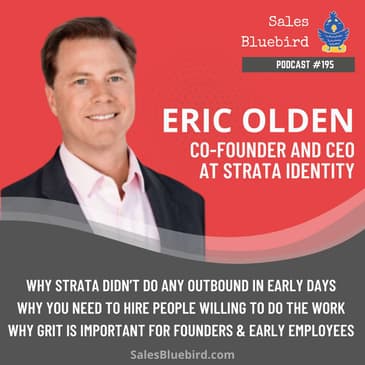
Eric Olden, CEO and co-founder of Strata Identity, joined us to share his journey from building a security software company in a garage, to taking a leap of faith to join Oracle, and then finally founding Strata Identity.
Tune in to hear his story and the tips, tricks, and experiences he has learned along the way.
In this episode, you will learn the following:
1. Why Strata didn’t do any outbound in early days; instead honed in on a long-term, thoughtful content strategy approach
2. Why you need to hire people willing to do the work
3. Why grit is important for founders & early employees
Sponsor:
This episode was brought to you by IT-Harvest.
With over 3,200 vendors in cybersecurity, it is hard to keep track of all the latest developments as well as researching and analyzing categories and subcategories…that’s where the IT-Harvest cybersecurity platform comes in.
IT-Harvest is the first and only research platform dedicated to cybersecurity. And it’s run by Richard Stiennon who has done it all in cybersecurity. Find out more by going to salesbluebird.com/research
Resources:
Strata Identity
Eric Olden
Other episodes you'll enjoy:
Why your team may be "losing" prospects and ONE drastic way to stop it
One tip to avoid sounding stupid in conversations with your prospects
Outbound is broken
Action:
You know how every podcast host asks you to rate and review their podcast but doesn’t tell you how and where to actually do that?! Well, I’ve made it easy for you! If you enjoy the podcast, please could you give a review with this easy-to-use tool by going to Salesbluebird.com/R. It would mean a lot to me personally and it helps grow the podcast.
Connect with me:
YouTube: https://www.youtube.com/@salesbluebird
Twitter: https://www.twitter.com/unstoppable_do
LinkedIn: https://www.linkedin.com/in/andrewmonaghan
The Cyber Go-To-Market Talk is the show for cybersecurity sales leaders, founders, CROs, and go-to-market operators looking to improve cyber sales performance and build more predictable revenue growth. Hosted by Andrew Monaghan, founder of Unstoppable.do, covering cyber sales leadership, revenue leadership, sales onboarding, forecasting, pipeline generation, and cybersecurity go-to-market execution.
Follow me on LinkedIn for regular posts about growing your cybersecurity startup
Want to grow your revenue faster? Check out my cybersecurity sales consulting and training
Need ideas about how to grow your pipeline? Sign up for my newsletter.
Our guest today has founded three cybersecurity companies, two of which exited to RSA, the third he is building right now. Eric Olden is the CEO and cofounder of Strata Identity, and he talks on this episode about what it takes to start a company, how to approach getting the first customers. Why at Strata, they didn't do any outbound as a seed and series a company and the impact that approach had. And also the surprising subject he liked most at school and which had a big impact on his career. Don't go away. Welcome to the Sales Bluebird podcast, where we help cybersecurity companies grow sales faster. Whether you're a seller, marketer, leader or founder, we give you tips, tricks, experiences, examples, ideas and inspiration from people who know a thing or tan about building great cybersecurity companies. I am your host, Andrew Monaghan. Our guest today is Eric Olden, co founder and CEO at Strata Identity. Eric. Welcome to Sales Bluebird.
Eric Olden 00:01:09
Thanks for having me, Andrew. Excited to be here.
Andrew Monaghan 00:01:11
Yeah, I'm looking forward to this. Eric, you and I are both in Colorado, so we're looking at our windows in different parts of state right now. Probably a little bit snow lying around, but it's good to chat always with someone from the state in which I live. But you've got a good history of creating and building companies in the cybersecurity space, so I'm really intrigued to dig into that little bit, learn what you're doing in the past, what you've done in the past, and what you're doing right now. I think there's some interesting areas to cover in there.
Eric, what was your first real job after college when you're in the big, bad world?
Eric Olden 00:03:06
Well, I actually started my first security software company in college. I was in my junior year at Berkeley and it was 1994 going into 1995, and the web had just come out and my best friend from high school and I decided to start a software company to handle the security of this untamed wilderness that was the web mid 90s. So I've only had jobs that I've been the founder of, with the rare exception. A few years ago, I went over to run the security and identity division for Oracle. So it was a big transition from being somebody who's used to working in a garage to working and running a massive organization with hundreds of employees and all of that which comes from Oracle. So that was kind of my atypical path.
Andrew Monaghan 00:04:03
Did you feel like you were, I don't know, you knew you were doing in 1994 was secured or was it feeling your way every day, every week, trying to figure out what's next?
Eric Olden 00:04:13
It was more the latter, I think. I come from an entrepreneurial family where the idea of, hey, if you want something in life, go out and build it, but if you are always working for someone else, you're only going to be able to get so far. And so my friend, my co founder, he came from a very similar background. So it was a funny drive. We were driving somewhere on we were roommates in college as well. And we were driving somewhere on spring break and he was graduating a year earlier. As we were driving, I said, what are you going to do now that you're going to be out of school? And he didn't know. And I said, well, there's this company that makes security software for the web. And it's a really cool company, very cutting edge. And I think it's got great future ahead of it. And he says, well, my friend John, he says, well, hey, could you make an introduction? Can you help me meet these people? And I said, well, a little complicated. It's us. Let's do that. Let's make that company. And he was driving at the time. He looks over his shoulder like, are you serious? Like, I'm totally serious. I think we could do it. And then on that car ride down to Santa Barbara, that's when we said, yeah, we're going to do it. By the time we got to go into the bookstore, we're like, how do you do it? And so we got all the books we could and talked to everybody we could. And 22 year olds started off on a crazy journey that very quickly became a 300 person organization. And we were about to go public.com. Crash happened. So we learned a lot in those couple of years. But I think the whole notion that if you have the guts to carry forward and to move past the dreamer, to become a doer, then that's probably the biggest lesson that he and I learned together.
Andrew Monaghan 00:06:07
Yeah, that is a key one, right? It's the ideas are all around us, but who actually grabs them and figures out what to do with them are the ones that really made the difference. Sounds like you did that you got caught up a little bit in.com, but you exited to RSA, right, with securing, is that right?
Eric Olden 00:06:23
That's right, September 2001.
Andrew Monaghan 00:06:25
Okay. November 2001, okay. Then it looks like you took a couple of years to do some angel investing and I don't know, maybe sitting a beach or something for recover from that experience. And then you find that you went back again and you found it with the finding CEO as Simplified, which is a company that I've certainly heard of and remember as well. What was the genesis of Simplified?
Eric Olden 00:06:47
Yeah, so the very tail end of securing, I was the CTO of Securent and I built all the software and responsible for the product. And we ran into this problem that companies couldn't connect securely with other companies on the internet, and they needed a trusted way to do that. And so me and another person at Secure and Darren Platt, we said, hey, why don't we create a standard to do this? And then we started talking with a lot of customers and partners and one thing led to the next. We got a lot of great ideas together and that became the standard sample and we put that in the open domain. And that was part of what led RSA to have me sign a non compete for five years so that they didn't buy the same company twice. And I said, sure, I was ready for a little change in scenery, moved to Colorado, those five years went by in a flash. And then I looked at the market in 2006 and everything was moving into SAS. And I figured, well, what if you were to use Saml to connect to all of these applications that are out in the world of SAS? And then when you start to figure out, yeah, that's something that people all need because nobody's going to use it without security. So then we thought, well, how do you make federation work at scale? And that was the genesis for Simplified. So similar thing. Talked to John T, said, hey, let's start another company. And we created Simplified and we brought Darren Platt into it as well. And that became the kind of the genesis for solving identity for SAS based applications in 2006. It was very early, a lot of companies didn't know what we were talking about. We'd have to spell out software as a service, and if it gives you any kind of flashback to the old days of when you would tell someone on a website, you would have to say, http today. You never would even think to say that. But that is to give you a sense of where we were in 2006 starting the first cloud identity company. And we looked at that and we said, there's a problem here that companies are going to have admittedly. We're a couple of years early. And so we had to be kind of very creative on how to develop a product as the market would develop, and we were able to do that in many ways. I feel like we sold too early because we had at the time that RSA bought us, we had the most users under our platform and so forth, and SAS was really just starting to take off. So I thought it was kind of funny that RSA wound up buying two companies from me. And I don't know if they ever did that before, but it did happen more than five years after the first sale. So I guess we all worked out in the end. But that was the reason that we built simplified.
Andrew Monaghan 00:10:01
Yeah, that was June 2012. It looks like you're right, that's when SAS was a thing. At that point, people would know what you were talking about, but by no means the growth we've seen over the last decade or so since then.
Eric Olden 00:10:14
Absolutely.
Andrew Monaghan 00:10:15
And then fast forward a little bit. I'm kind of intrigued by the stop at Oracle, because, as you say, you want something, you build it, and you create a company and you take control of things and do it. And then it looks like October 2017, you made the move to Oracle in their identity management division, it looks like, but still working for a big company with lots of things going on at it.
Eric Olden 00:10:43
Yeah, that was a very unusual experience, and I had a great time there. What had happened was that Oracle had reached out to me and they said, look, the time Thomas Curian was the president of Oracle, and he had reached out through the recruiter saying, I'd like to meet with you. And the recruiter said, Thomas wants to meet with you, you should take the meeting. And it doesn't happen very often. I thought, well, I'll be in town. And so I swung by and I really had no expectation of joining Oracle. I had no real clear idea what he had in mind. And as we had a really in depth conversation, we were talking about the kind of future of the cloud. And I explained to him my view on multicloud and the way that cloud services are highly distributed, and really told him a lot about my history of how I saw identity from the beginning to that time frame. And he said, Well, I'd love for you to come do that here at Oracle. And I thought you sure? You've got like 150,000 employees that probably know Oracle better than I do. I work out of a garage. And he said, well, that's exactly what we're looking for. We want to take this in a different direction, become more cloud native. And so I said, well, if I can learn from someone who has the experience that you do, count me in. And so that began began my time with Oracle, and it was very different you might imagine, right? You go from a company where I'm used to going from zero to one and from one to ten and so on, that world is very different. And the way that you build software and startups is a very technical CEO reforms CTO and my point being there that it was really about the trade craft of how to build software that I realized the biggest contribution that I could bring to the team at Oracle. And so we started really retooling the whole software development process and so forth. And it went from release cycles that you would measure in quarters to something that you can measure in days. And that's probably the thing I'm most proud of is making the impact on the speed and the agility. Other things I learned at Oracle is the way in which the really massive enterprises were and how they see the world very differently. I'd always sold to big companies, but it was more of the outside looking in at Oracle, I was on the inside of one of the biggest companies also selling to other big companies. And so there's a bit of a different calculus involved and it was fascinating to learn that language, and that is dialects insofar as the way that customers think about how they spend and buy things from the incumbent platform vendor. And then I think the last thing that was most interesting was that I was at Oracle in a period of a lot of change because Oracle was making a move to become cloud focused. And the opportunity that I was seeing was that you didn't have to argue with customer to get them to the cloud. They were already well on their way. What we saw was that they weren't going to just one cloud, they were going to multiple clouds. And my job was to get them to go to the Oracle cloud and make that the most secure and best experience that they could. But I saw the other clouds that were out there doing a really good job in their own respective way. And looking at that empathetically from the customer standpoint, I realized why would any one company choose to just use one of these clouds? It's crazy. They're not going to do that. And so kind of tapping on that empathy that I mentioned earlier, I looked at it from a customer standpoint and saw that multicloud is the future. That's only way to hedge your bets, to get the best technology to keep prices in a competitive way. And all of a sudden I realize that nobody's looking at the world from a multicloud standpoint. And that was one of the first sparks of realization that that's a massive opportunity that nobody was looking at because everyone seemed to be focused on getting customers onto their cloud versus solving the problem of many different clouds. And that led to strata and strata.
Andrew Monaghan 00:15:36
Did you put the band back together with the same people you worked with before, or did you put together a new team?
Eric Olden 00:15:42
A little bit of both. So, starting strata. I grew up surfing and can't do the same amount of surfing living in the mountains of Colorado. Naturally, I have to go on a trip to surf. And I was in a surf trip in Sri Lanka, and I was having just kind of a meditative moment out there alone with my thoughts. And I was thinking through that issue of, well, how would you make this multicloud thing work from an identity standpoint? And kind of drawing on that experience, I had it simplified, where we tied everything together. I realized what's new is old and what's old is new. And maybe we could find a way to take some of the things that worked in the kind of second generation of SAS identity, but take it to the next level. There have been a lot of things going on with Kubernetes as an example, where companies were learning to manage many things using a concept called orchestration. And so you had server orchestration, which was part of how you take docker containers of things, which is really the next generation of VMware virtualization. But now you've got a lot of things that you need to manage. And so Kubernetes came out as a way to manage many different things. And I thought, what if you could apply Kubernetes thinking but to the identity systems? And when I kind of said that out loud, I was like, well, you would build the VMware of identity. And I thought, well, VMware great company, had a great outcome. Why don't I do that? And so started to think through a little bit more what would be involved in how to do that. And the team is one of the first things that come to mind. So I reached out to Tofur, who is our CTO, and Tofu and I had worked together at Simplified. I brought him into oracle and I said, hey, Toffer, I got this crazy idea. What if we could do this and make it work across all of the different identity technologies there? And he thought for a moment. He says, that'd be really difficult, but it's something that I think I could try because the hard problems are the ones that are most satisfying to solve. And then I went to another person who worked for me at Oracle, Eric Olden. And I said, Look, I need someone who can run product. You've got a lot of deep product experience going back to the early days of sun and then salesforce and Oracle. And so I thought, well, it's a pretty good team. We've got CTO and we've got a product person, and we've got myself. And then I went to the next ring out. Those were my two co founders. And then we very quickly got people who had worked with me over the last 1520 years and brought them in, who have been with me at two, three, as many as four of my previous companies. So really got a lot of the core band back together. My original co founder and best friend, John T, he was running another company, so we had to kind of just work with him as an investor. But it was a lot of fun because in those early days, you really have so much work to do. You can't spend all your time distracted about trying to see if you can trust the people around you. So that was the route. One became three became seven, and then we kept that seven for almost a year. And then we had raised our seed and then we started to grow with our institutional financing with Menlo Ventures leading that, and then grew to where we are today. So started the company in 2019 and here we are, 2023 and going into our fourth year and things are just up into the right, really happy.
Andrew Monaghan 00:19:58
So it's interesting. When you were sitting there and you got the idea in your mind and your two co founders are kind of on board any step of the process after that with the seven that you mentioned and beyond where you're thinking. I wonder if these people that have worked with you before will want to join me, or whether they're going to have some sort of reticence. But you personally, but just jumping on an idea like this, are we quite gratified to see that happen or do you think, oh, yeah, it should be no problem.
Eric Olden 00:20:28
Yeah. One of the things that I would give advice to founders or early stage companies is really understand how different the road is in the startup world than it is in the corporate world. What I mean is that a friend of mine has a metaphor. He talks about a dirt road versus a highway, and they're both ways to get from one place to the other. But if you are used to driving on a highway and it's smooth and you're going fast, and it's really obvious that you keep driving in one direction, that doesn't necessarily translate well to the off road where you're in a dune buggy that's just kind of holding it together with whatever you can. And guess what? There's no roads. You're in the open prairie. So whether you choose to go left, go right, or continue straight is all on the person driving the car. And there's a lot of ambiguity in that world. And the people who I found are most successful in startups are ones that have been down that road before. Maybe they're not the founder, but they're not surprised when things get completely turned upside down. And my world is like, okay, that's why I have a roll cage on the dune buggy. Just push it over and keep going. Because we knew that could happen, which is why we put things in place to handle those surprises. Whereas someone who's never rolled a car, metaphorically, they may get freaked out, like, oh, my gosh, that wasn't supposed to happen, and kind of have a hard time getting back into the car and have a hard time saying, all right, let's keep going. Especially when you know that there's more of that rocky road ahead. So I think the thing that I look for, what I look for more than anything, is the person's grit. Right. Do they have what it takes to get through the rough road? The uncertainty or the ambiguity that comes with early stage startups? Because you can't learn that. I think that's a much more of a DNA kind of thing or it's deep experience and scar tissue comes to mind. But I think that's probably the biggest way to distinguish who's ready for startup and who's not. And virtually everybody in the early stages. C to series A, you've got to have people who love not just they can do okay, they have to love the bumpiness of that dirt road. Otherwise, you just start to wonder like, hey, are we going in the right direction? I don't see any signs. And that can be hard for some people to make that transition.
Andrew Monaghan 00:23:25
I remember when I moved from a bigger organization to my first start up. I was an employee number 40 or something like that. So not at the start like you are, but beyond that. And I came from a mentality in sales where you hit numbers every quarter. Right? And if you don't hit numbers every quarter, things might get bad for you. That was the world that I came from. And of course, you get to at that stage. It was probably a series, a start up. We didn't have a product to sell yet. And a small team of us right there, evangelizing and early adopting, taking on early adopters, things like that. But I felt very uncomfortable with the fact that I've been here six months and I'm not closing a whole bunch of deals right now. This feels very weird to me. I was okay with the ups and downs because in sales, you kind of have to deal with that bit more than most. But it was that very different viewpoint on what we're trying to do. And I think that's what you were saying, right? You're thinking much further on than are we going to do something by the end of this month or the end of this quarter? You're not necessarily judged on that. It's on the trajectory that you're looking at.
Eric Olden 00:24:32
Yeah, and I think you're absolutely right on that, Andrew. I think. Another thing that that brings to mind. I've been running startups. Like building them from zero to hundreds of employees. That is what I do. So all I can say, most common question that early stage founders CEOs are always asked is to forecast revenue. And it's impossible. And it may not even be the goal in the earliest days. Not about getting revenue. You have to manage your investors expectations. That what we need to do in the very beginning is figure out what is the problem that we're going to solve. And if the next step is what is the product we need to build to solve that problem. And then the step after that is how do we sell the product? And then after that is how do we sell a lot of that product. So, stage four, you've got a whole lot of different metrics that make sense when you're trying to scale sales. And a big mistake that even good investors have a pattern where they're trying to predict the future. And so they want to know what's the number? What are we going to do in revenue this year? And the truth is that you don't know. And so my advice is to be very upfront with your investors saying, look, if we get any revenue, that's icing on the cake. But what we need to do right now is set a set of criteria that we're going to identify the market that we're going to go into. And the way that we're going to do that is by interviewing tons of people who have hopefully have this problem and hear from their words what it is. And then we call that customer development. And there's a woman who wrote a book named Alvarez that's got the best guide on that. And then the second is now you build your product and you're trying to get product to market fit. And I have a philosophy of what I call the Dirty Dozen. So your very first twelve customers are they're really hard because they don't know what they're buying. You don't know what you're building. And so you got to get into the nuts and bolts on that. And I'm talking about the founders. And I did half of the customer development calls and it's all hands on deck. It's like, hey, let me interview you because I'm trying to understand what it is that you can't solve today. And if you're trying to sell something in that conversation, people get turned off. And anyways, it doesn't matter, you don't have something to sell. So you find your way with these early twelve customers. And I come from the Enterprise, so I'm thinking twelve logos, not individuals. If you kind of get through that. The Dirty Dozen. What I've found is there's a pretty interesting pattern is that you're on the right track if six of those twelve want to buy what you built. And what about the other six? Well, three of them will buy it if you add one feature or something else like that. And so you can get them if you make changes. The other three, they want things that are going to take your product in the wrong direction. And so you need to have the discipline to say thanks for sharing your insights, but we're not going to try and make these last third our customer because it takes the focus off of our product. So when I say the Dirty Dozen, I'm really talking about getting nine customers out of that and walking away from three that aren't a fit. And I've seen this now work not only in my own companies, but in others that I'm an investor in and so forth. So that pattern is maybe the number could shift a little bit. But that mindset, I think, is the thing that people should take away from what I'm sharing at the moment. Because if you have that mindset that we can get a critical mass and then maybe make some tweaks, we've got something that's going to meet the broad needs of the big market. And so at that point, you are making revenue depending on your specifics of your business. That may be a lot or a little. And who's to say my company strata happened to find a really lucrative problem to solve? Because without it, our customers were spending tens of millions, hundreds of millions of dollars doing things manually for something that we invented software to automate. So we have a very kind of different value proposition than most security companies. But then now we're in our Series B and our focus is on scaling the go to market. And so to do that, we moved from founder selling to having an actual full on team. And we only got the full team with the Series B. And before that we had some account managers, account executives who would handle the relationship with the customer. But the founders and the executive team have to be doing those early days of selling because no one knows the market like we do. No one knows the technology like the ones building it. And so if you rely on or try and outsource that to someone else, I haven't seen it be successful. Maybe people can do it. But what I've seen is you usually either find someone who says, oh, we couldn't sell it to so and so because you didn't have this feature or that feature, or they didn't understand what the customer is asking for and therefore they couldn't translate that and bring that data into the product. So you can build the product to do what it needs to do. So it's either a communication mismatch or it's a mismatch on kind of maturity. You can't sell startup software to every company. Some companies just can't buy it for a host of reasons. But yeah, that's kind of a little winding road of what I've seen in those early sales days.
Andrew Monaghan 00:31:06
Eric, I have a list of, believe it or not, 35 questions. The good news is I'm not going to read all 35 questions. I'm going to ask you to pick three random numbers in one and 35. And I'll read these questions to get to know you a little bit better.
Eric Olden 00:31:21
Okay? One, three and. 13.
Andrew Monaghan 00:31:24
Okay. Juan, philosophical one. What happens when we die?
Eric Olden 00:31:28
Well, that's an easy to answer question. Right. Well, I think it depends on who you are and what you've done with this opportunity. So my personal belief is that there's a great sunset in the sky, and you go from walking around and being bits and atoms to kind of becoming one with the light.
Andrew Monaghan 00:31:51
That's quite a thoughtful way to answer that. More thoughtful than I would be, I think, caught off the cuff on that one. I like how you approached it, though.
Eric Olden 00:31:59
I met it on that fair amount.
Andrew Monaghan 00:32:01
Yeah.
Eric Olden 00:32:02
That's the imagery that I have when I do. And I think, like I said, probably different for everybody, but that's what I'm expecting.
Andrew Monaghan 00:32:11
Good. Well, question number three is a bit more straightforward. The Four Seasons or Cabin in the woods?
Eric Olden 00:32:18
Cabin in the woods.
Andrew Monaghan 00:32:19
Where is that cabin for you?
Eric Olden 00:32:22
I would say that cabin would be probably in Crested Butte, Colorado, if you've ever been there. It's one of our favorite places to go, and you got the beautiful, natural beauty that you just can't find anywhere else on earth. And for all my work experience, it's all about working with people. And what's appealing about The Cabin in the woods is that you just go there, bring a good book, bring some people that you love, and go experience that on your own.
Andrew Monaghan 00:32:53
Yeah. You've convinced the cardinal sin about Crested Butte, which is telling people about it.
Eric Olden 00:32:59
Would I say Crested Butte? I meant breckenridge. Oh, the unknown place called Breckenridge that nobody knows about.
Andrew Monaghan 00:33:07
Yeah, Breckenridge a slightly different vibe than I think the DNA of it is the same. It's just obviously easier to access than Chris Butte. Both places are pretty special with that kind of Main Street vibe about them. Right. And then 13 is best subject in school.
Eric Olden 00:33:25
The best subject when I found most interesting, believe it or not, was a pre law class called Rhetoric, and it was the logic or reasoning. And when I was in school, I thought at one point, maybe I'll be a lawyer. So I took all the pre law, and that was most interesting part of pre law at my university. And the way that they taught you how to structure reasoning and arguments allows me to really I think the big gift that I got from that was to be able to take a deep aspect of empathy, and you had to argue both sides of any position. And so that, I think, was really insightful because there's always more than one way to look at something. And I took that and I use it every day. But it also was very important to craft how I do a lot of writing. I do the majority of the writing for the company, especially in the early days. We have more people now that do more of the writing. But when I do write, it's really structured and it's about communicating and trying to answer the questions that I think the reader has and that I learned from rhetoric. It was something that people always scratch their head when I would say, yeah, rhetoric was my favorite, my favorite course. But that's the reason why isn't it.
Andrew Monaghan 00:34:49
Funny how sometimes the non standard classes, courses, things like that, that we take and do have more of an impact on how we think about our lives than the standard ones?
Eric Olden 00:35:02
Yeah, absolutely right. And I think the second one was it was a course that was about world religion and that exposed me to things like Buddhism and some things that I still practiced to this day. I grew up in very Roman Catholic family in California, and, boy, that was very different than what I learned about Buddhism. And so, to your point, it wasn't the course that I studied religious studies or anything like that, but I had an elective and thought, that sounds interesting, and went in a very different direction after that.
Andrew Monaghan 00:35:39
So you get to your Series B at Strata, and that's to help scale the go to market. What what are the first hires that you made on the sales side with Series B?
Eric Olden 00:35:51
We had our CRO on board. Drew had joined us about nine months before we closed Series B. And we said to him, we said, look, go build out your team and know that we need to really get people who know this industry because identity. Which is managing user security and passwords and things of that type is very different than other kinds of technology like storage infrastructure. Complex, mission critical. But we have seen it's very difficult to transfer from, say, storage into identity. It's even harder to go from non infrastructure into identity, still a little bit tricky to go from security into identity. So there's a real high indexing on getting people who know the very pain points that the customers we sell to understand those. The second thing that we did was recognize that no rep is going to have a Rolodex or a LinkedIn network big enough to carry their number, carry the year. So you got to think about how you get your demand generation happening. And in the early stages, Series C and Series A, we had a policy at Strata having zero cold calls and no spam email. And do you say that to most sales leaderships or sales teams and say, well, how can I do my job without the main tool? Well, the way that we did it was we took a content marketing approach. And so we wrote up all of this content around thought leadership to explain what this new World of Identity orchestration is about, how multicloud is different and do these problems resonate with the reader. And what we found is we produced a lot. And that's what I was saying earlier. I did a lot of writing, a lot of blog posts, a lot of white papers and you put that out there and then people who have the problem, they Google and they search and they find that and they go, this company knows what I'm talking about. Let me reach out, and they come inbound. So inbound is a term that I think HubSpot had come up with. And wherever it came up, doesn't matter who coined it, but what's different about inbound, and you're probably preaching to the choir here, is the difference between trying to sell something to someone who's coming towards you saying, I have this problem, can you help me with it? Versus I'm busy doing other things. And you're pestering them with a bunch of emails and cold calls saying, hey, is this a problem? Is this a problem? The issue is that some people will respond just to get you to stop bugging them, but they don't have the problem. And so you waste all of these cycles chasing this person, you get happy ears. You're saying, oh, well, they keep returning my call. They wanted to see a demo. But reality is, maybe often they're just too polite to tell you to stop calling them. So on the other hand, when you have inbound, those are the ones to spend your time with in the early days because you don't have to chase them. In many ways they're chasing you. And so I think that was a surprise to a lot of people that we said, in my marketing team and my sales teams, you can't send a spam email and you can't do a cold call. So think of how you're going to attract people. And once you dedicate your whole strategy around that, it starts to multiply. So now we do some outreach, but it's always content driven. And I think there's another thing to recognize, that HubSpot does a really good job on content marketing, but when we go and we talk to prospects, we're bringing something that's useful to them. And the outreach isn't, hey, we want the cliche. Do you have 10 seconds? Do you have ten minutes? Of course everyone does, but no one wants to waste it with a stranger. So instead we like to say, hey, here's a solution guide for companies like others in your industry that solve these particular problems. If this is helpful and you'd like to learn more, let me know. And then you'd be surprised how many people respond to that. And they say, oh great, you weren't asking me for anything, you were just offering something. And that content isn't a brochure. Content is empathetically written to address their problems so that you get that alignment between what the customer is trying to solve and what you have to offer. When that lines up, then the sale happens on its own in many ways. I won't say any product sells itself. That's not what I'm saying. I'm saying you align the interest and the solution. There's a lot of selling that has to happen. But it's a lot more effective than go out and spraying and praying that you're hitting somebody with just bulk email. Because let's be honest, everyone's got caller ID today, and everyone's got a spam filter on their email. So those are the two mechanisms that are the natural enemy, the cold calls and spam. Then I think it's time that we all get more creative and do the extra work to add value instead of extract.
Andrew Monaghan 00:41:39
Yeah, I think it's it's become a little bit ridiculous. The solution to we don't have enough pipeline is make more calls and send more emails. And that doesn't really help anyone at any stage of the buying or selling process to really be more effective. And this whole concept of I'd much rather be working with someone who came to me with I'm already thinking like you are. I like your philosophy of how you're doing things. I have that same sort of problem. And the way you solve it's interesting to me, I'd rather sell to that person than the person you're hoping to grab as they run past your house and say, come in, I've got something good for you. Right. It's such a different dynamic when you're working with someone, depending on who's coming to who at the start.
Eric Olden 00:42:24
Absolutely.
Andrew Monaghan 00:42:25
Andrew, I'm wondering if you've got things in your content or the way that you work in the market to try and get the attention, to try and rise above the noise. I mean, great content is part of it. I get it. I wonder if there's a lot of things that really work for you. Little tools.
Eric Olden 00:42:43
Yeah, well, I think a couple of things that work that have changed because we started Strata a few months before COVID came, and so all of a sudden live events disappeared. And in the past we used to use live events at simplified and secure it and everyone else was doing it. And that kind of became a common way to find yourself in the presence of other people. When that goes away, what we've seen working really well on digital media is this content, the content strategy. And so part of that is a really strong SEO game, because SEO, you're able to tap all of that search behavior, those people who are trying to find something, you want to be able to be well found in that regard. So I think there's a great content that's useful and not selling. Use SEO to get that found and discoverable. And then when you kind of break down the content world, the way that I think about it is this kind of a buyer's cycle and the way that think about the last time you bought something. And my LinkedIn profile and I own the web domain, bought, not sold. And so that really is central to what I'm describing. So how do you get people to buy where you're not selling? And the way that you get that mind shift is to really take empathy and get into the buyer's mindset and say, okay, I'm trying to buy. I need to solve this problem. How do I do that? And then trace all of the steps that that person would go through. And it's a journey, it's non linear, and it rarely starts with a phone call to the sales department of some vendor, right? And so you work backwards from that experience and then you realize you got to have content that explains the very top of the funnel awareness. Then we don't have content. That's something we can engage with. Then we want to have content that will convert audience into an opportunity. And then you want to have content that will justify a purchase. And being able to when I say nonlinear is you never know which way they're going to go through. It doesn't go like from A to B to C. You want to be able to have them jump from A to the end because they may get excited but say, well, if I can't justify this to the CFO, I'm never going to get anywhere. So having that kind of end of funnel justification content handy allows them to do what they need to do and maybe they re engage with you and go on through. So part of all of my experience and success in selling has really come from a lot of marketing because of that bot not sold mindset. When you get into things that stand out, find a way to make a really differentiated position that is defensible with your architecture. And what I mean by that is if you're using superlatives to say you're the fastest of something, or you're the biggest or the smallest or any of those superlatives, it's not hard for your competitor to say, oh, they're fast, we're faster. And next thing you know, your marketing muddies the water and nobody can tell the difference at all. So what we look for in all my companies but this one that I'm with Strata today, what we looked at is let's find something about our architecture that no one else can just rip off. Because saying you do orchestration. Easy to say, very hard to do. So we lead with show, Don't Tell and that means that we demonstrate how the software works. And we had a bunch of pretenders come into the market once we started to get popular saying, oh, we do orchestration. And then the customer would say, oh, you both say that you do this. And I say, well watch, we'll show you. Have them show you how they're solving your specific use case. And if they can't put up, then maybe they should shut up and you can be polite about it, of course. But my point being is that the proof is in the pudding. And so we really drive an evidence based model and that allows us to stand out. And the last thing I'll say on that is pricing. And we took a very radical approach to pricing in Identity. In a world where all of the vendors sell on the number of users on your system, we don't. We charge by the number of applications we secure and the amount of infrastructure we integrate with. And so it's the same affordable price whether you've got ten users or 10 million users. And so that is something we can get very quickly with to the customer to say, look, you can have the biggest ecommerce site in the world and you're not going to pay a penalty because we don't charge you for any of your users. And they can then take that to the competition and say, how are you going to charge me for this? And it's very hard to switch pricing models. Imagine trying to go from everything's built around per user to can't charge by user. So those are ways to stand out, which are very hard to replicate. You really need to either change your architecture or change your whole business model. And those create these barriers to entry and make sure that it works for the customer more than anything. And so this consumption model, we take the risk off the table for the customer. They can start small, spend $3,000. Now we have customers spending millions of dollars per year, but they start really small, get confident that it works and let it grow from there. And we've never lost a customer.
Andrew Monaghan 00:48:50
You told me beforehand, Eric, that you had something. If someone gave you, was it their identity or email address or something, you could do something with it. Who was that?
Eric Olden 00:48:59
I'm glad you brought that up. Yes, Andrew. So it's a new market and we are really excited about Identity Orchestration. We think it can solve all of the identity use cases that we've come into contact with. And we have kind of a contest of sorts that if any of your listeners have an identity use case that they want to submit to Strata. And what we'll do is we'll give them a pair of Apple earpods, the pro ones, real nice ones, and so they're interested. They can go and learn about this online. And we have a website that they can go to and it's at Strata IO. That's S-T-R-A-T-A IO. And you can also email us at podcast at strata IO and that's Podcast podcast. And what we do is basically go to the website, you'll see the use case challenge and see if you can throw a challenge to us that you're facing. And we'd be happy to demonstrate to you how we do it and give you a pair of wonderful ear pods.
Andrew Monaghan 00:50:10
Noise canceling wise, I love these creative ideas, especially when it's not let me just send you something, right? If something attached to their value, they're going to get something from this that could make a real difference. And there's a good credit manager there of what you're trying to get from such a transaction.
Eric Olden 00:50:26
That's right, it's a win win.
Andrew Monaghan 00:50:29
Do you have a question for me, Eric, about this world that we're in?
Eric Olden 00:50:33
Yeah Andrew, I would love to hear from you because I know you live and breathe this space and everyone's always looking for more opportunities and a lot of different channels that are out there, there's online, there's events. Where are you seeing today opportunities to build pipeline and find opportunities?
Andrew Monaghan 00:50:53
Yeah, this is probably the number one challenge that most cybersecurity startups are dealing with right now. They're one of the 3000 and they're thinking what can I do to be noticed? And do it in a manner that actually will drive meetings with the right sort of people that I want to meet with. And I think a lot of people are trying to figure this out right now. I'll just give you two or three things I've seen from some of my clients and wider kind of network that seemed to work better than most, each with various costs attached to doing it. Depending on the stage the company is at, they have to decide whether they're ready for it or not. I'll tell you one that is really interesting to me is that who your VC is matters a lot. I think Andreessen Horowitz were the first, in my eyes anyway. The first ones, maybe ten years ago we had this idea of value added VC where you didn't just get money, you got into their whole world and they had a good market team and a hiring team and whatever it might be, right, marketing team that would help you out. What I'm seeing from some VC firms now is where they're really good at bringing CiSOs into their networks and then using those relationships to get meetings with their portfolio companies. So they'll say look, this company is in SpaceX, we have 55 CiSOs who we interact with, who are part of our advisor world or where it might be and some portion of those are actually keen to learn more, interact with companies in that sort of world. So obviously they don't charge for that, you take the money and that's part of the service they provide. But some of them are doing a really good job of that and I've seen some startups get a really healthy number of meetings per week just from the VCs on the board and the little networks they have around that. So that's one thing that's important and somewhat similar but different is I've seen there's a strata of service providers right now who they charge to meet with their little VC communities, right? So you might run a little company and you might know 50 sisos or 50 sisos and 50 siso minus ones or VP of security wherever it might be in your network and that person does a really good job of keeping in touch with them. And again, they'll take on only a small number of clients at a time. And then they'll advocate for you to get the meetings, the 1 hour briefings with the security leaders where they're coming in, knowing why they're meeting with you as high quality people who are used to working with startups and want to hear what you're talking about. Very different to meeting booking companies which are low level. Just anyone shows up or doesn't show up usually and it can be a challenge. There's two areas right there which I've seen work very well on a more tactical basis. My last bit of thought for everyone is what I've seen happen is two or three startups in similar but different areas of cybersecurity might team up and say, let's go on a dinner roadshow. And one of them might have they might have hired an evangelist that used to be a CISO, something like that, where they can say, well, John Smith, the former Cisco, this and this is going to speak at and there's a dinner happening and everyone's going to charge with getting people to the dinner. That seems to work quite well, I think. Especially bouncing back from COVID where people are ready for face to face interaction. They like that. I think the key is you got to have a person, the kingpin in the middle, hear someone speak or interact with or meet with them and then also meet with your peers. So, I don't know, I mean, that's three things that I've seen work more often than not, as you know, this is a world where there's no absolutes. You got to really kind of work at this and be creative, but I've seen those things work for other companies.
Eric Olden 00:54:55
Yeah, that's great. Very helpful. You're right about the investors can be very helpful in making connections and so, yeah, we benefit from that. We've gotten great relationship introductions from Telstra Ventures, from Menlo Ventures and from Forge Point Capital. So they've been wonderful. And then our smaller venture partners, Innovating Capital and Preface Ventures, have been really good at kind of opening doors because smaller funds have a higher concentration in any given investment, so we got a lot of their attention. So that's worked well for us as well.
Andrew Monaghan 00:55:33
Well, Eric, I've really enjoyed our conversation today. It's truly been a pleasure hearing about all the big difference you've made in the cybersecurity world over the last 2025 years. If someone wants to reach out to you personally and continue the conversation, what's the best way to do that?
Eric Olden 00:55:49
Sure, send me an email. Eric. Eric at Strata IO.
Andrew Monaghan 00:55:54
That's great. Listen, I wish you and the team all the best for the rest of the year and into 2024 as well.
Eric Olden 00:56:00
Wonderful. Thanks for having me, Andrew.
Andrew Monaghan 00:56:02
Well, that was a fun discussion with someone who's had a big impact on the cybersecurity marketplace over the last 2025 years. In fact, you know, one of the things I asked Eric before we recorded was, you know, what does he want to get from something like this? And he said he wants he likes giving back, he likes mentoring people and I think this is one way to do it by sharing some of his experiences for me. Three takeaways I had, even though it was a whole ton.
First one was that the idea that he had about no outbound as an early stage company, it's really hard to say that what the market really needs is more emails and more phone calls and shout louder to try and get more pipeline. But I get it right. It's tough because we can't feel like we're sitting back sometimes waiting for the market to come to us. But I think what Eric really talked about was a very thoughtful content strategy that can make a difference. Done the right way and done with the right longer term viewpoint, it can make a difference. He is a CEO. Setting the tone for that makes all the difference. If he's the CEO and he's asking for how many MQLS and SQLs and what was our pipeline growth today and yesterday and things like that is going to have that very short term thinking on the sales and marketing team. But if you got someone who really creates the culture of doing it right and thinking about how to really engage with an audience, it makes a difference. And here's what I think. If I'm a salesperson. Let's say I'm selling Pepsi. I want to be selling Pepsi to people who like Pepsi, right? I don't want to be selling Pepsi to people who like Coke and trying to convince them that my way is a better way. And a really thoughtful content strategy will help to bring people to us who are already thinking about the same ideas and the philosophies that we are. So I thought that was really telling how he set the stall out in the company about how they were going to do that.
Second thing was he said quite near the start, the idea about there's lots of ideas out there, but really you need people who are willing to do the work. It takes a lot of work, it takes hard work, it takes thoughtful work, but you got to do the work. Ideas are ten a penny, but the person that figures out a work has to be done, b what it is at the right time to be done and then goes about doing it. It's the people that made the real difference and I think aligned to that but different is my third takeaway. When he talked about grit, I love the analogy that they used about is it dirt road and is the freeway. Some of us just thrive better when there's a freeway where you got barrier done each site and you're going on a smooth tarmac and it's fast and you're just getting somewhere. And there's definitely things along the way that are tough, but it's a set way to do it versus the dirt road, which it's bumpy, it twists and turns, some points it might end and you have to go off road and figure things out. So having people that are comfortable with a dirt road and not just sitting happy with the freeway and his idea of the roll cage as he was saying it, I was thinking the mental roll cage, you need to have that. We're going to be okay, right? We're going to work through things and there's going to be these things where the car tips up along the way and we're going to get it back on the wheels and keep going forward and just not be put off or give up when these things happen. So I love that way approach. That his analogy for doing it. So what great conversation with Eric and I wish everyone, the team would try to success for 2023 and beyond.